
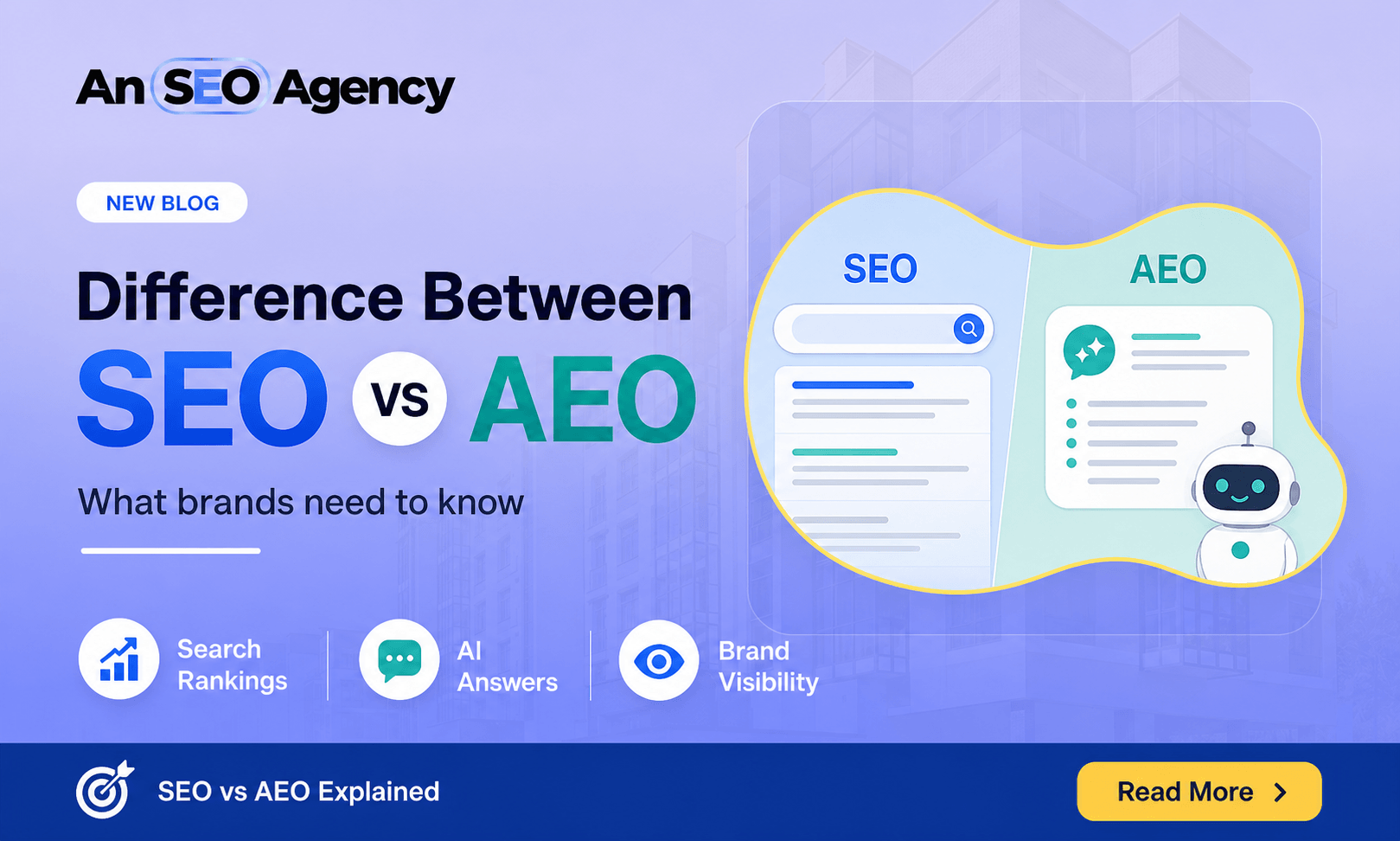
Difference Between SEO and AEO: What Brands Need to Know in 2026
What Is SEO?
SEO stands for Search Engine Optimization. It is the process of improving your website so search engines can crawl, index, understand, and rank your pages for relevant searches.
In simple words, SEO helps your website appear on Google when people search for your products, services, or information.
For example, if someone searches “best digital marketing agency near me,” SEO helps your agency website appear in the search results.
SEO includes many important activities, such as:
- Keyword research
- On-page optimization
- Technical SEO
- Internal linking
- Backlink building
- Content writing
- Website speed improvement
- Mobile optimization
- Local SEO
- Google Business Profile optimization
Google’s SEO Starter Guide explains that basic SEO can have a noticeable impact because it helps search engines find, crawl, index, and understand website content.
Therefore, SEO is still very important. Without SEO, your website may not get enough visibility in traditional search results.
What Is AEO?
AEO stands for Answer Engine Optimization. It is the process of optimizing your brand and content, so AI-powered answer engines can understand, summarise, cite, and recommend your business.
AEO focuses on becoming the answer, not just ranking as a link.
Today, users are asking questions on Google AI Overviews, AI Mode, ChatGPT, Perplexity, Copilot, Gemini, and voice assistants. These tools do not always show users a list of links first. Instead, they often provide a direct answer.
For example, a user may ask:
“What is the best SEO strategy for a small business in 2026?”
An AI tool may summarise the answer from multiple trusted sources. If your brand has helpful, clear, and trustworthy content, it may have a better chance of being mentioned or used as a supporting source.
Google says its AI features can help users find websites, and that site owners should continue following regular Search fundamentals for visibility in AI-powered results.
Featured Snippet Answer
The main difference between SEO and AEO is that SEO helps your website rank in search engine results, while AEO helps your content appear in AI-generated answers. SEO focuses on keywords, rankings, traffic, and links. AEO focuses on direct answers, brand authority, entity recognition, trust signals, and AI search visibility.
Difference Between SEO and AEO
SEO and AEO are connected, but they are not the same.
SEO is designed for search engines. AEO is designed for answer engines.
SEO helps your web pages rank. AEO helps your brand become part of the answer.
SEO focuses heavily on keywords, metadata, backlinks, technical health, and rankings. However, AEO focuses more on questions, context, entities, authority, structured answers, and trust.
For example, SEO may target the keyword “SEO services Edmonton.” AEO may target a full question like “Which SEO service is best for a small business in Edmonton that wants more local leads?”
This is a major shift because people now search more conversationally. They do not always type short keywords. Instead, they ask complete questions and expect fast, useful answers.
SEO vs AEO Comparison Table
| Point of difference | SEO | AEO |
| Full form | Search Engine Optimization | Answer Engine Optimization |
| Main goal | Rank web pages in search results | Get cited, summarized, or recommended in AI answers |
| Search behavior | Keyword-based searches | Question-based and conversational searches |
| Main platform focus | Google Search, Bing, Yahoo | Google AI Overviews, ChatGPT, Perplexity, Gemini, Copilot |
| Content style | Blog posts, service pages, landing pages | Direct answers, FAQs, definitions, comparisons, expert explanations |
| Optimization focus | Keywords, backlinks, technical SEO, content quality | Clear answers, entities, trust signals, and topical authority |
| Success metrics | Rankings, impressions, clicks, organic traffic | AI mentions, citations, answer visibility, assisted conversions |
| User journey | User clicks a search result | The user may get an answer before clicking |
| Best content type | Optimized pages and blogs | Question-led guides, FAQs, how-to content, comparison content |
| Main benefit | More organic traffic | More brand visibility in AI search |
Why AEO Is Important Now
AEO is becoming important because search behavior is changing.
Users now ask AI tools for recommendations, comparisons, summaries, and decisions. Instead of visiting many websites, they expect AI tools to collect and explain the information for them.
Google says AI Mode is useful for complex questions, comparisons, reasoning, and follow-up questions.
This matters for brands because AI search can influence what users believe, compare, and choose.
For example, a customer may ask:
- What is the best roofing company in my city?
- Which study abroad consultant is trusted?
- What is the difference between SEO and AEO?
- How do I choose a construction company?
- Which marketing agency can help with AI search visibility?
If your content clearly answers these questions, your brand can become more visible during the decision-making stage.
Moreover, Gartner predicted that traditional search engine volume would drop by 25% by 2026 because users are shifting toward AI chatbots and virtual agents.
This does not mean SEO is dead. It means brands need SEO and AEO together.
How SEO Helps a Brand
SEO helps a brand attract users from traditional search results.
For example, SEO can help your business rank for keywords like:
- SEO agency near me
- Best web development company
- General contractor Tampa
- Study abroad consultant in Chandigarh
- Roofing company in Montana
When your website ranks higher, users are more likely to visit your website, read your services, and contact you.
SEO also helps build long-term digital authority. A strong SEO strategy improves your website structure, technical health, page quality, and content depth.
Important SEO benefits include:
- More organic website traffic
- Better Google rankings
- Stronger local search visibility
- More leads from service pages
- Better website structure
- Improved user experience
- Stronger brand credibility
- Long-term marketing value
Google recommends creating helpful, reliable, people-first content instead of content made mainly to manipulate rankings.
Therefore, modern SEO is not only about keywords. It is about helpful content, trust, experience, and relevance.
How AEO Helps a Brand
AEO helps a brand appear where users are asking direct questions.
For example, if someone asks an AI tool, “How can a business improve brand visibility in AI search?” the tool may summarize content from trusted sources.
If your brand has a strong AEO strategy, your content may support that answer.
AEO can help brands with:
- AI search visibility
- Brand mentions in answer engines
- Better trust signals
- Clearer content structure
- Stronger topical authority
- Better FAQ visibility
- More high-intent discovery
- Better conversion support
AEO is especially useful for brands that sell services, because buyers often ask detailed questions before contacting a company.
For example:
- “How much does SEO cost?”
- “What should I check before hiring an agency?”
- “Is AEO better than SEO?”
- “How long does local SEO take?”
- “What makes a website rank better?”
When your website answers these questions clearly, you build trust before the user even contacts you.
How SEO and AEO Work Together
SEO and AEO should not be treated as separate strategies. They work best together.
SEO creates the foundation. AEO builds on top of that foundation.
For example, your page still needs to be crawlable, indexable, fast, mobile-friendly, and useful. Without these basics, AI systems may not easily access or trust your content.
Google explains that pages must meet normal Search requirements and be eligible to appear with a snippet to be eligible for AI features. Google also says there is no special AI-specific schema requirement for inclusion in AI features.
This means AEO does not replace SEO. Instead, AEO improves how your SEO content is understood and used by AI-driven search systems.
A good SEO and AEO strategy should include:
- Optimized service pages
- Helpful blog content
- Clear FAQ sections
- Strong internal linking
- Expert author information
- Case studies and examples
- Local business information
- Reviews and testimonials
- Structured data where relevant
- Clear brand positioning
Google also explains that structured data helps Google understand website content, although it should match the visible content on the page.
Practical Example: SEO vs AEO
Let’s say your blog topic is “How to Choose an SEO Agency.”
A traditional SEO approach may focus on keywords like:
- SEO agency
- Best SEO agency
- SEO company near me
- SEO services
This is useful because users still search with these terms.
However, an AEO approach would also answer complete questions like:
- What should I look for in an SEO agency?
- How do I know if an SEO agency is trustworthy?
- What questions should I ask before hiring an SEO company?
- How much should SEO cost for a small business?
- What is the difference between SEO, AEO, and GEO?
This makes the content more helpful for AI tools and real users.
Therefore, the best strategy is to combine both. Use SEO to target keywords and use AEO to answer questions.
Best AEO Strategy for Brands in 2026
1. Create question-based content
Start by collecting real customer questions.
Use questions from:
- Sales calls
- Emails
- Google Search Console
- People Also Ask
- Customer reviews
- Competitor FAQs
- Social media comments
- Reddit and Quora discussions
Then, create content that answers those questions clearly.
2. Add direct answers near the top
Every important page should answer the main question quickly.
For example, if the page topic is “Difference between SEO and AEO,” give a clear answer in the first section.
This helps users understand the topic faster. Additionally, it makes your content easier for AI systems to summarize.
3. Build topical authority
Do not publish one random blog and stop.
Create a full content cluster around the topic.
For example, an AEO content cluster can include:
- What is AEO?
- Difference between SEO and AEO
- AEO strategy for small businesses
- How to rank in AI Overviews
- How AI search affects brand visibility
- AEO checklist for 2026
- Best tools for AI search optimization
This helps search engines and AI systems understand your expertise.
4. Use strong internal linking
Internal links help users and search engines move through your website.
For example, this blog can link to:
- SEO services page
- Content marketing page
- Website audit page
- Digital strategy page
- Contact page
Good internal linking also distributes authority across your website.
5. Add proof and trust signals
AEO depends heavily on trust.
Add trust elements such as:
- Case studies
- Testimonials
- Reviews
- Author bios
- Expert quotes
- Business credentials
- Real examples
- Original insights
- Screenshots or data where possible
This helps your content feel more credible.
6. Keep content updated
AI search changes quickly. Therefore, old content should be updated regularly.
Update your blogs with:
- New examples
- Fresh statistics
- Better FAQs
- Improved headings
- Updated screenshots
- Clearer answers
- New internal links
This improves both SEO and AEO performance.
Common Mistakes to Avoid
Mistake 1: Thinking AEO replaces SEO
AEO does not replace SEO. Your website still needs strong technical SEO, good content, internal links, and authority.
Mistake 2: Writing only for AI tools
Your content should still help real people first. Google’s helpful content guidance focuses on content created for people, not only for search engines.
Mistake 3: Ignoring service pages
Blogs are important, but service pages convert visitors into leads. Therefore, connect AEO blogs with strong service pages.
Mistake 4: Publishing generic AI content
Generic content does not build authority. Add real examples, expert insights, customer questions, and original experience.
Mistake 5: Not tracking AI visibility
Traditional SEO tracks rankings and traffic. AEO also needs tracking for brand mentions, citations, AI answers, and visibility across AI tools.
Expert Quote
“SEO helps people find your website, but AEO helps AI systems understand why your brand should be trusted as an answer. In 2026, brands need both: technical visibility from SEO and answer-level authority from AEO.”
FAQs
What is the main difference between SEO and AEO?
SEO focuses on ranking web pages in search results. AEO focuses on getting your brand or content included in AI-generated answers.
Is AEO better than SEO?
AEO is not better than SEO. It is an extension of SEO. Brands need SEO for rankings and AEO for AI search visibility.
Does SEO still matter in 2026?
Yes, SEO still matters. AI search features still depend on crawlable, indexable, helpful, and trustworthy web content.
How can a brand start with AEO?
Start by answering customer questions clearly. Then add FAQs, expert insights, comparison tables, internal links, case studies, and strong trust signals.
Can small businesses use AEO?
Yes, small businesses can use AEO by creating helpful local content, optimizing service pages, improving reviews, and answering buyer questions.
What content works best for AEO?
FAQs, comparison blogs, how-to guides, service explainers, buyer guides, case studies, and expert-led content work well for AEO.