
How to Protect Your Online Reputation With ORM
- Introduction
- Featured Snippet Answer
- What Is ORM?
- Why Online Reputation Matters for Businesses
- How ORM Protects Your Brand
- Review Management and Google Business Profile
- How SEO Supports Reputation Management
- How Content Helps Control Brand Perception
- Social Media and Reputation Monitoring
- ORM for Local Businesses
- Negative Review Response Strategy
- ORM and AI Search Visibility
- Technical SEO and ORM
- Comparison Table: Poor ORM vs Strong ORM
- Best ORM Strategies for Businesses
- Mini Case Study Example
- Expert Quote
- Common ORM Mistakes to Avoid
- ORM Checklist for Business Owners
- FAQs
- Introduction
- Featured Snippet Answer
- What Is ORM?
- Why Online Reputation Matters for Businesses
- How ORM Protects Your Brand
- Review Management and Google Business Profile
- How SEO Supports Reputation Management
- How Content Helps Control Brand Perception
- Social Media and Reputation Monitoring
- ORM for Local Businesses
- Negative Review Response Strategy
- ORM and AI Search Visibility
- Technical SEO and ORM
- Comparison Table: Poor ORM vs Strong ORM
- Best ORM Strategies for Businesses
- Mini Case Study Example
- Expert Quote
- Common ORM Mistakes to Avoid
- ORM Checklist for Business Owners
- FAQs
Introduction
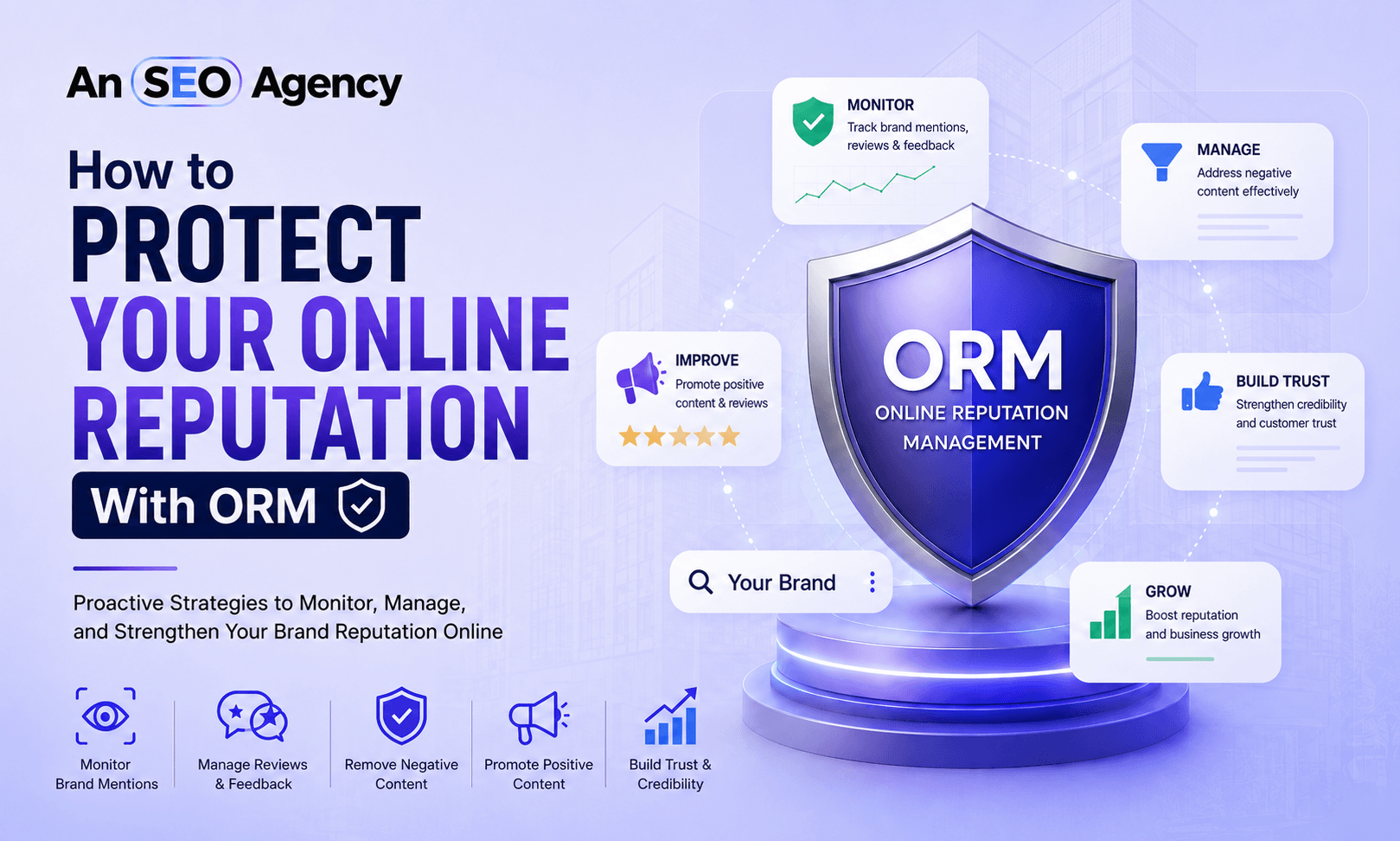
Learning how to protect your online reputation with ORM is now essential for every business that wants to earn trust, leads, and long-term customers. Today, people search your brand before they call, book, buy, or visit your location.
However, your online reputation is not only about reviews. It includes Google search results, business listings, social media comments, blog mentions, news articles, customer feedback, and even AI-generated brand summaries.
As a result, businesses need a clear online reputation management strategy that protects brand trust and improves how people see the company online. With the right ORM approach, a business can manage negative reviews, promote positive content, respond professionally to customer concerns, and build stronger visibility.
For businesses that need SEO, digital marketing, and reputation support, AN SEO Agency’s SEO services can help strengthen online visibility while improving brand trust across search results. AN SEO AGENCY SEO service page also references reputation management as part of a wider digital marketing approach.
Featured Snippet Answer
ORM protects your online reputation by monitoring brand mentions, improving positive search results, managing reviews, responding to feedback, removing or reporting policy-violating content where possible, and building trusted brand assets. A strong ORM strategy helps businesses control public perception, protect credibility, and turn customer trust into more leads.
What Is ORM?
Online reputation management, also called ORM, is the process of improving and protecting how your business appears online.
It includes monitoring search results, managing customer reviews, responding to complaints, improving brand content, building positive mentions, and reducing the impact of harmful or misleading information.
Moreover, ORM helps businesses create a more trustworthy online presence. When people search your brand, they should find accurate information, helpful content, positive reviews, strong service pages, and clear proof of credibility.
For example, a customer may search your company name before making a purchase. If they see negative reviews, outdated listings, unanswered complaints, or confusing brand information, they may choose a competitor instead.
However, when they find strong reviews, helpful blog content, professional responses, and clear service information on your website, trust increases.
Why Online Reputation Matters for Businesses
Online reputation directly affects customer decisions. Many people check reviews and search results before choosing a business, especially for local services, healthcare, legal services, home services, restaurants, e-commerce, and professional agencies.
BrightLocal 2025 Local Consumer Review Survey focuses on how people find, read, and write local business reviews, showing that online reviews remain a major part of local business discovery.
Therefore, businesses cannot afford to ignore their digital reputation.
A weak online reputation can cause:
- Fewer calls
- Lower website conversions
- Lost leads
- Lower local SEO trust
- Reduced brand credibility
- More customer hesitation
- Poor first impressions
Meanwhile, a strong reputation can help:
- Increase trust
- Improve conversion rates
- Support local SEO
- Build brand authority
- Attract better customers
- Improve customer loyalty
- Strengthen long-term growth
In addition, online reputation now affects how search engines and AI tools understand your brand. If your business has clear information, strong customer sentiment, and trusted online mentions, your brand becomes easier to recommend.
How ORM Protects Your Brand
ORM protects your brand by helping you take control of the online conversation around your business.
Instead of waiting for negative content to damage trust, ORM gives your business a proactive system.
A strong reputation management strategy includes:
- Monitoring brand mentions
- Responding to reviews
- Improving positive search results
- Publishing helpful content
- Updating business listings
- Building customer trust
- Reporting fake or harmful reviews
- Strengthening local SEO
- Creating positive brand assets
For example, a company can improve its online reputation by publishing helpful blogs, optimizing its Google Business Profile, earning customer reviews, and building trusted service pages. In addition, businesses can use AN SEO Agency to improve overall search visibility and create stronger digital trust.
However, ORM should never rely on fake reviews, spam, or misleading claims. Google takes fake and incentivized reviews seriously and may restrict Business Profiles that violate fake engagement policies. (Google Help)
Review Management and Google Business Profile
Reviews are one of the most visible parts of online reputation. When people search your business on Google, reviews often appear before they even visit your website.
Therefore, review management is a core part of ORM.
Google allows verified businesses to read and reply to reviews through their Business Profile. Google’s official review management guidance explains that businesses need to verify their profile before replying to reviews. (Google Help)
A strong Google review strategy should include:
- Asking real customers for honest feedback
- Responding to positive reviews with appreciation
- Responding to negative reviews with professionalism
- Reporting reviews that violate platform policies
- Avoiding fake or incentivized reviews
- Tracking review trends over time
- Improving operations based on feedback
However, businesses should not pressure customers, offer rewards for positive reviews, or create fake review campaigns. The FTC’s guidance on endorsements, influencers, and reviews gives businesses clear direction on using customer reviews and testimonials responsibly. (Federal Trade Commission)
How SEO Supports Reputation Management
SEO and ORM work closely together.
When people search your brand name, the first page of Google shapes their opinion. If positive pages rank higher, your brand looks stronger. However, if negative articles, old complaints, or poor listings dominate the results, trust drops quickly.
Therefore, ORM uses SEO to improve what people see when they search your business.
A reputation-focused SEO strategy may include:
- Optimizing the homepage
- Improving About and service pages
- Publishing helpful blog content
- Creating case studies
- Building brand-focused pages
- Improving internal linking
- Earning high-quality backlinks
- Updating business listings
- Optimizing social profiles
For example, if your business provides digital marketing, you can strengthen brand trust by building helpful resources around SEO, AEO, PPC, content marketing, and local SEO. AN SEO Agency already publishes educational content such as Difference Between SEO and AEO, which helps strengthen topical authority around modern search. (AN SEO AGENCY)
Additionally, businesses can support ORM by creating service pages that explain expertise clearly. Search engines can better understand your brand when your website includes clear service information, reviews, FAQs, location signals, and trust-building content.
How Content Helps Control Brand Perception
Content is one of the strongest tools in online reputation management.
When your business publishes helpful, accurate, and customer-focused content, it can shape how people understand your brand. Moreover, strong content can rank in search results and push positive brand assets higher.
Content that supports ORM includes:
- Brand story pages
- Service pages
- Customer success stories
- Case studies
- FAQ pages
- Review pages
- Blog posts
- Press releases
- Expert guides
- Comparison articles
For example, a business that receives repeated questions about pricing, process, or service quality should publish helpful answers on its website. This reduces confusion and builds trust before a customer contacts the business.
Google’s helpful content guidance encourages website owners to create content that serves people first. This matters for ORM because people-first content builds trust and makes your brand look more credible. (Federal Trade Commission)
In addition, publishing detailed guides on your own website gives your brand more control over the information customers find online.
Social Media and Reputation Monitoring
Social media can strengthen or damage reputation very quickly.
A single complaint, viral post, or unanswered customer message can influence public perception. Therefore, businesses should monitor platforms like Facebook, Instagram, LinkedIn, X, TikTok, Reddit, and YouTube.
However, monitoring does not mean reacting emotionally to every negative comment. Instead, businesses should respond calmly, professionally, and consistently.
A smart social ORM process includes:
- Tracking brand mentions
- Responding to customer questions
- Addressing complaints quickly
- Sharing positive customer stories
- Posting useful updates
- Avoiding arguments
- Escalating serious issues internally
- Keeping brand voice consistent
Additionally, businesses should use social media to show proof of real work. Photos, project updates, customer stories, team posts, and educational content all help create a more human and trustworthy brand image.
For example, a service business can share behind-the-scenes project content while linking users back to the main website or service pages. This connects social proof with conversion-focused website content.
ORM for Local Businesses
Local businesses depend heavily on reputation.
A customer searching for a dentist, contractor, lawyer, restaurant, salon, roofer, or SEO agency often checks reviews before making contact. Therefore, local ORM should connect review management, local SEO, and Google Business Profile optimization.
A local ORM strategy should include:
- Accurate business name, address, and phone number
- Updated hours
- High-quality photos
- Service descriptions
- Review responses
- Local landing pages
- Customer FAQs
- Local backlinks
- Directory listings
- Consistent citations
Google’s Business Profile policies and guidelines help businesses understand what is acceptable when managing profiles and customer interactions.
Moreover, businesses that serve local customers can improve credibility through location-focused content. For example, AN SEO AGENCY SEO Agency in United States page helps create location relevance for businesses searching for SEO support in the U.S. market.
Negative Review Response Strategy
Negative reviews are not always bad. In fact, a professional response can show future customers that your business listens and cares.
However, ignoring negative reviews can make the problem worse.
A strong negative review response should:
- Stay calm
- Thank the reviewer for feedback
- Acknowledge the concern
- Avoid blaming the customer
- Offer a next step
- Move sensitive details offline
- Keep the response short
- Follow platform policies
For example, instead of writing an emotional reply, a business can say:
“Thank you for sharing your feedback. We are sorry your experience did not meet expectations. Please contact our team directly so we can review the issue and work toward a solution.�
This kind of response helps protect trust because it shows professionalism.
Meanwhile, businesses should report reviews that are fake, abusive, irrelevant, or policy-violating. Google Help toreview management documentation explains that businesses can flag reviews they believe violate content policies.
ORM and AI Search Visibility
Online reputation now affects more than Google rankings. It also influences how AI search tools understand and summarize brands.
When users ask AI platforms for business recommendations, AI systems may look at public information, trusted sources, brand mentions, reviews, and website content. Therefore, ORM should also support AI visibility.
A strong AI-era ORM strategy includes:
- Clear brand positioning
- Helpful service pages
- Strong About page
- Consistent business listings
- Positive third-party mentions
- Review management
- FAQs
- Schema markup
- Expert content
- Case studies
AN SEO Agency’s blog on AEO for brand visibility explains how answer engines use structured content, trust, and authority to understand and recommend brands. Therefore, businesses should not treat ORM as only damage control. Instead, ORM should become part of a wider SEO, AEO, and brand visibility strategy.
Technical SEO and ORM
Technical SEO also plays an important role in online reputation.
If your website is slow, broken, insecure, or hard to use, customers may lose trust before they even contact you. Additionally, technical problems can stop positive content from ranking well.
Important technical ORM factors include:
- Fast loading pages
- Mobile-friendly design
- Secure HTTPS connection
- Working contact forms
- Accurate metadata
- Clean navigation
- No broken links
- Proper redirects
- Crawlable pages
- Structured data
Google’s Core Web Vitals guidance explains important user experience metrics related to loading performance, responsiveness, and visual stability. These technical factors matter because a poor website experience can weaken trust.
In addition, businesses should use Google’s structured data documentation to help search engines understand important page details more clearly.
Comparison Table: Poor ORM vs Strong ORM
| Area | Poor ORM | Strong ORM |
| Reviews | Negative reviews remain unanswered | Reviews receive professional responses |
| Search results | Outdated or harmful pages dominate | Positive brand assets rank higher |
| Content | Website has thin or vague pages | Website has helpful, trust-building content |
| Social media | Complaints receive no response | Customers receive timely support |
| Local SEO | Business listings are inconsistent | Name, address, phone, and hours stay accurate |
| Customer trust | People feel unsure before contacting | People see proof, reviews, and clear answers |
| AI visibility | Brand information appears unclear | Brand signals look consistent and trustworthy |
| Crisis response | Team reacts emotionally | Team follows a calm response process |
Best ORM Strategies for Businesses
Build a Strong Brand Foundation
Your website should clearly explain who you are, what you do, who you help, and why customers should trust you.
A strong brand foundation includes:
- Clear homepage messaging
- Detailed service pages
- Real customer testimonials
- Professional About page
- Case studies
- Contact details
- Consistent brand voice
Additionally, businesses should connect service pages and blogs with smart internal links. For example, a blog about reputation can naturally guide readers toward SEO services when discussing search visibility and brand protection.
Monitor Your Brand Regularly
You cannot protect your reputation if you do not know what people are saying.
Businesses should monitor:
- Google reviews
- Social media mentions
- Blog mentions
- Directory listings
- Reddit discussions
- YouTube comments
- News mentions
- Competitor comparison pages
Moreover, teams should review brand search results at least once a month. This helps identify negative content, outdated listings, broken pages, or misleading information early.
Ask for Reviews the Right Way
Reviews should come from real customers who had real experiences.
Businesses can ask customers to leave honest feedback after a completed project, purchase, visit, or service experience. However, they should not pressure customers or offer rewards for positive reviews.
Google’s policies around fake engagement make it clear that businesses can face restrictions when review activity violates platform rules.
Therefore, a compliant review strategy should focus on honesty, timing, and customer convenience.
Respond to Every Important Review
Customers notice whether businesses respond.
A simple thank-you response shows appreciation. Meanwhile, a calm response to a complaint shows professionalism.
Good review responses should:
- Use the customer’s concern as context
- Stay polite
- Avoid private details
- Offer a direct contact option
- Show accountability
- Keep the tone human
In addition, businesses should track repeated complaints. If customers mention the same issue again and again, ORM should work with operations to fix the real problem.
Publish Positive Brand Assets
Positive brand assets help search engines and customers see your business in a stronger way.
These assets may include:
- Blog posts
- Case studies
- Customer success stories
- Press mentions
- Service pages
- Awards pages
- Team pages
- Review pages
- Social profiles
- Video content
For example, a business can publish a case study showing how it solved a client problem. This builds credibility and gives Google more positive content to rank for branded searches.
Use Digital PR for Reputation Growth
Digital PR helps businesses earn trusted mentions from external websites.
This can include guest articles, expert quotes, local news features, podcast interviews, and industry collaborations.
External mentions matter because they help validate your brand beyond your own website. In addition, high-quality mentions can support SEO and AI search visibility.
For businesses that want stronger brand authority, combining digital PR with SEO and AEO strategies can help improve visibility across both search engines and answer engines.
Mini Case Study Example
Imagine a local home improvement company with strong services but weak online reputation.
The company has several unanswered Google reviews, inconsistent directory listings, no recent blog content, and outdated service pages. As a result, potential customers hesitate before calling.
The company starts an ORM campaign.
First, the team updates the Google Business Profile, corrects business listings, and responds to reviews professionally. Next, they publish helpful service blogs, add FAQs, improve internal linking, and create project case studies. Meanwhile, they ask recent happy customers for honest reviews without offering incentives.
Over time, the brand search results improve. Customers see better reviews, clearer service information, and stronger proof of experience. Consequently, the business earns more trust before the first phone call.
This example shows why ORM works best when review management, SEO, content, and customer service work together.
Expert Quote
“Online reputation management is not about hiding every negative comment. It is about building enough trust, transparency, helpful content, and customer proof that one negative result does not define the entire brand.�
Common ORM Mistakes to Avoid
Ignoring Negative Reviews
Ignoring negative reviews sends the wrong message to future customers. Even if the review feels unfair, a calm response can protect trust.
Buying Fake Reviews
Fake reviews can damage credibility and violate platform policies. Moreover, customers often recognize unnatural review patterns.
Only Responding During a Crisis
ORM works best before a crisis happens. Businesses should build reputation assets consistently.
Publishing Thin Content
Thin content does not build authority. Businesses need helpful pages that answer real customer questions.
Forgetting About Local SEO
Local reputation depends on reviews, listings, maps visibility, and location-based trust signals. Therefore, ORM and local SEO should work together.
ORM Checklist for Business Owners
Use this checklist to protect your online reputation:
- Claim and verify your Google Business Profile
- Respond to positive and negative reviews
- Report fake or policy-violating reviews
- Keep business listings accurate
- Publish helpful service content
- Build positive branded search results
- Add testimonials and case studies
- Monitor social media mentions
- Use professional review response templates
- Improve technical SEO
- Add structured data
- Build local citations
- Earn trusted third-party mentions
- Track branded search results monthly
- Train your team on customer response standards
FAQs
What is ORM in digital marketing?
ORM stands for online reputation management. It helps businesses monitor, protect, and improve how they appear online through reviews, search results, social media, content, and brand mentions.
Why is online reputation important?
Online reputation matters because customers often research a business before buying. Positive reviews, helpful content, and strong search results can increase trust and leads.
How do negative reviews affect a business?
Negative reviews can reduce trust, lower conversions, and discourage potential customers.
Can ORM remove negative reviews?
ORM can help report reviews that violate platform policies. However, legitimate negative reviews usually cannot be removed just because a business dislikes them.
How does SEO help ORM?
SEO helps ORM by improving positive search results, ranking helpful brand content, strengthening service pages, and reducing the visibility of outdated or harmful results.