
Can Free Tools Really Replace a Digital Marketing Agency?
- Introduction
- What Are Free Digital Marketing Tools?
- Why Businesses Use Free Marketing Tools
- What Free Tools Can Do Well
- Where Free Tools Fall Short
- Free Tools vs Digital Marketing Agency
- SEO Tools Cannot Replace SEO Strategy
- PPC Tools Cannot Replace Campaign Expertise
- Content Tools Cannot Replace Brand Strategy
- AI Tools Cannot Replace Human Marketing Judgment
- When Free Tools Are Enough
- When You Need a Digital Marketing Agency
- Comparison Table: Free Tools vs Digital Marketing Agency
- Mini Case Study
- Common Mistakes Businesses Make With Free Tools
- Best Way to Use Free Tools With an Agency
- Free Digital Marketing Tools Checklist
- FAQs
- Introduction
- What Are Free Digital Marketing Tools?
- Why Businesses Use Free Marketing Tools
- What Free Tools Can Do Well
- Where Free Tools Fall Short
- Free Tools vs Digital Marketing Agency
- SEO Tools Cannot Replace SEO Strategy
- PPC Tools Cannot Replace Campaign Expertise
- Content Tools Cannot Replace Brand Strategy
- AI Tools Cannot Replace Human Marketing Judgment
- When Free Tools Are Enough
- When You Need a Digital Marketing Agency
- Comparison Table: Free Tools vs Digital Marketing Agency
- Mini Case Study
- Common Mistakes Businesses Make With Free Tools
- Best Way to Use Free Tools With an Agency
- Free Digital Marketing Tools Checklist
- FAQs
Introduction
Free digital marketing tools are more powerful than ever. Today, businesses can use free tools for keyword research, website audits, analytics, social media scheduling, competitor checks, page speed testing, content ideas, and basic SEO tracking.
As a result, many business owners ask one important question: can free tools really replace a digital marketing agency?
The honest answer is no, not completely. Free tools can help businesses collect data, find problems, and manage basic marketing tasks. However, they cannot fully replace expert strategy, campaign planning, technical execution, creative thinking, competitor analysis, conversion optimization, and long-term growth management.
For example, a tool can show that your website has low traffic. However, it may not tell you why your competitors are winning, which pages need to be rebuilt, how your content should support AI search, or which keywords can bring actual leads.
That is why businesses should see tools as support systems, not complete replacements. AN SEO Agency also offers free online tools that can help businesses check marketing performance, but professional digital growth still needs planning, execution, and consistent improvement.
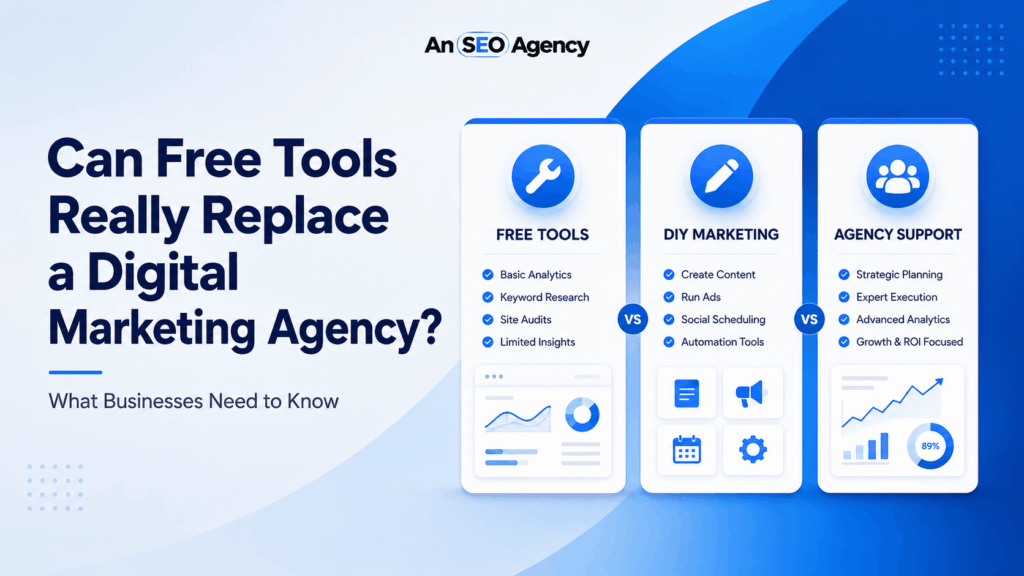
Free digital marketing tools can help with basic SEO checks, analytics, keyword research, website speed testing, and campaign tracking. However, they cannot fully replace a digital marketing agency because tools provide data, while agencies provide strategy, expertise, execution, testing, creativity, and business-focused decision-making.
What Are Free Digital Marketing Tools?
Free digital marketing tools are online platforms that help businesses manage or analyze parts of their marketing without paying for advanced software.
These tools can support SEO, PPC, social media, content writing, reporting, website performance, local SEO, and email marketing.
For example, businesses can use Google Search Console to measure search performance, check indexing issues, and understand which queries bring visitors to their website. Similarly, Google Analytics helps businesses understand customer journeys across websites and apps.
Common free digital marketing tools include:
- Google Search Console
- Google Analytics
- Google Keyword Planner
- Google Trends
- PageSpeed Insights
- Google Business Profile
- Canva free plan
- ChatGPT free plan
- Meta Business Suite
- Mailchimp free plan
- Looker Studio
- SEO audit tools
- Keyword research tools
These tools are useful because they make marketing more accessible. However, they still need the right human interpretation.
A beginner may see a traffic drop in analytics and assume SEO has failed. However, an agency may check indexing, search intent, content quality, algorithm impact, technical errors, competitor movement, and conversion data before making a decision.
Why Businesses Use Free Marketing Tools
Businesses use free marketing tools because they are easy to access, cost-effective, and helpful for early-stage marketing.
For small businesses, startups, freelancers, and local service providers, free tools can provide a good starting point. They can reveal website problems, keyword ideas, traffic trends, page speed issues, and local visibility gaps.
For example, Google Keyword Planner helps businesses discover keyword ideas and search estimates for campaigns. Meanwhile, Google Trends helps users explore search interest by time, location, and topic popularity.
Free tools are especially helpful when businesses want to:
- Check website traffic
- Find basic keyword ideas
- Test website speed
- Monitor Google search visibility
- Manage a Google Business Profile
- Schedule simple social posts
- Create basic graphics
- Track simple conversions
- Build simple reports
Moreover, free tools help business owners understand digital marketing better. This can make conversations with an agency more productive.
However, the problem starts when businesses expect tools to make decisions by themselves. Tools can show numbers, but they do not understand business goals, customer behavior, competitive positioning, or brand tone the way experienced marketers do.
What Free Tools Can Do Well
Free digital marketing tools are valuable when used correctly. They can save time, reduce guesswork, and help businesses identify obvious problems.
They can show basic website performance
Free tools can show whether your website gets traffic, which pages attract users, and where visitors come from. For example, Google Analytics can help you understand customer behavior, while Google Search Console can show clicks, impressions, and keyword visibility.
They can find technical issues
Tools like PageSpeed Insights can test loading performance and provide improvement suggestions. This is useful because slow websites can hurt user experience and reduce conversions.
They can support keyword research
Free keyword tools can help identify search terms related to your business. However, they usually do not tell you which keywords are most profitable, easiest to rank, or best for lead generation.
They can help with local visibility
A verified Google Business Profile helps local customers find business information on Google Search and Maps. This is especially important for restaurants, clinics, local agencies, home service companies, and retail stores.
They can simplify content creation
AI writing tools, design tools, and content planning tools can speed up content creation. However, they still need expert editing, fact-checking, brand alignment, and SEO optimization.
Free tools are good assistants. However, they are not complete marketing teams.
Where Free Tools Fall Short
Free tools usually show what is happening, but they do not always explain why it is happening or what to do next.
For example, a free SEO audit may show that your website has missing meta descriptions, slow pages, or broken links. However, it may not prioritize which issue matters most for revenue.
This is where tools fall short.
They often lack:
- Strategic planning
- Competitor context
- Revenue understanding
- Conversion insight
- Brand positioning
- Creative direction
- Technical implementation
- Campaign testing
- Cross-channel strategy
- Business-specific judgment
For example, a keyword tool may suggest a high-volume keyword. However, that keyword may attract users who are not ready to buy. A digital marketing agency can evaluate search intent, competition, funnel stage, and conversion potential before choosing the keyword.
Similarly, AI content tools can create a blog draft. However, they may not add real examples, expert insight, internal links, accurate sources, brand trust, or conversion-focused calls to action.
AN SEO Agency’s blog on how to write content Google AI trusts explains why content now needs experience, expertise, trust, and topic depth instead of generic writing.
Free Tools vs Digital Marketing Agency
Free tools help collect information. A digital marketing agency turns that information into action.
For example, a free audit tool may show that a website has low SEO scores. However, an agency can identify whether the problem comes from poor content, weak backlinks, bad technical structure, low trust, poor user experience, or wrong keyword targeting.
A tool can suggest improvements. An agency can build and execute a complete strategy.
A digital marketing agency can help with:
- SEO strategy
- Technical SEO
- Content planning
- PPC management
- Social media strategy
- Conversion optimization
- Brand positioning
- Competitor research
- Local SEO
- Link building
- Reporting and analysis
- AI search optimization
- AEO and GEO strategy
For example, if your business wants to grow organic traffic, AN SEO Agency’s SEO services can help connect keyword research, technical SEO, content, backlinks, and reporting into one complete strategy.
Free tools can help you start. However, an agency helps you scale.
SEO Tools Cannot Replace SEO Strategy
SEO tools are useful, but they cannot replace SEO strategy.
A tool can show keyword volume, backlinks, technical errors, or page speed issues. However, it cannot fully understand your business model, profit margins, service priorities, customer pain points, and sales process.
For example, one keyword may have high search volume but low buyer intent. Another keyword may have lower volume but better conversion potential. A skilled SEO strategist knows how to choose keywords based on business value, not only search volume.
SEO strategy includes:
- Search intent analysis
- Keyword prioritization
- Content mapping
- Technical audits
- Internal linking
- Competitor analysis
- Backlink planning
- Conversion tracking
- Topic cluster planning
- AI search readiness
AN SEO Agency’s guide on the difference between SEO and AEO explains how modern SEO now needs both traditional rankings and answer-based visibility.
Additionally, Google’s guide to optimizing for generative AI features explains that SEO best practices still matter for generative AI search. Therefore, businesses need more than tool reports. They need strategy that connects SEO, AEO, and AI visibility.
PPC Tools Cannot Replace Campaign Expertise
Free tools can help with PPC research, but they cannot manage campaigns like an expert.
Google Ads offers tools for keyword research, forecasts, campaign setup, and performance tracking. However, PPC success depends on much more than launching ads.
A PPC expert must manage:
- Keyword match types
- Negative keywords
- Bidding strategy
- Ad copy testing
- Landing page quality
- Conversion tracking
- Audience targeting
- Budget allocation
- Quality Score improvement
- Competitor analysis
- A/B testing
- ROI measurement
For example, a business may use Keyword Planner to find keywords and then run ads without understanding match types. As a result, the campaign may spend money on irrelevant clicks.
A digital marketing agency can prevent this by aligning ad strategy with buyer intent and conversion goals.
For businesses investing in paid growth, AN SEO Agency’s PPC services can support campaign planning, ad performance, and lead generation more effectively than tool-only management.
Free tools can help with PPC setup. However, expert management protects budget and improves results.
Content Tools Cannot Replace Brand Strategy
Content tools can help businesses write faster, but they cannot replace brand strategy.
Many AI tools can generate blog outlines, captions, email drafts, and ad copy. However, content success depends on message quality, audience understanding, search intent, internal linking, trust signals, and brand positioning.
For example, a blog written by a free AI tool may sound polished but still fail because it lacks:
- Real examples
- Expert insight
- Customer pain points
- Original opinions
- Internal links
- External sources
- Conversion strategy
- Brand voice
- Topic authority
- Search intent match
Google’s helpful content guidance encourages content that serves people first. Therefore, businesses should not publish generic content only because a tool can create it quickly.
AN SEO Agency’s blog on content strategy for AI search is a useful internal resource because it explains how blogs should build trust, answer real questions, and support AI search visibility.
Moreover, good content should support business goals. It should guide users from awareness to trust and then toward action.
AI Tools Cannot Replace Human Marketing Judgment
AI tools are powerful, but they still need human judgment.
They can create drafts, summarize data, suggest ideas, analyze patterns, and speed up research. However, they may also create generic content, miss context, misunderstand the brand, or produce inaccurate claims.
Human marketers add judgment in areas like:
- Brand positioning
- Audience psychology
- Competitive strategy
- Tone of voice
- Offer clarity
- Sales funnel planning
- Reputation risk
- Content accuracy
- Campaign prioritization
- Conversion improvement
For example, an AI tool can suggest blog topics. However, a marketer decides which topic fits the business, which keyword has value, which internal links should be used, and how the content should lead to conversions.
AI tools are best when they support expert teams, not when they replace them completely.
This is especially important in AI search. AN SEO Agency’s guide on how to get your brand mentioned in ChatGPT and Perplexity explains why brand mentions, trust signals, clear content, and authority matter for AI-powered discovery.
When Free Tools Are Enough
Free tools may be enough when your business is very small, your budget is limited, or your marketing goals are simple.
For example, a new business may use free tools to:
- Set up basic analytics
- Check search traffic
- Create social posts
- Test page speed
- Find keyword ideas
- Manage a Google Business Profile
- Publish simple blogs
- Track basic leads
This can work during the early stage.
Free tools are also helpful when a business owner wants to understand marketing before hiring help. In addition, they can help teams monitor basic performance between agency reports.
However, free tools become limited when the business needs serious growth, better rankings, more leads, stronger PPC performance, technical fixes, content strategy, or competitor-level execution.
Therefore, free tools are good for learning and basic management. They are not enough for advanced growth.
When You Need a Digital Marketing Agency
You need a digital marketing agency when marketing becomes too complex, too competitive, or too important to manage casually.
A business should consider hiring an agency when:
- Website traffic is not growing
- Leads are low quality
- Ads are wasting budget
- Competitors outrank you
- Content is not converting
- Technical SEO issues are increasing
- Google rankings are unstable
- Local SEO visibility is weak
- AI search visibility matters
- You need a complete growth strategy
For example, if your website has hundreds of pages, multiple services, several locations, paid campaigns, and technical issues, free tools alone will not be enough.
A digital marketing agency can connect strategy, execution, tracking, and improvement.
For businesses that need professional support, AN SEO Agency offers SEO, PPC, content marketing, web design, social media marketing, and digital growth services. Additionally, businesses can use the free SEO audit tool as a starting point before planning a deeper strategy.
Comparison Table: Free Tools vs Digital Marketing Agency
| Area | Free Tools | Digital Marketing Agency |
| Cost | Usually free or low-cost | Requires investment |
| Strategy | Limited or generic suggestions | Custom strategy based on goals |
| SEO | Shows issues and data | Fixes issues and builds growth plans |
| PPC | Helps with setup and keyword ideas | Manages budget, bids, testing, and ROI |
| Content | Creates drafts or ideas | Builds brand-aligned content strategy |
| Analytics | Shows performance numbers | Explains insights and next steps |
| Technical SEO | Identifies basic problems | Prioritizes and implements fixes |
| Local SEO | Helps manage basic listings | Improves local rankings and trust |
| AI search | Gives basic content support | Builds AEO, GEO, and AI visibility strategy |
| Best for | Beginners and basic checks | Growth-focused businesses |
Mini Case Study
Imagine a local service business that wants more leads.
At first, the owner uses free tools. Google Analytics shows website visitors. Search Console shows some keyword impressions. PageSpeed Insights shows slow mobile performance. A keyword tool suggests several blog ideas.
However, the business still does not get enough calls.
The owner then contacts a digital marketing agency. The agency reviews the data and finds deeper problems. The website targets broad keywords, service pages are thin, calls to action are weak, mobile speed is poor, local SEO is incomplete, and competitors have stronger content.
Next, the agency builds a strategy. It improves service pages, fixes technical SEO issues, updates Google Business Profile, creates local content, improves internal links, adds FAQs, and starts tracking form submissions properly.
Within a few months, the business gets better keyword visibility, stronger local rankings, and more qualified leads.
This example shows the real difference. Free tools revealed problems, but expert strategy turned those problems into action.
Expert Quote
“Free tools can tell you what is happening in your marketing. A digital marketing agency helps you understand why it is happening, what matters most, and how to turn insights into measurable business growth.�
Common Mistakes Businesses Make With Free Tools
Relying only on tool scores
Tool scores are helpful, but they do not always show business impact. A page may have a low score but still convert well, while another page may score highly but bring poor leads.
Choosing keywords only by volume
High-volume keywords are not always profitable. Businesses should also consider intent, competition, location, and conversion potential.
Publishing AI content without editing
AI drafts need human review, examples, fact-checking, and brand voice before publishing.
Ignoring conversion tracking
Traffic is not enough. Businesses need to track calls, forms, purchases, bookings, and lead quality.
Fixing small issues before big problems
A tool may show many errors, but not all errors matter equally. Strategy helps prioritize what affects growth.
Forgetting competitor context
Tools can show your website data, but competitor analysis explains why others may be winning.
Best Way to Use Free Tools With an Agency
The best approach is not tools vs agency. The best approach is tools plus agency.
Free tools provide data. Agencies provide strategy and execution.
A smart workflow looks like this:
- Use Search Console to monitor search visibility
- Use Google Analytics to track user behavior
- Use PageSpeed Insights to test speed
- Use Google Business Profile to manage local presence
- Use Keyword Planner for keyword ideas
- Use Looker Studio to build reports
- Use agency expertise to interpret, prioritize, and act
For example, Looker Studio can turn data into dashboards and reports. However, an agency can explain what the dashboard means and which actions should come next.
This combination gives businesses better control, better insights, and better execution.
Free Digital Marketing Tools Checklist
Use this checklist before deciding whether you need agency support:
- Set up Google Analytics
- Verify Google Search Console
- Check website speed
- Review Google Business Profile
- Research keywords
- Track calls and forms
- Review top landing pages
- Check mobile usability
- Monitor rankings
- Review competitors
- Audit old content
- Check technical SEO issues
- Track ad spend
- Review conversion rates
- Update business listings
- Plan content topics
- Add internal links
- Measure monthly growth
If you can collect data but struggle to turn it into results, it may be time to work with experts.
FAQs
Can free tools replace a digital marketing agency?
No. Free tools can support basic marketing tasks, but they cannot replace expert strategy, execution, and optimization.
Are free SEO tools useful for small businesses?
Yes. Free SEO tools help small businesses check traffic, keywords, indexing, speed, and basic website issues.
What free tools should every business use?
Every business should use Google Analytics, Google Search Console, PageSpeed Insights, and Google Business Profile.
When should I hire a digital marketing agency?
Hire an agency when you need stronger rankings, better leads, PPC management, content strategy, or technical SEO support.
Can AI tools replace marketing experts?
No. AI tools can speed up research and content creation, but they still need human strategy, editing, and judgment.