
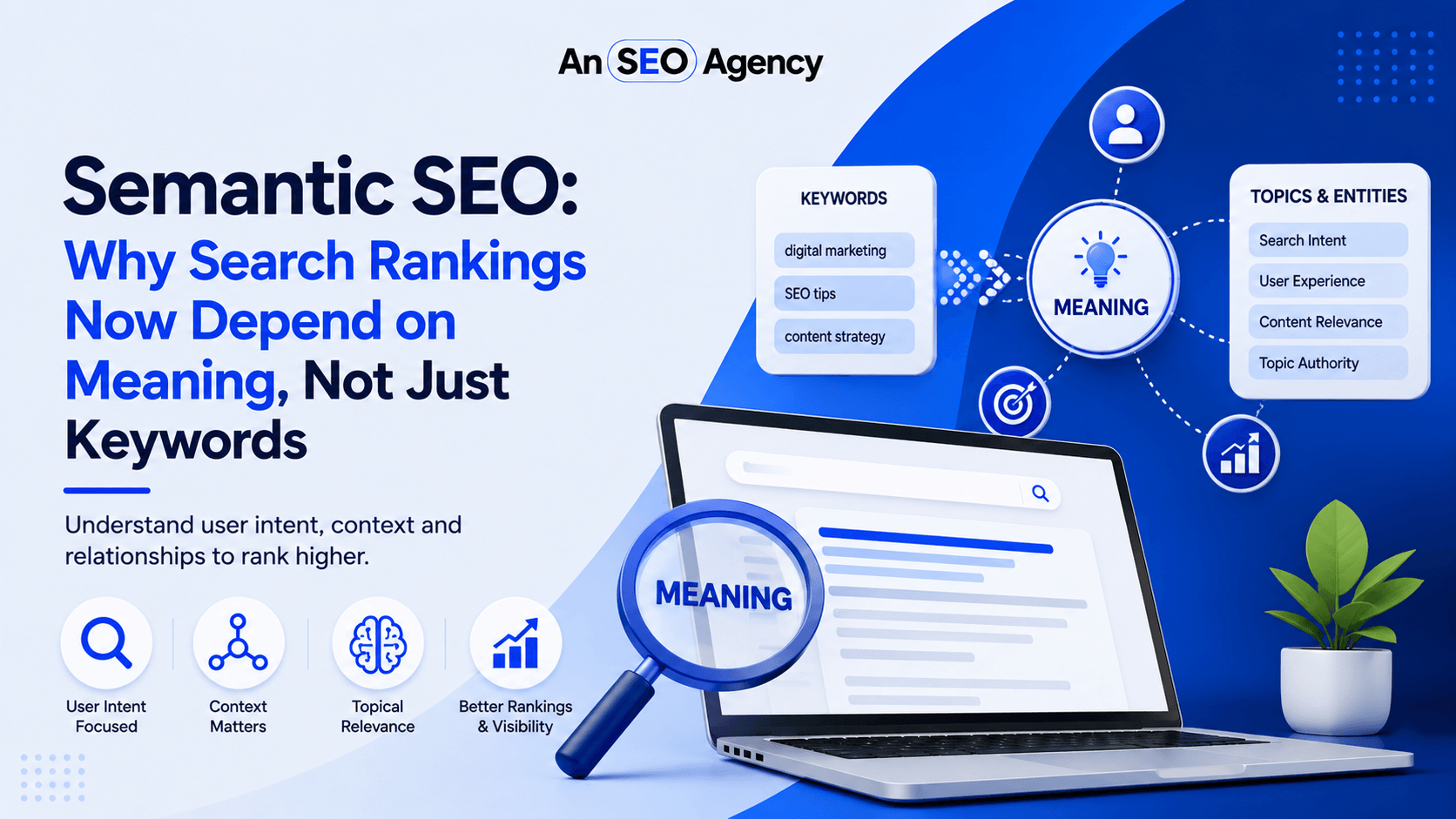
Why Search Rankings Now Depend on Meaning, Not Just Keywords
- What Is Semantic SEO?
- Why Semantic SEO Matters Today
- How Search Engines Understand Meaning
- The Role of Entities in Semantic SEO
- Why Search Intent Is More Important Than Keyword Density
- How Topical Authority Improves Rankings
- How Semantic SEO Supports AI Search Visibility
- How to Build a Semantic SEO Strategy
- Common Semantic SEO Mistakes to Avoid
- Expert Quote
- FAQs
- What Is Semantic SEO?
- Why Semantic SEO Matters Today
- How Search Engines Understand Meaning
- The Role of Entities in Semantic SEO
- Why Search Intent Is More Important Than Keyword Density
- How Topical Authority Improves Rankings
- How Semantic SEO Supports AI Search Visibility
- How to Build a Semantic SEO Strategy
- Common Semantic SEO Mistakes to Avoid
- Expert Quote
- FAQs
What Is Semantic SEO?
Semantic SEO is the process of optimizing website content around meaning, context, search intent and topic relationships instead of focusing only on exact-match keywords.
In older SEO, many websites tried to rank by repeating the same keyword multiple times. Today, search engines are much smarter. They do not only look at the words on a page. They try to understand what the content means, what the user wants and how different ideas are connected.
For example, a page about “technical SEO” may also need to explain crawling, indexing, XML sitemaps, robots.txt, page speed, schema markup and internal linking. These related ideas help search engines understand that the page covers the topic properly.
Semantic SEO helps your website become more useful for both users and search engines. It also supports modern SEO services because ranking today depends on helpful content, technical clarity and strong topical coverage.
Why Semantic SEO Matters Today
Search behavior has changed. People no longer search only with short keywords. They ask complete questions, compare options and expect direct answers.
For example, instead of searching only “SEO agency,” a user may search:
“Which SEO agency can help my business rank in Google and AI search?”
This type of query has a deeper meaning. The user is not only looking for a company. They want a trusted agency that understands traditional SEO, AI search, technical SEO and answer-based content.
Google’s guidance explains that helpful, reliable and people-first content is important for search visibility. Its ranking systems are designed to reward content created for users, not content made only to manipulate rankings. (Google for Developers)
That is why semantic SEO is important. It helps you create content that answers the full intent behind a search query.
Traditional SEO vs Semantic SEO
Traditional SEO and semantic SEO are connected, but they are not the same.
| Traditional SEO | Semantic SEO |
| Focuses mainly on keywords | Focuses on meaning and intent |
| One keyword per page | Complete topic coverage |
| Repeats target phrases | Uses related concepts naturally |
| Measures only rankings | Measures topical authority and visibility |
| Content can be isolated | Content connects through internal links |
| Optimization is page-based | Optimization is topic-based |
You still need keyword research, meta titles, headings, technical SEO and backlinks. However, semantic SEO adds a deeper layer.
It helps search engines understand why your page deserves to rank, not just which keyword it contains.
How Search Engines Understand Meaning
Search engines now use advanced systems to understand context. They look at how words, entities, topics and pages relate to each other.
For example, if a website has a single page about “local SEO,” search engines may understand it at a basic level. But if the same website also has pages on Google Business Profile, local citations, reviews, service-area pages, and local keyword research, it becomes more authoritative in local SEO.
This is where semantic connections matter.
Search engines may evaluate:
- Main topic of the page
- Related subtopics
- Search intent
- Internal links
- Structured data
- Author expertise
- Brand trust
- Content depth
- User usefulness
- External references
Google also states that foundational SEO best practices remain relevant for generative AI search features, including technical clarity, crawlability and useful content. (Google for Developers)
This means semantic SEO is not replacing SEO. It is improving the way SEO is done.
The Role of Entities in Semantic SEO
An entity is a specific thing that search engines can recognize. It can be a person, place, brand, service, product, topic or concept.
Examples of entities include:
- AN SEO Agency
- Search engine optimization
- Technical SEO
- Google Search
- Structured data
- WordPress SEO
- Local SEO
- AI search
- Answer Engine Optimization
Semantic SEO helps search engines understand how these entities are connected.
For example, if AN SEO Agency publishes content around SEO services, technical SEO, structured data, AEO, AI search and WordPress SEO, search engines can better understand that the brand is connected with search visibility and digital growth.
This is why internal linking is important. A blog about semantic SEO should naturally link to related pages such as technical SEO services, structured data optimisation and AEO and SEO strategies.
These links help users explore the topic and help search engines understand the relationship between pages.
Why Search Intent Is More Important Than Keyword Density
Keyword density is no longer the main ranking focus. Search intent matters more.
Search intent means the reason behind a user’s search.
There are four common types of search intent:
| Search Intent | Example Query | User Goal |
| Informational | What is semantic SEO? | Learn something |
| Commercial | Best SEO agency for small business | Compare options |
| Transactional | Hire SEO agency | Take an action |
| Navigational | AN SEO Agency SEO services | Find a specific website |
A semantic SEO strategy should match the content with the right intent.
For example, a blog post can target informational intent by explaining what semantic SEO is. A service page can target transactional intent by explaining how an agency can help with SEO implementation.
This makes your content more useful and more aligned with what users actually want.
How Topical Authority Improves Rankings
Topical authority means your website has strong, useful and connected content around a specific subject.
A website with one SEO blog may not appear very authoritative. But a website with detailed content about SEO, AEO, technical SEO, semantic SEO, structured data, local SEO, WordPress SEO and AI visibility sends stronger topical signals.
A good topical structure may include:
- Main pillar page: SEO Services
- Supporting page: Technical SEO
- Supporting page: Structured Data Optimisation
- Supporting page: WordPress SEO
- Supporting blog: What Is Semantic SEO?
- Supporting blog: Difference Between SEO and AEO
- Supporting blog: How AI Search Is Changing Customer Discovery
This structure helps search engines see that the website covers the topic deeply.
It also improves user experience because visitors can move from one helpful page to another.
How Semantic SEO Supports AI Search Visibility
AI search tools like ChatGPT, Gemini, Copilot and Google AI Overviews are changing how users find information. These tools often provide direct answers instead of only showing a list of links.
Semantic SEO can help because AI tools need clear, well-structured and trustworthy information.
Google explains that pages generally need to be indexed and eligible to appear in Google Search with a snippet to be eligible for AI features in Search. (Google for Developers)
This means your content should be:
- Easy to crawl
- Easy to understand
- Helpful for users
- Structured with clear headings
- Supported by related pages
- Updated regularly
- Written with real expertise
- Connected through internal links
Semantic SEO also supports AEO and SEO strategies because it helps content answer real questions clearly.
For example, instead of writing only “SEO is important,” a semantic article should answer:
- What is SEO?
- Why does SEO matter?
- How does SEO work?
- What is technical SEO?
- What is AEO?
- How does AI search affect SEO?
- How can businesses improve search visibility?
This type of content is more useful for users and more understandable for AI systems.
How to Build a Semantic SEO Strategy
A strong semantic SEO strategy needs planning. It is not only about adding related keywords. It is about building a complete topic ecosystem.
1. Start with a core topic
Choose the main topic you want your website to be known for.
For example:
- SEO services
- Technical SEO
- Local SEO
- AI search optimization
- WordPress SEO
- Digital marketing strategy
The core topic should be connected to your business goals.
2. Identify related subtopics
Once you choose the main topic, list all important related subtopics.
For “semantic SEO,” related subtopics may include:
- Search intent
- Entity SEO
- Topical authority
- Internal linking
- Structured data
- Content clusters
- Helpful content
- AI search visibility
- Keyword context
- User experience
These subtopics help build a complete article or content cluster.
3. Create pillar and cluster content
A pillar page covers a broad topic. Cluster pages cover specific subtopics in more detail.
For example:
Pillar page: SEO Services
Cluster pages: Technical SEO, WordPress SEO, Structured Data, Local SEO, AEO, Semantic SEO
Each cluster page should link back to the main pillar page. The pillar page should also link to the cluster pages.
This creates a clear content network.
4. Use semantic keywords naturally
Semantic keywords are related words and phrases that help explain the topic.
For example, semantic keywords for “semantic SEO” may include:
- Search intent
- Entity optimization
- Topical relevance
- Content clusters
- Knowledge graph
- Structured data
- Internal linking
- AI search
- Helpful content
- Contextual relevance
Use these terms naturally. Do not force them into every paragraph.
5. Add structured data
Structured data helps search engines understand your page more clearly. Google explains that structured data can help Google understand page content and make pages eligible for rich results when guidelines are followed. (Google for Developers)
Useful schema types include:
- Article schema
- FAQ schema
- Organization schema
- LocalBusiness schema
- Breadcrumb schema
- Service schema
- Person schema
For professional support, businesses can use structured data optimisation to improve how their website information is organized for search engines.
6. Strengthen internal linking
Internal links connect related pages and help search engines understand your website structure.
For example, this blog can internally link to:
- SEO services
- Technical SEO services
- Structured data optimisation
- AEO and SEO strategies
- Difference between SEO and AEO
- Web development services
Internal linking helps users move through your website and helps search engines understand page relationships.
7. Add expert insight and trust signals
Semantic SEO is stronger when the content shows real expertise.
Add:
- Author information
- Expert quotes
- Case studies
- Examples
- Updated dates
- Real business details
- Clear contact information
- Client results
- Helpful external references
Google’s helpful content guidance encourages content that demonstrates experience, expertise, authoritativeness and trustworthiness. (Google for Developers)
8. Measure more than keyword rankings
Keyword rankings are still useful, but they are not the only metric.
Track:
- Organic traffic
- Impressions
- Click-through rate
- Indexed pages
- Featured snippets
- AI Overview visibility
- Brand mentions
- Internal link performance
- Conversion rate
- Search Console queries
- Engagement on content clusters
Semantic SEO is about building long-term visibility, not only short-term keyword movement.
Common Semantic SEO Mistakes to Avoid
Many websites try semantic SEO but make simple mistakes.
Avoid these problems:
- Writing for keywords only
- Ignoring search intent
- Creating thin content
- Publishing disconnected blogs
- Not using internal links
- Adding schema incorrectly
- Ignoring technical SEO
- Repeating the same keyword too much
- Not covering related subtopics
- Forgetting the author and the rust signals
- Not updating old content
- Creating content without a clear structure
Semantic SEO works best when content, technical SEO, internal linking and authority all work together.
Expert Quote
“Semantic SEO is not about using more keywords. It is about helping search engines understand your topic, your expertise and the relationships between your pages. When your content is clear, connected and useful, it becomes easier to rank and easier to trust.”
— AN SEO Agency SEO Team
Semantic SEO is the future of search rankings because search engines now focus on meaning, context and user intent. A page can no longer depend only on keyword repetition. It must explain the topic clearly, answer related questions, connect with supporting pages and show real expertise.
For businesses, this is a major opportunity.
If your website builds topical authority, uses structured data, answers user questions and maintains strong technical SEO, it can perform better in traditional search and AI-driven search experiences.
Semantic SEO helps your website become more than a collection of pages. It helps your website become a trusted source around your core topics.
AN SEO Agency helps businesses improve search visibility through SEO services, technical SEO, structured data optimisation and modern AEO and SEO strategies.
FAQs
What is semantic SEO?
Semantic SEO means optimizing content around meaning, intent, entities and related topics, not only keywords.
Is semantic SEO better than traditional SEO?
It improves traditional SEO by adding deeper topic coverage and search intent understanding.
Do keywords still matter?
Yes. Keywords still matter, but they should support meaning instead of being repeated unnaturally.
How does semantic SEO help rankings?
It builds topical authority, improves relevance and helps search engines understand your content better.
Does schema help semantic SEO?
Yes. Schema helps search engines understand page content, entities and business information.
Who needs semantic SEO?
Any business that wants stronger rankings, better content visibility and improved AI search presence.