
SEO vs AEO vs GEO: What Businesses Need to Know
- What Is SEO?
- What Is GEO?
- SEO vs AEO vs GEO Explained
- Why Businesses Need All Three
- How AI Search Is Changing Visibility
- Key Differences Between SEO vs AEO vs GEO
- How to Build a Combined SEO vs AEO vs GEO Strategy
- Content Strategy for SEO vs AEO vs GEO
- Technical SEO Still Matters
- Brand Authority and Trust Signals
- Local SEO vs AEO vs GEO
- SEO vs AEO vs GEO Comparison Table
- Mini Case Study
- Expert Quote
- Common Mistakes to Avoid
- SEO vs AEO vs GEO Checklist
- FAQs
- What Is SEO?
- What Is GEO?
- SEO vs AEO vs GEO Explained
- Why Businesses Need All Three
- How AI Search Is Changing Visibility
- Key Differences Between SEO vs AEO vs GEO
- How to Build a Combined SEO vs AEO vs GEO Strategy
- Content Strategy for SEO vs AEO vs GEO
- Technical SEO Still Matters
- Brand Authority and Trust Signals
- Local SEO vs AEO vs GEO
- SEO vs AEO vs GEO Comparison Table
- Mini Case Study
- Expert Quote
- Common Mistakes to Avoid
- SEO vs AEO vs GEO Checklist
- FAQs
SEO vs AEO vs GEO is now one of the most important digital marketing topics for businesses. Traditionally, search was limited to Google rankings. However, customers now use Google, Google AI Overviews, ChatGPT, Perplexity, Gemini, Copilot, voice assistants, and AI-powered recommendation tools to find answers and compare brands.
As a result, businesses need to understand how visibility works across different search experiences. While SEO helps websites rank in search engines, AEO helps content appear in answer-based results. Meanwhile, GEO helps brands become visible and citable inside generative AI responses.
However, these strategies should not work separately because they are deeply connected. For example, a strong business website still needs crawlable pages, helpful content, technical SEO, backlinks, internal links, and trust signals. In addition, modern websites now require direct answers, topic depth, structured data, brand mentions, and AI-friendly content.
If you want a deeper foundation, AN SEO Agency’s guide on the Difference Between SEO and AEO explains how traditional search and answer-based visibility work together in modern digital marketing.
In simple terms, SEO helps businesses rank in search engines, AEO helps content appear in direct answers, and GEO helps brands get mentioned or cited in generative AI responses. Therefore, businesses need all three because customers now search through Google, AI Overviews, ChatGPT, Perplexity, Copilot, and other AI-powered platforms.
What Is SEO?
SEO stands for Search Engine Optimization. Essentially, it is the process of improving a website so it can rank higher in search engine results and attract organic traffic.
Traditionally, SEO focuses on helping search engines crawl, understand, index, and rank your website. Specifically, it includes keyword research, on-page SEO, technical SEO, content optimization, backlinks, internal links, user experience, and local SEO.
For example, a business may use SEO to rank for terms like:
- SEO services
- Digital marketing agency
- Local SEO company
- Best SEO agency near me
- Website optimization services
Most importantly, SEO is still the foundation of online visibility. Without proper SEO, your website may struggle to appear in Google, Bing, and other search engines.
According to Google’s SEO Starter Guide, even simple SEO improvements can make it easier for search engines to crawl, index, and understand website content.
Furthermore, businesses that need stronger organic visibility should focus SEO services on technical SEO, content quality, link building, and long-term digital strategy. For example, AN SEO Agency’s SEO services page demonstrates how these elements work together to improve rankings and search visibility.
What Is AEO?
AEO stands for Answer Engine Optimization. It focuses on helping your content appear in direct answers.
Answer engines include Google AI Overviews, featured snippets, People Also Ask sections, voice assistants, ChatGPT search experiences, Perplexity answers, and other AI-driven answer platforms.
AEO is different from traditional SEO because it does not only focus on ranking a page. Instead, it focuses on becoming the best answer to a specific question.
For example, users may ask:
- What is the difference between SEO and AEO?
- How does local SEO help small businesses?
- Which SEO agency helps with AI search visibility?
- How can my brand appear in ChatGPT?
- What is the best digital marketing strategy for 2026?
AEO helps businesses answer these questions clearly.
AN SEO Agency’s blog on How to Use AEO for Brand Visibility explains how answer engine optimization can help brands become easier for AI-powered tools to understand, summarize, and recommend.
Moreover, AEO works best when content includes direct answers, FAQs, comparison tables, schema markup, expert insights, and helpful examples.
What Is GEO?
GEO stands for Generative Engine Optimization. It focuses on improving brand visibility inside generative AI tools that create summarized answers.
Generative engines include tools like ChatGPT, Perplexity, Gemini, Microsoft Copilot, and AI search experiences that synthesize information from multiple sources.
GEO is closely connected to AEO, but the focus is slightly different. AEO often focuses on answering questions clearly. GEO focuses on helping generative AI tools recognize, trust, cite, or mention your brand when creating responses.
For example, a user may ask an AI tool:
- Which SEO agencies specialize in AI search?
- What companies offer Generative Engine Optimization?
- Which digital marketing agencies understand GEO?
- What brands are trusted for AEO and SEO strategy?
If your business has strong content, consistent mentions, trusted sources, and clear expertise, generative AI tools may be more likely to include your brand.
The research paper GEO: Generative Engine Optimization introduced GEO as a framework for improving content visibility in generative engine responses. Therefore, GEO is becoming an important topic for brands that want visibility beyond traditional search rankings.
AN SEO Agency’s page on Top Generative Engine Optimization Agencies in India also explains how GEO focuses on AI-driven search visibility, entity-based content, structured data, and digital trust-building.
SEO vs AEO vs GEO Explained
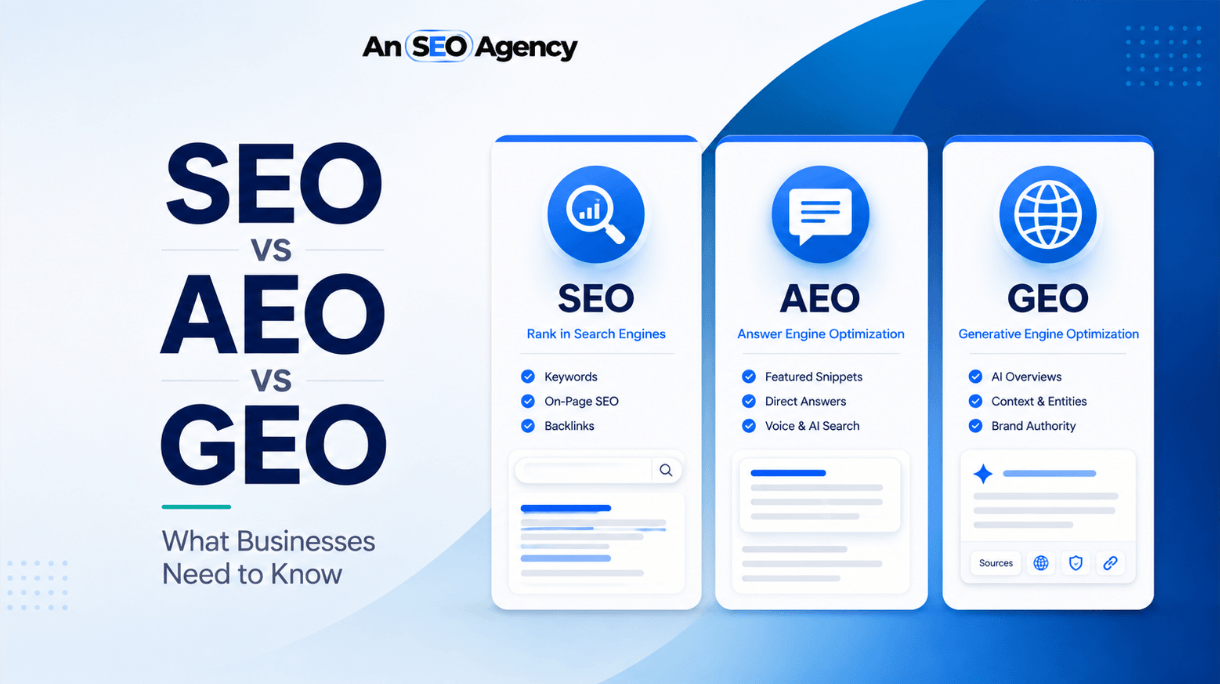
SEO helps your website get discovered in search engines. AEO helps your content answer questions clearly. GEO helps your brand become visible in generative AI responses.
In simple words:
- SEO helps you rank.
- AEO helps you answer.
- GEO helps you get mentioned or cited.
However, businesses should not choose only one. A strong digital strategy needs all three.
For example, a blog may rank on Google through SEO. The same blog may appear in a featured snippet through AEO. In addition, the same content may support brand visibility in ChatGPT or Perplexity through GEO.
Google’s official generative AI search guidance says that optimization for generative AI features in Google Search is still SEO from Google’s perspective. Therefore, the best approach is not to abandon SEO. Instead, businesses should modernize SEO for answer engines and generative AI platforms.
Why Businesses Need All Three
Businesses need SEO, AEO, and GEO because customer search behavior has changed.
Earlier, a customer typed a keyword into Google, clicked a result, and compared websites. Now, customers may ask AI tools for recommendations, summaries, comparisons, and direct answers before visiting any website.
For example, a business owner may ask:
- What is the best SEO strategy for a small business?
- Should I invest in SEO, AEO, or GEO?
- Which agency helps brands appear in AI search?
- How do Google AI Overviews affect website traffic?
If your brand does not appear in these discovery moments, competitors may gain trust first.
SEO helps you appear in organic search. AEO helps your content match question-based search. GEO helps your brand enter AI-generated conversations.
This is why AN SEO Agency’s article on How to Get Your Brand Mentioned in ChatGPT and Perplexity is useful for businesses that want to improve visibility inside AI tools.
Additionally, businesses should think beyond clicks. AI visibility can influence awareness, credibility, consideration, and lead quality.
How AI Search Is Changing Visibility
AI search is changing visibility because users now receive direct answers instead of only link lists.
Google AI Overviews can summarize information inside search results. Perplexity often gives answers with source links. ChatGPT can help users compare options, explain concepts, and discover brands. Microsoft Copilot also uses search and AI together to support user queries.
This means businesses need to become trusted sources, not only ranked pages.
Google’s page on AI features and your website explains how AI features in Search can help users find web content. Meanwhile, Microsoft’s Bing Webmaster Guidelines explain that crawling, indexing, and content clarity support visibility in search and AI-powered experiences.
Therefore, businesses should create content that is clear, indexable, helpful, structured, and trustworthy.
AN SEO Agency’s blog on How Google AI Overviews Impact SEO in 2026 explains how AI-generated summaries are changing rankings, traffic patterns, and content planning.
Key Differences Between SEO vs AEO vs GEO
Although SEO, AEO, and GEO overlap, they focus on different outcomes.
SEO focuses on search rankings
SEO aims to improve website rankings, traffic, and conversions from traditional search engines.
It includes:
- Keyword research
- On-page SEO
- Technical SEO
- Link building
- Content optimization
- Internal linking
- Local SEO
- Core Web Vitals
For example, AN SEO Agency’s link building services help businesses improve authority, which can support rankings and brand trust.
AEO focuses on direct answers
AEO aims to help content appear in answer-style results.
It includes:
- Featured snippet answers
- FAQs
- Clear headings
- Conversational search intent
- Schema markup
- Concise definitions
- Comparison tables
- Voice search readiness
For example, a blog that answers “What is AEO?” clearly near the top has stronger answer engine potential.
GEO focuses on generative AI visibility
GEO aims to help brands appear, get mentioned, or get cited in generative AI responses.
It includes:
- Brand mentions
- Entity optimization
- Source-worthy content
- Original insights
- Third-party validation
- AI-readable content structure
- Strong digital footprint
- Trusted references
For example, AN SEO Agency’s page on Top Generative Engine Optimization Companies in the USA connects GEO with AI-readable content, digital trust, and entity optimization.
How to Build a Combined SEO vs AEO vs GEO Strategy
A complete search strategy should combine SEO, AEO, and GEO instead of treating them as separate services.
1. Start with SEO foundations
First, make sure your website can be crawled, indexed, and understood.
Your SEO foundation should include:
- Clean website architecture
- Fast page speed
- Mobile-friendly pages
- HTTPS security
- Optimized title tags
- Helpful meta descriptions
- Clear headings
- Internal links
- XML sitemap
- Proper redirects
- No broken pages
Google’s technical requirements for Search explain the basic requirements websites need to meet for Google Search eligibility.
Without these basics, AEO and GEO become harder.
2. Add answer-focused content
Next, create content that answers customer questions clearly.
For example, each blog should include a short answer near the beginning, followed by detailed sections. Each major heading should solve one specific question or problem.
This helps users and answer engines understand the content quickly.
3. Build generative AI trust signals
Then, strengthen the signals that generative AI tools may use to understand your brand.
These include:
- Author bios
- Case studies
- Reviews
- Brand mentions
- External citations
- Consistent business information
- Topic clusters
- Expert quotes
- Helpful service pages
AN SEO Agency’s blog on AEO Brand Recognition Strategies for AI Tools explains how brand recognition, authority, and answer-based content can improve visibility inside AI tools.
4. Connect pages with internal links
Finally, use internal links to connect blogs, service pages, and supporting resources.
For example, this article can link naturally to older blogs about SEO vs AEO, Google AI Overviews, AEO brand visibility, and ChatGPT mentions. This helps users learn more while helping search engines understand topic relationships.
Content Strategy for SEO vs AEO vs GEO
Content strategy is where SEO, AEO, and GEO meet.
A strong content strategy should include:
- Keyword research for SEO
- Question research for AEO
- Brand and entity research for GEO
- Topic clusters
- Internal links
- Expert insights
- External citations
- Original examples
- FAQs
- Comparison tables
- Case studies
For example, a content cluster around AI search could include:
- SEO vs AEO vs GEO
- Difference between SEO and AEO
- Google AI Overviews optimization
- How to get mentioned in ChatGPT
- AEO brand visibility
- GEO agency comparison
- Topical authority for AI search
- Schema markup for AI search
- Reviews and AI visibility
This content cluster helps search engines and AI tools understand your expertise.
Moreover, old blogs should not sit alone. If AN SEO Agency publishes a new article about SEO vs AEO vs GEO, it should connect to existing blogs like AEO and SEO Strategies for Modern Search and How Search Intent Has Changed in 2026.
This improves topical depth and user experience.
Technical SEO Still Matters
Some businesses believe AI search makes technical SEO less important. However, that is not true.
Technical SEO still matters because AI systems and search engines need access to your content. If your pages are blocked, slow, broken, or poorly structured, visibility can suffer.
Important technical SEO elements include:
- Crawlability
- Indexability
- Mobile usability
- Page speed
- Structured data
- XML sitemaps
- HTTPS
- Internal links
- Core Web Vitals
- Clean navigation
- Canonical tags
- JavaScript rendering
Google’s Core Web Vitals documentation explains performance and user experience metrics that can affect how users experience your website.
Additionally, structured data helps search engines understand content more clearly. Google’s structured data documentation explains how structured data can provide explicit clues about page meaning.
For SEO, AEO, and GEO, technical clarity supports visibility.
Brand Authority and Trust Signals
Brand authority is becoming more important because AI tools need confidence before mentioning or citing a business.
Trust signals help search engines and AI platforms understand whether your business is reliable.
Strong trust signals include:
- Clear About page
- Real contact information
- Service details
- Case studies
- Reviews
- Testimonials
- Author expertise
- Business history
- Industry mentions
- Backlinks
- Awards
- Consistent listings
- Social profiles
For example, a business that claims to provide GEO services should also publish content about generative AI search, AI Overviews, entity SEO, structured data, and brand mentions.
In addition, third-party mentions help strengthen trust. If other credible websites mention your business, AI systems may better understand your brand’s relevance.
This is why GEO often depends on both on-site content and off-site authority building.
Local SEO vs AEO vs GEO
Local businesses also need SEO, AEO, and GEO.
A local customer may ask Google, ChatGPT, or Perplexity:
- Best SEO agency near me
- Best dentist in my city
- Which plumber has good reviews?
- Top digital marketing agency for small businesses
- Best restaurant for family dinner nearby
Traditional local SEO helps businesses appear in local rankings and Google Maps. AEO helps answer local customer questions. GEO helps the brand appear in AI-generated local recommendations.
Local businesses should focus on:
- Google Business Profile
- Customer reviews
- Local service pages
- Location landing pages
- Local FAQs
- Local citations
- Review responses
- Local backlinks
- Consistent NAP details
- Local schema
Google’s Business Profile Help offers official guidance for managing local business information across Google Search and Maps.
For businesses targeting specific regions, AN SEO Agency’s SEO Agency in United States page shows how location-focused SEO pages can support geographic relevance.
SEO vs AEO vs GEO Comparison Table
| Category | SEO | AEO | GEO |
| Full form | Search Engine Optimization | Answer Engine Optimization | Generative Engine Optimization |
| Main goal | Rank higher in search results | Appear in direct answers | Get mentioned or cited in AI responses |
| Main platforms | Google, Bing, Yahoo | Google AI Overviews, voice search, featured snippets | ChatGPT, Perplexity, Gemini, Copilot |
| Search style | Keyword and intent-based | Question and answer-based | Conversational and synthesized |
| Content focus | Optimized pages and blogs | Direct answers and FAQs | Source-worthy and citable content |
| Authority signal | Backlinks and topical relevance | Clarity, schema, and answer quality | Mentions, citations, trust, and entities |
| Business benefit | Traffic and leads | Visibility in answer results | Brand discovery in AI tools |
| Best use | Ranking web pages | Answering customer questions | Becoming visible in AI recommendations |
Mini Case Study
Imagine a small accounting firm that wants more leads.
At first, the firm only focuses on traditional SEO. It creates service pages for bookkeeping, tax filing, and payroll. It also optimizes title tags, adds keywords, and builds a few backlinks.
This helps the website rank for some local terms.
However, customers are now asking AI tools questions like:
- When should a small business hire an accountant?
- What bookkeeping mistakes should I avoid?
- Which accounting firm is trusted near me?
- What is the difference between bookkeeping and payroll?
The firm then adds AEO content. It creates FAQ sections, direct answers, comparison blogs, and helpful guides.
Next, it improves GEO signals. It earns local mentions, publishes case studies, improves reviews, adds structured data, and creates expert content that AI tools can understand.
As a result, the firm improves search rankings, answer visibility, and brand trust across AI tools.
This shows why businesses need SEO, AEO, and GEO together.
Expert Quote
“SEO helps customers find your website, AEO helps them get clear answers from your content, and GEO helps AI tools understand why your brand deserves to be mentioned. Therefore, businesses that combine all three will be better prepared for the future of search.”
Common Mistakes to Avoid
Treating SEO, AEO, and GEO as separate strategies
These strategies work best together. While SEO creates the foundation, AEO improves answer visibility, and GEO strengthens AI-generated brand discovery.
Ignoring SEO basics
AEO and GEO will not work well if search engines cannot properly crawl or index your website. Therefore, technical SEO should always remain a priority.
Writing thin AI-generated content
Generic content does not build trust. Instead, businesses should add original examples, expert insights, real data, and helpful details to improve credibility and engagement.
Forgetting internal links
Internal links help connect old blogs, new articles, and service pages. In addition, they help search engines understand topic relationships and improve site structure.
Ignoring brand mentions
GEO depends heavily on brand recognition. Therefore, businesses should earn mentions from trusted websites, directories, partners, and industry sources whenever possible.
Overusing keywords
Keyword stuffing hurts readability and user experience. Instead, use natural language and answer real questions clearly and naturally.
SEO vs AEO vs GEO Checklist
Use this checklist to build a future-ready visibility strategy:
- Fix technical SEO issues
- Make important pages crawlable
- Create helpful service pages
- Add direct answer sections
- Build FAQ content
- Use structured data
- Improve Core Web Vitals
- Build topical authority
- Link old blogs naturally
- Earn quality backlinks
- Build brand mentions
- Add expert insights
- Publish case studies
- Keep content updated
- Optimize Google Business Profile
- Track AI search mentions
- Monitor branded search results
- Improve reviews and testimonials
FAQs
What is the difference between SEO, AEO, and GEO?
SEO focuses on rankings, AEO focuses on answers, and GEO focuses on visibility in generative AI responses.
Is GEO replacing SEO?
No. GEO is not replacing SEO. It builds on SEO by helping brands appear in AI-generated answers.
Is AEO better than SEO?
AEO is not better than SEO. Both work together to improve rankings, answer visibility, and user trust.
Why do businesses need GEO?
Businesses need GEO because customers now use ChatGPT, Perplexity, Gemini, and Copilot to discover brands.
Does Google use GEO?
Google says optimization for its generative AI features is still SEO, but GEO is useful for broader AI platforms.
How can a business start with AEO and GEO?
Start with strong SEO, then add direct answers, FAQs, schema, topic clusters, reviews, and brand mentions.