
Your Next Customer May Never Visit Your Website. Here’s Why?
- What Does It Mean When Customers Don’t Visit Your Website?
- The Latest Zero-Click Search Statistics: What the Data Reveals
- Seven Ways Customers Can Find You Without Visiting Your Website
- Why Traditional Website Traffic Is Losing Some of Its Importance
- Traditional Customer Journey vs Zero-Click Customer Journey
- Which Businesses Are Most Affected by Zero-Click Marketing?
- Is Zero-Click Marketing Good or Bad for Businesses?
- 10 Ways to Attract Customers Without Relying Only on Website Visits
- How to Measure Marketing Success Beyond Website Traffic
- Practical Example: A Local Business Growing Without More Website Traffic
- Does Your Business Still Need a Website?
- Common Zero-Click Marketing Mistakes
- A 90-Day Zero-Click Marketing Strategy for Businesses
- What Industry Experts Say About the Zero-Click Future
- Predictions: How Customer Discovery May Change in 2027
- Frequently Asked Questions
- What Does It Mean When Customers Don’t Visit Your Website?
- The Latest Zero-Click Search Statistics: What the Data Reveals
- Seven Ways Customers Can Find You Without Visiting Your Website
- Why Traditional Website Traffic Is Losing Some of Its Importance
- Traditional Customer Journey vs Zero-Click Customer Journey
- Which Businesses Are Most Affected by Zero-Click Marketing?
- Is Zero-Click Marketing Good or Bad for Businesses?
- 10 Ways to Attract Customers Without Relying Only on Website Visits
- How to Measure Marketing Success Beyond Website Traffic
- Practical Example: A Local Business Growing Without More Website Traffic
- Does Your Business Still Need a Website?
- Common Zero-Click Marketing Mistakes
- A 90-Day Zero-Click Marketing Strategy for Businesses
- What Industry Experts Say About the Zero-Click Future
- Predictions: How Customer Discovery May Change in 2027
- Frequently Asked Questions
What if your next customer discovers your business, compares your Zero-click marketing services, trusts your reputation and decides to contact you without ever visiting your website?
It sounds unusual, especially when businesses have spent years investing in SEO, website development and digital marketing to attract more visitors.
However, the way customers discover businesses is changing.
Imagine someone looking for a reliable digital marketing agency.
Instead of searching Google, opening multiple websites and comparing service pages, they ask ChatGPT:
“Recommend a digital marketing agency that specializes in local SEO and lead generation for small businesses.”
The AI assistant provides a shortlist of agencies, explains their services and identifies options that appear relevant.
The customer recognizes one of the brands, searches for its contact details and calls directly.
The business receives a potential customer, but the website never records a visit from that discovery journey.
This is one example of a broader shift toward zero-click marketing.
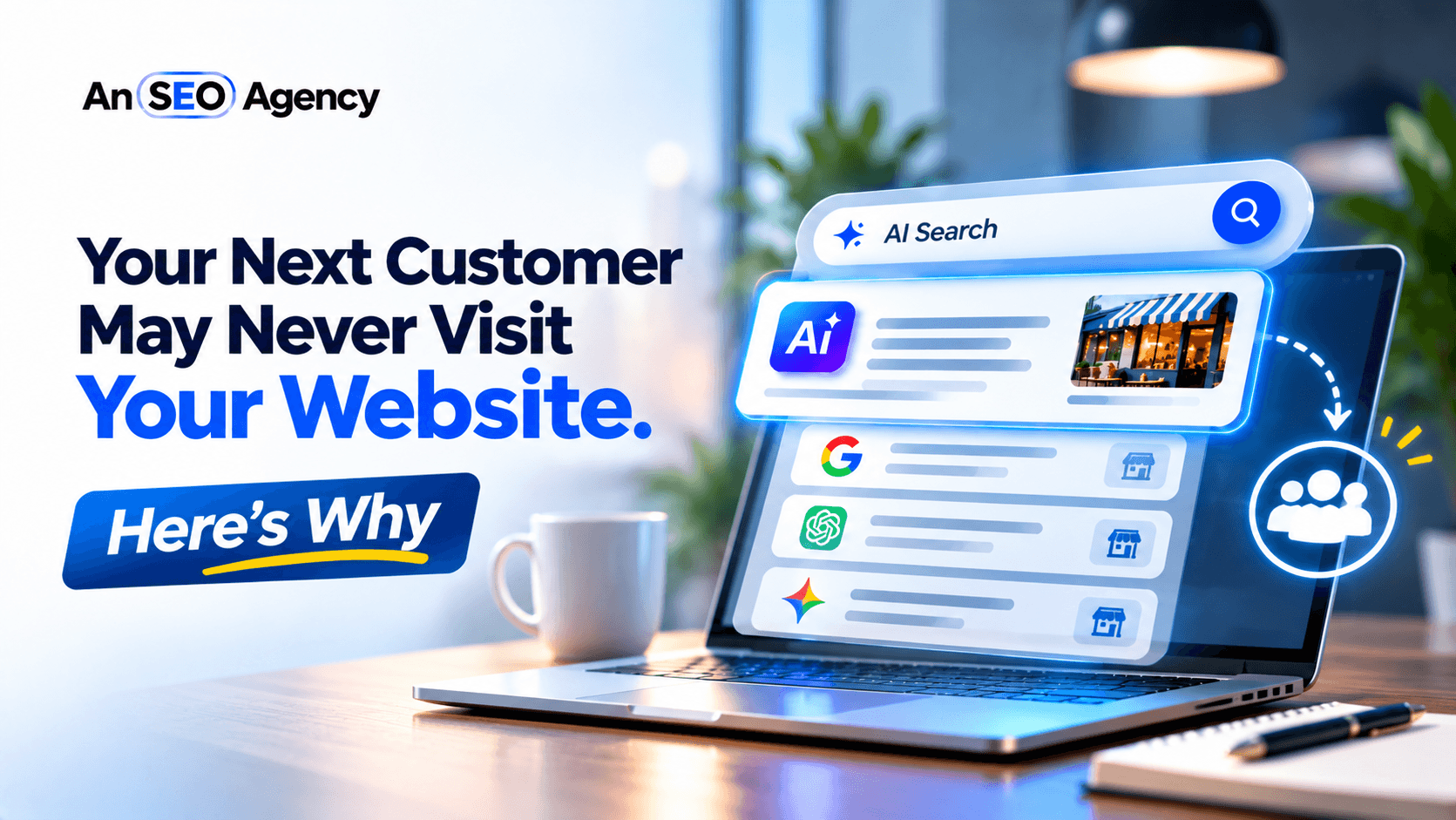
Google AI Overviews, ChatGPT, Google Maps, social platforms and emerging AI shopping experiences are giving customers more ways to discover and evaluate businesses without following the traditional website-first journey.
And this is not just speculation.
Recent research shows that a substantial proportion of Google searches already end without a click.
What Does It Mean When Customers Don’t Visit Your Website?
Traditionally, businesses have considered website traffic an important indicator of digital marketing success.
The process was relatively straightforward.
A customer searched for a product or service, found a business in Google search results, visited its website and decided whether to make an inquiry or purchase.
However, customers can now access useful information and take certain actions directly through other platforms.
For example, someone searching for a nearby restaurant may see its address, opening hours, customer reviews and phone number in Google Maps.
They may call the restaurant or request directions without visiting its website.
Similarly, someone researching software may use an AI assistant to compare several products before contacting a preferred provider through another channel.
These interactions illustrate a concept known as zero-click discovery.
What Is a Zero-Click Search?
A zero-click search occurs when a search session does not produce a click on a search result.
The user may find an answer directly on the search page, perform another search or leave the search platform without opening a result.
Zero-click searches are not always successful customer journeys.
Sometimes, users obtain the information they need. Other times, they abandon their search or change their query.
This distinction matters because a search ending without a click does not automatically mean a business gained a customer.
What Is Zero-Click Marketing?
Zero-click marketing is a strategy focused on creating brand awareness, delivering useful information and influencing customer decisions directly on the platforms where audiences discover content.
Instead of expecting every interaction to generate a website visit, businesses provide value within search results, social media, business listings and AI-powered experiences.
The objective is to become recognizable, credible and relevant even when the audience does not immediately visit the company’s website.
For example, an informative LinkedIn post might influence a potential customer who later contacts the company directly.
The post may create commercial value despite generating little referral traffic.
The Latest Zero-Click Search Statistics: What the Data Reveals
The shift toward zero-click behavior is supported by research.
However, the figures need to be interpreted carefully.
68% of U.S. Google Searches Ended Without a Click in a 2026 Study
In June 2026, SparkToro published research using Similarweb clickstream data covering U.S. Google searches from January through April 2026.
The study estimated that 68.01% of the measured searches ended without a click.
According to SparkToro’s 2026 zero-click search research, fewer than one-third of the searches in its analysis generated a click to another result or destination.
This illustrates how frequently people now complete or discontinue search interactions without visiting another page.
However, the study used a modeled combination of desktop and mobile browser panel data and excluded Google’s mobile search application.
Its findings should not be interpreted as a universal measurement of every Google search worldwide.
Nor do they mean that 68% of potential customers will never visit a business website.
Google AI Summaries Are Associated With Fewer Website Clicks
A separate Pew Research Center investigation published in July 2025 examined Google search behavior among 900 U.S. adults.
The researchers found that:
- Users clicked a traditional search result in 8% of visits where an AI summary appeared.
- Users clicked a traditional result in 15% of visits without an AI summary.
- Users clicked a link directly within the AI summary in just 1% of visits containing one.
The results suggest that people encountering AI-generated summaries may be less likely to continue to external websites.
However, this was an observational study. It does not establish that AI summaries alone caused the entire difference in clicking behavior.
Why These Findings Matter
For business owners, these statistics highlight a significant challenge.
A company may maintain strong Google rankings while receiving fewer visits for certain informational queries.
Meanwhile, customers may still encounter its brand through search features, AI-generated answers or business listings.
Therefore, website sessions and organic search visibility should not be treated as interchangeable metrics.
Businesses need to understand how different discovery experiences contribute to meaningful customer actions.
Seven Ways Customers Can Find You Without Visiting Your Website
The traditional website journey is being supplemented by several other discovery channels.
Understanding these experiences can help businesses identify where their customers are spending time.
1. Google AI Overviews Can Answer Questions Directly
Google AI Overviews generate summaries for selected search queries.
Instead of requiring users to open multiple pages, the feature can present information directly within Google Search.
For example, someone might search:
“What should I look for when hiring an SEO agency?”
An AI-generated overview may explain important considerations such as experience, reporting practices, technical expertise and pricing transparency.
The user could gather much of the initial information without visiting individual agency websites.
However, Google AI Overviews can also display supporting links, creating opportunities for users to explore relevant sources.
Google’s official guidance on AI features in Search explains that these experiences can help people explore complex questions while discovering relevant websites.
The commercial implication is important.
A business may influence a customer’s research journey through useful content even if the customer does not immediately click its search result.
2. ChatGPT Can Help Customers Compare Businesses
ChatGPT allows users to describe detailed requirements and refine their research through conversation.
For example, a customer might ask:
“Find a web development company that specializes in Shopify, supports international businesses and offers ongoing maintenance.”
The assistant may organize available information and suggest relevant providers.
The customer can then ask follow-up questions about capabilities, pricing considerations and business suitability.
This reduces some of the research effort previously associated with opening multiple websites.
However, ChatGPT recommendations are not guaranteed to be accurate or complete.
Businesses should not assume that appearing in an AI response automatically creates a qualified customer.
For a broader explanation of how these platforms are changing discovery, read our article on ChatGPT vs Google and the future of search in 2027.
3. Google Maps Can Generate Customer Actions Directly
Google Maps and Google Business Profile already allow customers to interact with businesses without first opening their websites.
A customer searching for an electrician may see nearby providers, operating hours, ratings and contact information.
They can request directions or click the call button directly from the business listing.
According to Google’s Business Profile performance documentation, businesses can measure interactions such as calls, direction requests and website clicks.
This is especially relevant for local service providers.
For example, a plumbing company may receive phone inquiries from customers who found its Google Business Profile but never explored its website.
However, a call-button click does not necessarily mean a completed phone conversation or a qualified lead.
Businesses should verify actual customer outcomes wherever possible.
4. Social Media Can Influence Purchase Decisions Without Referral Traffic
Social platforms have become important environments for product discovery, education and brand awareness.
A person might discover a digital marketing company through a LinkedIn post explaining a common advertising mistake.
They may follow the company, read additional posts and eventually contact it through the platform.
No website visit is required for those interactions.
Similarly, consumers can discover products through Instagram Reels, YouTube Shorts or creator recommendations.
The content itself may answer questions and help customers evaluate a brand.
This means social media success should not be measured exclusively by how many users click external links.
Engagement quality, relevant inquiries and subsequent customer actions can also matter.
5. AI Shopping Experiences Can Shorten the Purchasing Journey
Online shopping is becoming more conversational.
Instead of browsing several stores, customers can describe their product requirements to AI assistants.
For example:
“Find a lightweight laptop under $1,000 with good battery life for remote work.”
The assistant may compare available products and present relevant merchant information.
In March 2026, OpenAI expanded ChatGPT’s shopping capabilities to support richer product discovery and comparisons.
Its official product discovery announcement described connections between AI shopping experiences and merchant product information.
Some eligible commerce integrations also support purchasing within AI-assisted experiences.
However, checkout availability depends on the platform and merchant.
For ecommerce businesses, this creates another reason to maintain accurate product feeds, descriptions and inventory information.
Our ecommerce SEO services address the technical and content foundations that help customers discover products through conventional search.
6. Online Marketplaces Keep Customers Within Their Own Platforms
Not every customer needs to visit a brand’s independent website to complete a purchase.
Marketplaces allow shoppers to research products, compare sellers and place orders within the marketplace environment.
A consumer may recognize a brand from an advertisement, search for it on a marketplace and complete the purchase there.
The brand gains a sale without receiving a visit to its own website.
This behavior existed before generative AI.
However, it demonstrates why a business’s total customer activity has never been fully represented by website traffic alone.
Retailers should evaluate marketplace performance alongside direct ecommerce sales while considering fees, profitability and customer relationship limitations.
7. Brand Recognition Can Lead to Direct Contact Later
Not every marketing interaction produces an immediate measurable response.
Someone might see a company’s name in an AI-generated answer, hear it mentioned in a video or encounter it repeatedly on social media.
Several days later, they may search for the company directly or contact it through another channel.
The original discovery source may not be visible in standard website analytics.
This does not mean marketers should automatically attribute those customers to AI or social media.
Instead, it highlights why attribution requires more than examining the last recorded website visit.
Why Traditional Website Traffic Is Losing Some of Its Importance
Website traffic remains valuable, but the relationship between traffic and business performance is changing.
Visibility Does Not Always Produce a Click
A brand can appear in a search result, business listing or AI-generated recommendation without receiving a website visit.
That exposure may create awareness, but its actual value depends on how customers respond.
Businesses therefore need to distinguish visibility from engagement and commercial outcomes.
Customers Can Complete Certain Actions Elsewhere
A local customer may call directly from Google Maps.
A potential client may send an inquiry through LinkedIn.
An ecommerce customer may purchase through a marketplace or supported AI commerce integration.
In these scenarios, the customer action takes place outside the company’s website.
Informational Content Faces More Competition From Direct Answers
Simple informational questions can often be answered within search interfaces.
For example, a customer asking what a marketing term means may receive a sufficiently useful explanation without opening an article.
This can reduce opportunities to attract visitors through basic informational content.
However, more detailed resources, original research and practical tools can still give users reasons to visit.
Fewer Visitors Do Not Automatically Mean Fewer Customers
A website can receive fewer visits while maintaining or improving conversions if its remaining visitors are more commercially relevant.
However, this is not guaranteed.
A decline in traffic may also signal genuine lost demand, weaker search visibility or technical problems.
Businesses need to investigate the causes rather than assume all traffic declines are harmless.
Traditional Customer Journey vs Zero-Click Customer Journey
The customer journey is becoming less predictable.
| Stage | Traditional Website-First Journey | Zero-Click or AI-Assisted Journey |
| Discovery | Customer searches Google and visits a result | Customer encounters a brand in AI search, Maps or social media |
| Research | Customer reads multiple websites | Customer reviews summaries, listings and platform content |
| Comparison | Customer opens competitor websites | Customer compares options within a search or AI interface |
| Trust evaluation | Website testimonials and case studies | Reviews, independent mentions and platform recommendations |
| Contact | Website contact form | Direct call, platform message or later branded contact |
| Purchase | Merchant website checkout | Website, marketplace or eligible integrated checkout |
| Measurement | Website sessions and recorded conversions | Multiple platform interactions and partially observable customer journeys |
The second journey does not make the first obsolete.
Many customers will continue visiting websites before making important decisions.
However, businesses should prepare for a wider variety of customer touchpoints.
Which Businesses Are Most Affected by Zero-Click Marketing?
The impact varies depending on industry, customer behavior and the type of information people seek.
Local Service Businesses
Restaurants, dentists, plumbers, electricians and other local providers may receive inquiries directly through search and map listings.
Accurate business information, genuine reviews and relevant local visibility are important.
Our guide on improving local leads and Google Maps visibility explores how businesses can strengthen these discovery opportunities.
Ecommerce Retailers
Online stores may gain product visibility through marketplaces, AI shopping experiences and merchant listings.
However, catalog quality and checkout reliability remain essential.
Retailers should measure revenue across channels instead of focusing exclusively on traffic to their independent websites.
B2B Service Providers
B2B customers often conduct extensive research before contacting potential vendors.
They may use AI assistants to understand service categories, compare approaches and identify relevant companies.
A strong reputation, useful industry content and clear service positioning can support this research.
Nevertheless, high-value B2B decisions often still require detailed proposals, meetings and direct evaluation.
Publishers and Informational Websites
Websites that depend on traffic from straightforward informational queries may face greater exposure to direct-answer search features.
These publishers may need to invest more heavily in original reporting, analysis, audience relationships and other ways to differentiate their content.
The precise impact will vary by topic and audience.
Is Zero-Click Marketing Good or Bad for Businesses?
Zero-click marketing creates both opportunities and limitations.
| Potential Advantage | Potential Challenge |
| Customers can discover brands across more channels | Website referral traffic may decline for some queries |
| Businesses may receive direct calls and platform inquiries | Attribution becomes more difficult |
| Useful content can create awareness without clicks | Platforms control how information is presented |
| AI and search tools can simplify product research | AI responses may contain incorrect information |
| Local listings can support immediate customer actions | Businesses may become dependent on third-party platforms |
| Brands can reach audiences earlier in the buying journey | Visibility does not guarantee revenue |
The correct response is not to abandon website optimization or chase every new platform.
Businesses should evaluate which channels their customers actually use and how those channels contribute to meaningful results.
10 Ways to Attract Customers Without Relying Only on Website Visits
A strong zero-click marketing strategy combines established SEO practices with broader brand discovery activities.
1. Build a Recognizable Brand
Brand recognition becomes valuable when customers encounter multiple options inside a search or AI interface.
A familiar company may receive more consideration than an unknown one, although familiarity alone does not establish quality.
Businesses should communicate their services, positioning and identity consistently.
A digital marketing agency, for example, should clearly explain which industries it serves and what services it provides.
The goal is to make the business easier for customers to recognize and evaluate across different platforms.
2. Strengthen Your SEO Foundation
Zero-click behavior does not mean SEO is dead.
Search engines still need to discover, understand and present relevant website information.
Google’s guidance on optimizing for generative AI search emphasizes that established SEO fundamentals remain relevant.
Businesses should continue reviewing crawlability, indexing, internal links, content quality and website usability.
For a deeper discussion, explore our article Is SEO Dead in 2027? The Truth Nobody Wants to Talk About.
The objective is to improve visibility and website usefulness rather than optimize exclusively for traffic volume.
3. Answer Customer Questions Clearly
Businesses should create content that addresses real customer concerns.
For example, an accountant might publish an explanation of the factors that influence bookkeeping service costs.
A website development company could explain how businesses should evaluate Shopify and WordPress.
Start with a concise, accurate answer, then provide context, examples and relevant considerations.
This structure helps human readers and makes important information easier to locate.
However, providing concise answers does not guarantee placement in AI responses or featured snippets.
4. Improve Google Business Profile Information
For eligible local businesses, Google Business Profile provides an important opportunity to reach customers directly.
Keep operating hours, locations, phone numbers and service details accurate.
Add relevant photographs and maintain genuine customer reviews.
Check the profile’s performance data to understand how people interact with your business.
Remember that profile views, direction requests and call clicks are different from completed sales.
5. Publish Content That Works Without a Website Click
Not every useful piece of content needs to direct the audience to a website.
Businesses can publish informative LinkedIn posts, short educational videos, practical comparisons and relevant social media content.
For example, a marketing agency could explain three reasons a landing page receives clicks but fails to generate inquiries.
The post provides value directly to the reader.
It may also motivate the right audience to investigate the company’s services later.
A strong content marketing strategy can help connect platform-native educational content with broader business objectives.
6. Publish Original Research and Practical Insights
Generic content is easier for AI systems to summarize.
Original information can provide stronger reasons for people to recognize, reference or visit a business.
Examples include documented experiments, original industry surveys, expert interviews and real customer-approved case studies.
For instance, an ecommerce agency could analyze common technical problems across a defined sample of websites and publish its methodology.
The analysis would provide information beyond generic ecommerce advice.
Avoid publishing fabricated experiments or unsupported performance statistics merely to attract attention.
7. Strengthen Accurate Third-Party Brand Mentions
Customers may encounter company information through review sites, directories, industry publications and online communities.
Relevant independent mentions can help establish credibility.
Businesses should correct inaccurate listings and maintain consistent official details.
However, artificial mentions, fake reviews and paid recommendations presented as independent opinions can undermine trust.
Brand development should prioritize genuine recognition and factual accuracy.
8. Make Product and Service Details Easy to Understand
AI-powered discovery systems and human customers benefit from accurate information.
Service businesses should clearly describe their offerings, locations and important limitations.
Ecommerce retailers should maintain complete product specifications, pricing and availability.
Appropriate structured data can also help supported search engines interpret website information.
Our structured data optimisation services address this aspect of website organization.
However, structured data is not a universal shortcut to appearing in AI recommendations.
9. Strengthen Direct Customer Relationships
Third-party platforms can change their algorithms, interfaces and policies.
Businesses should therefore maintain appropriate direct customer relationships.
Email subscriptions, customer accounts, loyalty programs and direct communication channels can help companies remain connected with existing customers.
These relationships should be developed through transparent consent and useful communication.
A business that depends exclusively on one search or social platform may face greater exposure to changes in distribution.
10. Focus on Customer Outcomes, Not Just Visibility
The most important goal is not to appear everywhere.
It is to reach relevant customers and provide them with a useful experience.
Businesses should connect marketing activities with qualified inquiries, bookings, purchases and revenue.
This requires accurate tracking and an understanding of how different acquisition channels contribute to business outcomes.
Professional SEO services should support these objectives rather than treating keyword rankings and page views as the only measures of success.
How to Measure Marketing Success Beyond Website Traffic
Traditional website analytics provide valuable information, but they cannot capture every off-site customer interaction.
Businesses should use multiple sources of evidence.
1. Organic Search Performance
Google Search Console can help identify search impressions, clicks and trends associated with website visibility.
It can also show how different pages perform in traditional search.
Importantly, in August 2026, Google completed the global rollout of additional generative AI performance insights.
According to Google’s Generative AI performance report documentation, eligible websites can review impressions associated with AI Overviews and AI Mode.
These dedicated reports provide visibility information but should not be treated as complete AI referral or conversion attribution.
4. Google Business Profile Interactions
For local businesses, useful indicators include call-button clicks, direction requests and website clicks from business listings.
These metrics can help identify engagement that does not begin on a website.
However, they must be interpreted correctly.
A direction request is not a confirmed store visit, and a call-button click is not a completed booking.
3. Qualified Leads and Sales
Businesses should track actual inquiries, appointments and sales wherever possible.
For example, a professional services firm might measure consultation requests that meet its qualification criteria.
An ecommerce retailer might track completed orders by channel.
Google Analytics 4 supports important on-site actions through key events, such as form submissions or completed purchases.
However, GA4 cannot automatically measure every action taken entirely outside the website.
4. AI Referral Traffic
Some visits from AI platforms may be identifiable through referral information.
Businesses can examine traffic acquisition reports to understand whether relevant AI services generate website sessions.
However, a brand may be mentioned in an AI response without receiving a click.
Likewise, customers may return later through another channel.
Therefore, referral data provides only part of the picture.
5. Customer-Reported Discovery Sources
One practical method is to ask new customers how they discovered the business.
This can be included in a consultation form or discussed during sales qualification.
Responses may mention Google, ChatGPT, LinkedIn, referrals or other channels.
However, self-reported attribution has limitations because customers may not remember every touchpoint.
It should complement analytics rather than replace verified performance data.
A Better Marketing Measurement Framework
| Metric | What It Measures | Important Limitation |
| Organic impressions | Visibility in Google Search | An impression does not mean a click or sale |
| Generative AI impressions | Appearance in eligible Google AI search features | Does not establish customer conversions |
| Website sessions | Recorded visits to the website | Excludes many off-site interactions |
| Business Profile calls | Clicks on the profile’s call button | Does not confirm a connected call |
| Direction requests | Navigation requests from a business listing | Does not confirm an actual visit |
| Qualified leads | Inquiries meeting defined criteria | Requires reliable lead qualification |
| AI referrals | Identifiable visits from AI services | Misses AI exposure without a click |
| Customer acquisition cost | Marketing cost relative to acquired customers | Attribution and cost allocation may be incomplete |
| Revenue | Completed commercial transactions | Requires appropriate financial and channel reporting |
The strongest reporting approach combines visibility, customer actions and commercial results without treating them as the same thing.
Practical Example: A Local Business Growing Without More Website Traffic
Consider a hypothetical home services company called MetroFix Plumbing.
The company provides emergency plumbing repairs and scheduled maintenance.
Its website attracts organic traffic, but many customers are also finding the business through Google Maps and local search results.
The Traditional Marketing Approach
MetroFix initially evaluates performance mainly through website sessions and contact form submissions.
When website traffic declines, the owner assumes that fewer customers are discovering the business.
However, this conclusion may be incomplete.
The New Customer Journey
Imagine someone searches Google for:
“Emergency plumber available near me.”
The customer sees MetroFix’s business listing, checks its opening hours and reviews, then clicks the call button.
After speaking with the company, the customer books an appointment.
No website visit is required for that journey.
What the Business Should Improve
MetroFix reviews the accuracy of its business listings and service information.
It ensures its location and operating hours are correct.
The business also strengthens website content about emergency services, maintains legitimate customer reviews and evaluates the quality of incoming inquiries.
How Performance Should Be Measured
Instead of relying exclusively on website sessions, the company tracks several indicators.
| Metric | Hypothetical Earlier Period | Hypothetical Later Period |
| Website visits | 5,000 | 4,200 |
| Verified website inquiries | 65 | 70 |
| Google Business Profile call clicks | 90 | 125 |
| Confirmed total new customers | 45 | 52 |
All figures are illustrative and do not represent an actual client campaign.
The example demonstrates a situation where website traffic declines while confirmed customer acquisition improves.
However, the increase in Business Profile call clicks does not prove that those interactions produced the additional customers.
To establish that relationship, MetroFix would need appropriate call records, customer-source information and sales tracking.
The central lesson is that website traffic is only one component of customer acquisition.
Does Your Business Still Need a Website?
Yes. Most businesses still benefit substantially from having an accurate, accessible and trustworthy website.
Zero-click marketing does not remove the need for a business-owned digital presence.
Your Website Remains an Important Source of Official Information
A website allows businesses to explain their services, publish policies, showcase relevant work and provide current contact details.
Other platforms may summarize this information, but they do not replace the value of maintaining an authoritative company-controlled source.
High-Value Customers Often Need More Information
Someone purchasing an inexpensive product may make a quick decision.
However, a company hiring a marketing agency or a manufacturer evaluating an industrial service provider may require detailed information.
These customers may need to inspect portfolios, understand processes and request proposals.
A complete website can support this evaluation.
Your Website Helps Connect Marketing Channels
Search engines, AI assistants, directories and social platforms can all direct interested customers toward a company’s website.
The website can then support contact forms, product purchases and other conversions.
It also provides an environment where the business has greater control over its content and customer experience.
Rand Fishkin discussed this issue in his August 2026 article, Does Your Website Still Matter in the Zero-Click Era?.
His argument emphasizes the importance of maintaining a central online presence even when platforms send fewer visitors.
The practical conclusion is that websites remain valuable, but their effectiveness should not be judged by traffic alone.
Common Zero-Click Marketing Mistakes
Businesses adapting to new discovery behavior should avoid several common mistakes.
Mistake 1: Abandoning SEO Completely
Search engine optimization remains relevant because websites still need to be discoverable and useful.
AI-powered search also depends on accessible sources and reliable information.
Businesses should adjust their objectives rather than abandon established SEO fundamentals.
Mistake 2: Chasing AI Mentions Without Checking Accuracy
Appearing in an AI response is not always beneficial if the information is inaccurate.
Businesses should periodically check important factual statements about their services, locations and products.
An incorrect recommendation can create confusion rather than qualified demand.
Mistake 3: Assuming Every Brand Mention Produces Revenue
Brand exposure can support awareness, but it does not automatically generate customers.
Businesses should avoid assigning unsupported revenue values to AI mentions or social media impressions.
Mistake 4: Ignoring Website Conversion Problems
A business may improve discovery across several channels while still losing potential customers through confusing service pages or broken contact forms.
The website experience remains important for customers who choose to visit.
Mistake 5: Using Only One Marketing Channel
Relying entirely on Google, social media or a particular AI platform creates unnecessary dependency.
Businesses should diversify according to customer behavior, available resources and commercial objectives.
A 90-Day Zero-Click Marketing Strategy for Businesses
A practical strategy does not need to begin with expensive software or a complete marketing overhaul.
Businesses can use a structured approach to identify opportunities and improve measurement.
Days 1–30: Understand Where Customers Discover Your Business
Review existing search visibility, website traffic and customer acquisition sources.
Examine Google Business Profile performance where relevant.
Identify which social platforms, directories and search experiences your customers use.
Test important business-related questions across relevant AI platforms.
The objective is to establish a credible baseline.
Days 31–60: Strengthen Visibility and Content
Correct inaccurate business information.
Improve important service pages and product descriptions.
Publish useful educational content on platforms where your audience is active.
Review technical SEO and appropriate structured data.
Identify opportunities to earn legitimate third-party recognition.
Avoid creating duplicate or generic content solely to target AI prompts.
Days 61–90: Improve Reporting and Customer Conversion
Review measurable customer actions across relevant channels.
Verify that important website events and inquiry forms are tracked correctly.
Introduce customer-source questions where appropriate.
Compare qualified leads and revenue against the initial baseline.
Then identify which activities justify further investment.
Ninety days is enough to establish a stronger measurement process and implement prioritized improvements.
However, it does not guarantee higher rankings, AI recommendations or revenue growth.
What Industry Experts Say About the Zero-Click Future
Rand Fishkin, co-founder of SparkToro, has been researching zero-click behavior for several years.
In his June 2026 research, he made an important observation:
“Traffic can fall precipitously even as revenue rises.”
This statement, from SparkToro’s 2026 zero-click research, captures the distinction between traffic and commercial performance.
However, it should not be interpreted as a prediction that declining traffic will improve revenue.
Instead, it illustrates why businesses need to evaluate different metrics independently.
Meanwhile, Google Search Central continues to emphasize the value of accessible, useful website content.
In May 2026, John Mueller introduced Google’s updated generative AI optimization guidance, highlighting the continued importance of SEO fundamentals and distinctive content.
These perspectives point toward a balanced approach.
Businesses need discoverability across different platforms, but they also need an accurate website and reliable ways to measure commercial outcomes.
Predictions: How Customer Discovery May Change in 2027
Based on developments through November 2026, several trends deserve attention.
1. More Customer Research May Happen Inside AI Interfaces
Conversational search experiences could become more common for complex product and service comparisons.
This may reduce some early-stage website visits while creating additional brand discovery opportunities.
2. Local Business Actions May Remain Important
Customers will continue needing phone numbers, directions, reviews and operating hours.
Consequently, accurate local business profiles should remain valuable for relevant industries.
3. Brand Recognition Could Become More Influential
When customers encounter a shortlist of businesses within an AI-generated answer, familiarity and credible supporting information may influence further research.
However, brand recognition does not guarantee recommendations.
4. Website Traffic May Become a Less Complete Performance Indicator
Businesses may need to consider off-site inquiries, platform interactions and customer-reported discovery alongside website analytics.
The most appropriate metrics will depend on each business model.
5. Original Content May Become More Valuable
As AI systems make generic explanations easier to access, practical expertise and firsthand information can provide stronger differentiation.
Businesses that publish useful original material may give customers additional reasons to recognize or visit their websites.
6. Multi-Platform Marketing Strategies May Become More Important
Customers may use Google, ChatGPT, social media, marketplaces and brand websites during the same buying journey.
Businesses should focus on reaching relevant audiences rather than assuming every customer begins with a traditional search.
These are forward-looking assessments, not confirmed outcomes for 2027.
Frequently Asked Questions
What Is a Zero-Click Search?
A zero-click search is a search session that does not produce a click on a search result. The user may find an answer directly, change their query or leave the platform. Zero-click searches are common in modern search experiences, but they do not necessarily represent successful customer interactions.
Why Are Customers Visiting Websites Less Often?
Some customers can access information through Google AI Overviews, Maps, AI assistants and other platforms without opening a business website. Research has found high levels of zero-click search activity. However, behavior varies by industry and query type, and many customers still visit websites before making important decisions.
Will AI Replace Business Websites in 2027?
AI is unlikely to eliminate the need for business websites by 2027. Websites remain important for official information, detailed service explanations, purchasing, customer support and brand experience. AI may change how customers discover businesses and how frequently they visit websites during early research.
Can a Business Get Customers Without Website Traffic?
Yes. Businesses can receive inquiries through phone calls, business listings, marketplaces, social platforms and direct referrals. Some customers may also discover a company through AI search and contact it later through another channel. However, each channel's commercial contribution should be measured carefully.
Does Zero-Click Marketing Mean SEO Is Dead?
No. SEO remains important for website accessibility, search visibility and useful content. Zero-click marketing expands the focus beyond website traffic to include brand awareness and customer actions across other platforms. Businesses should combine SEO fundamentals with relevant off-site discovery strategies.
How Can Businesses Appear in AI Search Results?
Businesses can improve their discoverability by maintaining accurate website information, publishing useful content and ensuring important pages are technically accessible. Relevant third-party recognition and supported product data integrations may also help. However, no optimization technique guarantees inclusion or a particular ranking in AI-generated answers.
How Do You Measure Zero-Click Marketing Success?
Businesses can examine search impressions, Google Business Profile interactions, customer inquiries, AI referrals, brand search trends and confirmed sales. These indicators measure different aspects of performance. A brand mention or call-button click should not automatically be counted as a completed customer acquisition.
Is Zero-Click Marketing Good for Small Businesses?
Zero-click discovery can create opportunities for small businesses, particularly through local search listings and useful platform-native content. However, results depend on industry, audience and competition. Small businesses should focus on accurate information, customer trust and measurable inquiries rather than pursuing every new platform.
Will Google AI Overviews Reduce Organic Traffic?
AI Overviews can be associated with lower click rates for certain searches. Pew Research Center found that users clicked traditional results less frequently when AI summaries appeared in its 2025 observational study. However, the effect varies by query and website, so businesses should review their own performance before drawing conclusions.
Should Businesses Stop Investing in Website Development?
No. An effective website remains a valuable business asset. Companies should continue maintaining accessible, accurate and user-friendly websites while expanding relevant discovery channels. Website development investments should support customer needs, conversion performance and long-term business objectives.