
Why Long-Tail Keywords Are a Smarter Way to Rank Higher in Search
- What Are Long-Tail Keywords?
- Why Long-Tail Keywords Matter for SEO
- Long-Tail Keywords vs Short-Tail Keywords
- Why Long-Tail Keywords Convert Better
- How Long-Tail Keywords Support AI Search
- Types of Long-Tail Keywords
- How to Find Long-Tail Keywords
- How to Use Long-Tail Keywords in Content
- Long-Tail Keywords and Content Clusters
- How Long-Tail Keywords Help Local Businesses
- Common Mistakes to Avoid
- Expert Quote
- FAQs
- What Are Long-Tail Keywords?
- Why Long-Tail Keywords Matter for SEO
- Long-Tail Keywords vs Short-Tail Keywords
- Why Long-Tail Keywords Convert Better
- How Long-Tail Keywords Support AI Search
- Types of Long-Tail Keywords
- How to Find Long-Tail Keywords
- How to Use Long-Tail Keywords in Content
- Long-Tail Keywords and Content Clusters
- How Long-Tail Keywords Help Local Businesses
- Common Mistakes to Avoid
- Expert Quote
- FAQs
What Are Long-Tail Keywords?
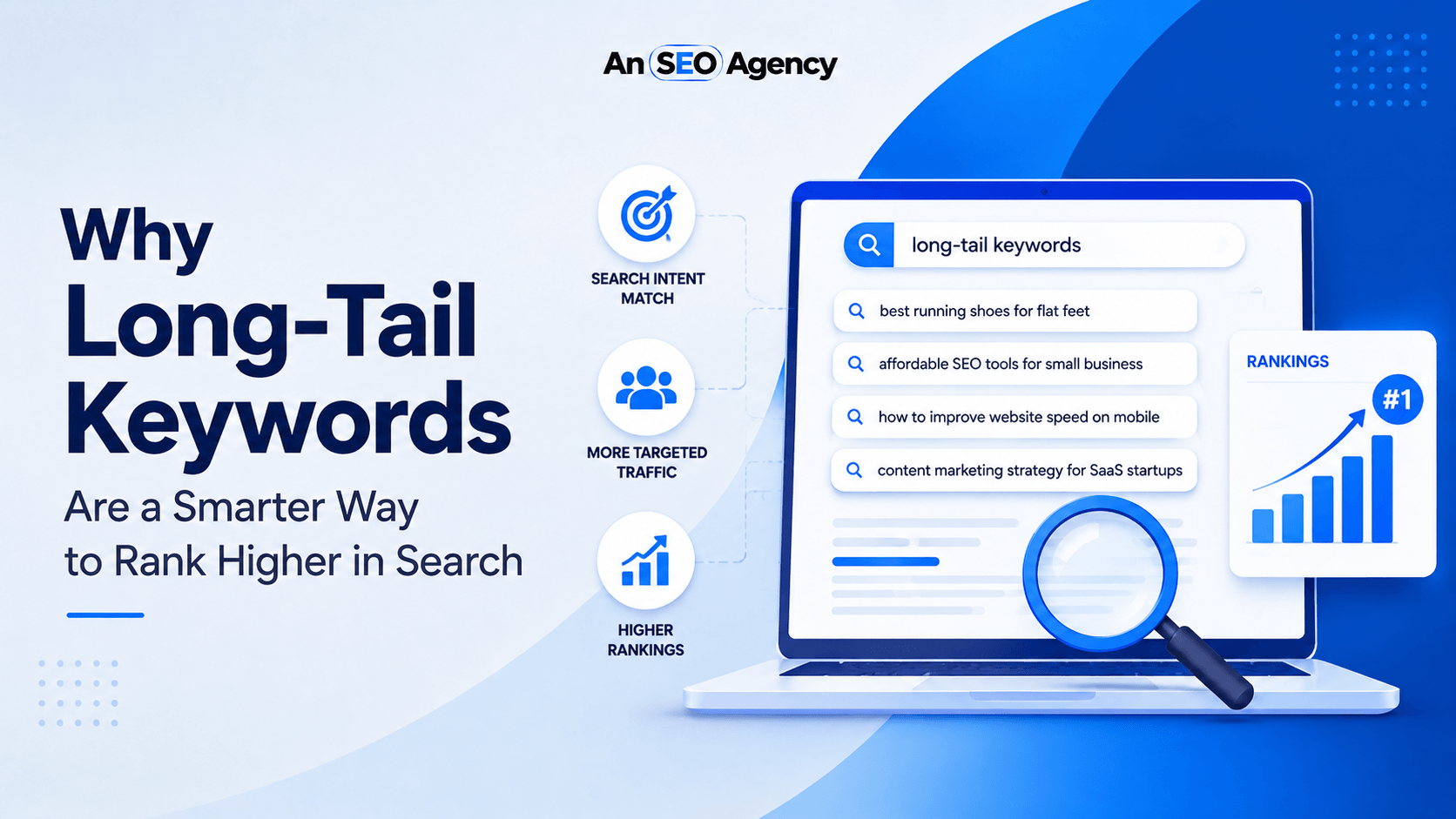
Long-tail keywords are specific search phrases that usually contain more detail than broad keywords. They may have lower search volume, but they often show clearer user intent.
For example:
| Short-Tail Keyword | Long-Tail Keyword |
| SEO | SEO services for small businesses |
| Shoes | Best running shoes for flat feet |
| Dentist | Emergency dentist near me open Sunday |
| WordPress security | WordPress plugin file change alert tool |
A person searching for “SEO” may only be researching. A person searching for “SEO services for small businesses” is much closer to choosing a service provider.
That is why long-tail keywords are valuable. They help businesses attract users who know what they want and are more likely to take action.
For businesses that want to grow organic visibility, long-tail keywords should be part of a complete SEO services strategy.
Why Long-Tail Keywords Matter for SEO
Long-tail keywords matter because they match how real people search. Users no longer type only one or two words. They ask detailed questions, compare options and search with specific needs.
Google’s SEO Starter Guide explains that website owners should create helpful content for users and make it easy for search engines to crawl, index and understand that content. Long-tail keyword content supports this because it answers more specific user needs. (Google for Developers)
For example, a broad keyword like “digital marketing” is very competitive. A more specific phrase like “digital marketing strategy for local service businesses” has clearer intent and may be easier to rank for.
Long-tail keywords help with:
- Lower competition
- Clearer search intent
- Better content targeting
- Higher quality traffic
- Stronger conversion opportunities
- Better support for voice and AI search
- More chances to answer customer questions
This is especially useful for small businesses that cannot compete immediately for highly competitive keywords.
Long-Tail Keywords vs Short-Tail Keywords
Short-tail keywords are broad. Long-tail keywords are specific.
| Factor | Short-Tail Keywords | Long-Tail Keywords |
| Length | Usually 1–2 words | Usually 3+ words or detailed phrases |
| Search volume | Higher | Lower |
| Competition | Higher | Lower |
| Intent | Broad or unclear | Specific and clearer |
| Conversion chance | Lower | Higher |
| Best use | Brand awareness | Leads, sales and targeted traffic |
For example, “SEO agency” is a short-tail keyword. It is broad and competitive. “SEO agency for WordPress websites” is a long-tail keyword because it has a clearer need.
A strong SEO strategy should use both. Short-tail keywords help with broad visibility, while long-tail keywords help attract users with specific intent.
Why Long-Tail Keywords Convert Better
Long-tail keywords often convert better because they show exactly what the user wants.
A person searching “website” may be looking for many things. They may want website examples, website builders or website design ideas.
A person searching “affordable web development services for small business” has a more specific requirement. They are closer to hiring someone.
That is why long-tail keywords are important for lead generation. They help bring users who already understand their problem and are looking for a solution.
For example, AN SEO Agency can target long-tail keywords like:
- SEO services for small businesses
- technical SEO services for WordPress websites
- structured data optimisation for service businesses
- how to improve visibility in ChatGPT and Gemini
- AEO and SEO strategy for business growth
These phrases connect directly with user intent and can guide visitors to relevant pages such as technical SEO services, structured data optimisation and AEO and SEO strategies.
How Long-Tail Keywords Support AI Search
AI search is making long-tail keywords even more important.
People now ask tools like ChatGPT, Gemini, Copilot and Google AI Overviews full questions instead of short keyword phrases. Google’s AI search guidance says foundational SEO best practices still matter for generative AI features and that technical clarity helps content become ready for discovery and indexing. (Google for Developers)
This means businesses should create content that answers detailed questions clearly.
For example, instead of targeting only “AI SEO,” a business can create content around:
- How can my website appear in ChatGPT?
- How do I rank in Gemini search?
- What is the difference between SEO and AEO?
- How does structured data help AI search visibility?
- What are the best SEO strategies for AI search?
These long-tail questions are useful for both users and AI systems.
Google also explains that SEO best practices remain relevant for AI features such as AI Overviews and AI Mode. Pages generally need to be indexed and eligible to appear in Google Search with a snippet to be eligible for these AI experiences. (Google for Developers)
So, long-tail content should not be written only for AI tools. It should still follow proper SEO, indexing and quality guidelines.
Types of Long-Tail Keywords
Not all long-tail keywords are the same. Some deserve their own pages, while others should be used inside a broader page.
1. Informational Long-Tail Keywords
These keywords are used when users want to learn.
Examples:
- What are long-tail keywords?
- How does SEO keyword research work?
- Why is technical SEO important?
- How does AEO help AI search?
These are good for blog posts, guides and FAQs.
2. Commercial Long-Tail Keywords
These keywords show that the user is comparing options before making a decision.
Examples:
- Best SEO agency for small businesses
- SEO vs paid ads for lead generation
- Best technical SEO services for WordPress
- Local SEO agency for service businesses
These are good for comparison blogs, service pages and landing pages.
3. Transactional Long-Tail Keywords
These keywords show that the user is ready to take action.
Examples:
- Hire SEO agency for small business
- Book technical SEO audit
- Get structured data optimisation service
- Contact SEO agency for website ranking
These should connect to strong service pages and conversion-focused CTAs.
4. Local Long-Tail Keywords
These keywords include location or service-area intent.
Examples:
- SEO agency near me
- local SEO services for small businesses
- digital marketing agency for local businesses
- website SEO audit for local companies
These are useful for local SEO pages and Google Business Profile optimization.
How to Find Long-Tail Keywords
Long-tail keyword research should not depend on only one tool. A good strategy uses search data, customer questions and real user behavior.
1. Use Google Search Suggestions
Start typing your main keyword into Google and review autocomplete suggestions. These suggestions can reveal how users phrase their searches.
Also check:
- People Also Ask
- Related searches
- Search result titles
- Featured snippets
- Competitor headings
These areas help you understand real questions around your topic.
2. Use Google Search Console
Google Search Console is one of the best places to find long-tail keywords because it shows the real queries users already use to find your website.
The Performance report shows search traffic data, including the queries most likely to show your site in Google Search. Google says this report can help users understand traffic changes, search queries and click-through performance. (Google Help)
Look for queries with impressions but low clicks. These can become new blog topics, FAQ sections or improved page headings.
3. Use Customer Questions
Your customers are one of the best keyword sources.
Collect questions from:
- Sales calls
- Contact forms
- Emails
- WhatsApp chats
- Reviews
- Social media comments
- Live chat
- Client meetings
If customers ask the same question again and again, it may be a strong long-tail keyword opportunity.
4. Use SEO Tools
SEO tools can help you find keyword volume, difficulty and related terms.
Useful tools include:
- Google Keyword Planner
- Google Search Console
- Semrush
- Ahrefs
- AlsoAsked
- AnswerThePublic
- Keywords Everywhere
However, do not choose keywords only because a tool shows volume. Choose keywords that match your business goals and user intent.
5. Study Competitor Content Gaps
Review competitor websites to see which long-tail topics they cover and which topics they miss.
Look at:
- Blog titles
- FAQs
- Service page headings
- Internal links
- Comparison articles
- Location pages
- Customer pain points
Then create better, more helpful and more complete content.
How to Use Long-Tail Keywords in Content
Long-tail keywords should be used naturally. Do not force them into every paragraph.
Use them in important places such as:
- Page title
- Meta title
- Meta description
- H1
- H2 headings
- Introduction
- Image alt text
- FAQ questions
- Internal anchor text
- URL slug
- Conclusion
For example, if the keyword is “technical SEO services for WordPress websites,” you can create a blog section titled:
“How Technical SEO Services Help WordPress Websites Rank Better”
Then link naturally to your WordPress SEO services or technical SEO services page.
This helps users and search engines understand the page relationship.
Long-Tail Keywords and Content Clusters
Long-tail keywords work best when they are part of a content cluster.
A content cluster includes one main pillar page and several supporting pages.
For example:
Pillar Page: SEO Services
Supporting Pages and Blogs:
- Technical SEO Services
- WordPress SEO Services
- Structured Data Optimisation
- What Is AEO?
- Difference Between SEO and AEO
- How AI Search Is Changing Customer Discovery
- Why Long-Tail Keywords Help You Rank Higher
Each supporting page should link to the main pillar page and related content. This creates a strong internal linking structure.
Internal links help search engines understand topic relationships. They also help users continue reading relevant content.
How Long-Tail Keywords Help Local Businesses
Local businesses can get strong results from long-tail keywords because local customers often search with specific needs.
Examples:
- best dentist near me for tooth pain
- emergency plumber open now
- SEO agency for local businesses
- web development company for service businesses
- restaurant marketing agency near me
These phrases show strong intent. The user is not just browsing. They may need help quickly.
For local businesses, long-tail keywords can be used in:
- Service pages
- Location pages
- FAQs
- Blog posts
- Google Business Profile posts
- Review responses
- Local landing pages
Google’s AI optimization guide also highlights the importance of accurate local business information for search experiences. (Google for Developers)
That means local businesses should keep their name, address, phone number, services and website details consistent across the web.
Common Mistakes to Avoid
Long-tail keywords are powerful, but many businesses use them the wrong way.
Avoid these mistakes:
- Creating thin pages for every small keyword
- Repeating the same phrase too many times
- Ignoring search intent
- Choosing keywords only by volume
- Forgetting internal links
- Not updating old content
- Ignoring Google Search Console data
- Using long-tail keywords without a clear CTA
- Writing for search engines instead of users
- Not connecting blogs to service pages
The goal is not to create hundreds of weak pages. The goal is to create useful pages that answer specific questions clearly.
Expert Quote
“Long-tail keywords help businesses reach users who already know what they need. When these keywords are matched with helpful content, strong internal links and clear service pages, they can drive more qualified traffic than broad keywords alone.”
— AN SEO Agency SEO Team
Long-tail keywords are a smarter way to rank higher because they target specific user needs. They may have lower search volume, but they often bring better intent, lower competition and stronger conversion opportunities.
In the AI search era, long-tail keywords are even more important. Users now ask detailed questions and expect direct answers. Businesses that create helpful content around those questions can improve visibility in Google, AI Overviews and answer-based search experiences.
A strong long-tail keyword strategy should include SEO research, user intent, technical SEO, content clusters, structured data and internal links.
For businesses that want to attract better traffic and more qualified leads, long-tail keywords should be part of a complete SEO strategy.
AN SEO Agency helps businesses grow with SEO services, technical SEO, structured data optimisation and modern AEO and SEO strategies.
FAQs
What are long-tail keywords?
Long-tail keywords are specific search phrases that show clearer user intent.
Are long-tail keywords good for SEO?
Yes. They often have lower competition and attract more qualified visitors.
Do long-tail keywords convert better?
Usually yes, because users are searching for something more specific.
How do I find long-tail keywords?
Use Google Search Console, search suggestions, customer questions and SEO tools.
Should every long-tail keyword have a page?
No. Only create pages for strong topics. Use small variations inside larger pages.
Do long-tail keywords help AI search?
Yes. AI tools respond well to clear, question-based and specific content.