
What Are the Meta Ads Updates in 2026? A Complete Guide for Businesses
- Introduction
- Quick Summary of Meta Ads Updates in 2026
- Why Meta Ads Are Changing in 2026
- AI Is Becoming the Core of Meta Advertising
- Meta Advantage+ Campaigns Are Now More Important
- Advantage+ Creative Is Changing Ad Production
- Meta AI Business Assistant for Advertisers
- Meta Business Agent for Customer Conversations
- WhatsApp and Click-to-Message Ads Are Growing
- Meta’s Ad Ranking Models Are Becoming Smarter
- Incremental Attribution Is Getting More Attention
- AI Ad Transparency Is Increasing
- Tracking and Data Quality Matter More Now
- Creative Strategy for Meta Ads in 2026
- Best Campaign Structure for Businesses
- What Businesses Should Avoid
- Comparison Table: Old Meta Ads vs Meta Ads in 2026
- Mini Case Study
- Meta Ads Checklist for 2026
- FAQs
- Introduction
- Quick Summary of Meta Ads Updates in 2026
- Why Meta Ads Are Changing in 2026
- AI Is Becoming the Core of Meta Advertising
- Meta Advantage+ Campaigns Are Now More Important
- Advantage+ Creative Is Changing Ad Production
- Meta AI Business Assistant for Advertisers
- Meta Business Agent for Customer Conversations
- WhatsApp and Click-to-Message Ads Are Growing
- Meta’s Ad Ranking Models Are Becoming Smarter
- Incremental Attribution Is Getting More Attention
- AI Ad Transparency Is Increasing
- Tracking and Data Quality Matter More Now
- Creative Strategy for Meta Ads in 2026
- Best Campaign Structure for Businesses
- What Businesses Should Avoid
- Comparison Table: Old Meta Ads vs Meta Ads in 2026
- Mini Case Study
- Meta Ads Checklist for 2026
- FAQs
Introduction
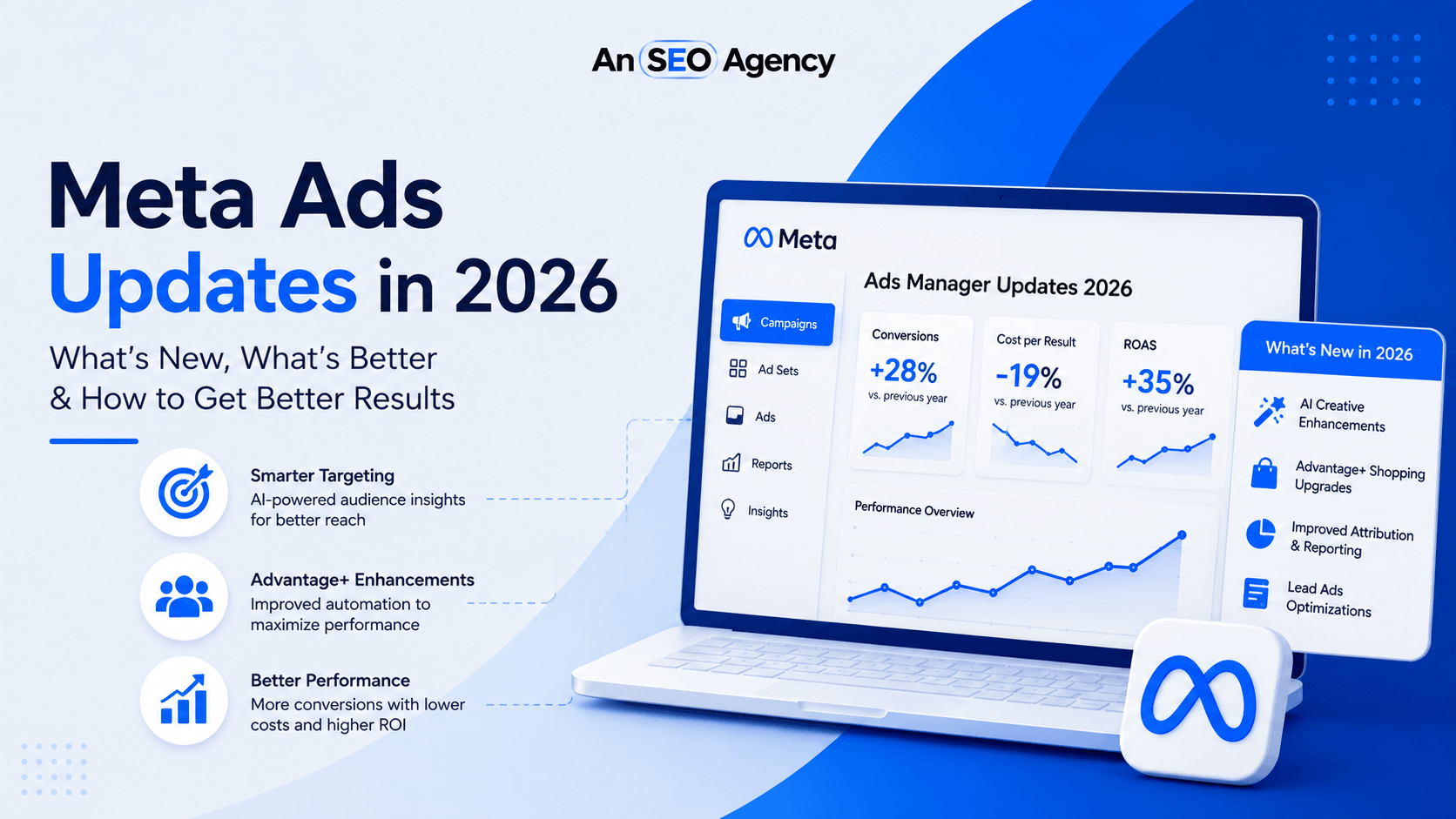
Meta Ads updates in 2026 show one clear direction: Facebook, Instagram, Messenger and WhatsApp advertising are becoming more AI-powered, more automated and more conversation-focused.
Earlier, advertisers had more manual control over targeting, placements, budgets and bidding. However, Meta is now pushing businesses toward AI-driven systems such as Meta Advantage+, Advantage+ creative, automated placements, AI ad ranking, Business Agent, WhatsApp Business AI and click-to-message campaigns.
This change does not mean advertisers can relax and depend fully on automation. In fact, strategy is now more important. Meta’s AI can help with delivery and optimization, but businesses still need strong offers, clear messaging, good creatives, accurate tracking, fast follow-up and high-quality landing pages.
For businesses, the main question is no longer only “How much should we spend on Meta Ads?” The better question is “Are we giving Meta the right creative, conversion data and customer journey to optimize properly?”
For brands that want better paid ad results, AN SEO Agency helps connect Meta Ads, PPC strategy, landing pages, tracking, SEO, content and conversion optimization into one practical growth system.
The main Meta Ads updates in 2026 include deeper AI automation, wider use of Meta Advantage+, stronger Advantage+ creative tools, Meta AI business assistant, Meta Business Agent, WhatsApp Business AI, click-to-message ad growth, smarter ad ranking models, incremental attribution, better AI ad transparency and more focus on tracking quality through Pixel, Conversions API and CRM data.
Quick Summary of Meta Ads Updates in 2026
| Meta Ads Update | What It Means for Businesses |
| AI-driven advertising | Meta is using AI across campaign setup, delivery, ranking, creative and recommendations. |
| Meta Advantage+ | More campaigns now rely on AI for audiences, placements, budget and optimization. |
| Advantage+ creative | AI can help create, resize, improve and personalize ad creatives. |
| Meta AI business assistant | Advertisers can get optimization support and account guidance through AI assistance. |
| Meta Business Agent | Businesses can use AI to answer customer questions and manage conversations. |
| WhatsApp Business AI | Small businesses can automate customer replies, lead capture and sales conversations. |
| Click-to-message ads | More businesses are using WhatsApp, Messenger and Instagram Direct for lead generation. |
| Smarter ad ranking | Meta is scaling larger AI models to better match ads with users. |
| Incremental attribution | Meta is giving more attention to measuring conversions caused by advertising impact. |
| AI transparency | Meta is adding more ad transparency around AI-created or AI-edited ads. |
| Better tracking | Pixel, Conversions API, CRM and offline data are becoming more important. |
Why Meta Ads Are Changing in 2026
Meta Ads are changing because user behavior is changing. People now discover brands through Reels, Stories, Facebook Feed, Instagram Explore, creator content, WhatsApp chats, Messenger conversations and AI-powered recommendations.
At the same time, privacy changes, cookie limitations and platform automation have changed how advertisers track users and optimize campaigns. Meta now depends more on machine learning to understand intent, predict actions and deliver ads to people most likely to convert.
This means businesses need to change how they run campaigns.
In 2026, success on Meta Ads depends on:
- Strong creative testing
- Better tracking setup
- Clean conversion events
- Clear campaign objectives
- Faster lead follow-up
- Strong landing pages
- Better use of WhatsApp and Messenger
- More video and Reels-style content
- Better offer positioning
- More focus on lead quality
This shift also connects with wider digital marketing trends. AN SEO Agency’s guide on New Digital Marketing Trends in 2026 explains why AI, automation, trust, personalization and customer experience are becoming central to online growth.
AI Is Becoming the Core of Meta Advertising
The biggest Meta Ads update in 2026 is the deeper role of AI.
Meta is using AI across ad delivery, creative optimization, campaign recommendations, ranking models, business messaging and account support. This means advertisers no longer control every small detail the way they did years ago.
AI can help Meta decide:
- Which users may respond to an ad
- Which placements may perform best
- Which creative variation may work better
- Which audience is likely to convert
- Which campaign needs optimization
- Which conversations can be automated
- Which signals matter for performance
However, AI still needs good inputs. If the campaign has weak creative, poor tracking, unclear offers or low-quality landing pages, automation will not magically fix everything.
Businesses should focus on giving Meta better signals.
Important inputs include:
- Accurate conversion events
- Strong videos and images
- Clear ad copy
- Good landing pages
- Fast-loading website pages
- Real lead quality feedback
- Customer list data
- Product catalogs
- CRM data where possible
- Offline conversion data
In simple words, Meta’s AI can optimize delivery, but businesses must still control strategy.
Meta Advantage+ Campaigns Are Now More Important
Meta Advantage+ is one of the most important Meta Ads updates in 2026.
Advantage+ is Meta’s AI-powered advertising suite. It helps automate and improve campaign performance by using machine learning across audiences, placements, budgets, bidding and creative optimization.
Meta Advantage+ includes different solutions for different goals, such as:
- Advantage+ sales campaigns
- Advantage+ leads campaigns
- Advantage+ app campaigns
- Advantage+ catalog ads
- Advantage+ creative
- Automated placements
- Audience expansion
- Budget optimization
The biggest change is that advertisers now need to think less about manually narrowing audiences and more about feeding Meta enough good data.
For example, instead of creating ten small interest-based ad sets, a business may test broader audiences with Advantage+ and provide multiple creative assets. Meta’s system then learns which people are more likely to take action.
However, Advantage+ should not be used blindly. Advertisers should still monitor:
- Cost per lead
- Cost per qualified lead
- Cost per purchase
- Return on ad spend
- Lead quality
- Sales conversion rate
- Creative performance
- Placement performance
- Landing page conversion rate
For businesses investing in paid campaigns, AN SEO Agency’s PPC services can help connect campaign automation with strategy, tracking and performance analysis.
Advantage+ Creative Is Changing Ad Production
Creative is one of the most important parts of Meta Ads in 2026.
Users scroll quickly. If your ad does not grab attention in the first few seconds, they may ignore it. This is why Meta is investing heavily in Advantage+ creative.
Advantage+ creative can help advertisers create and optimize ad assets using AI. It can support:
- Image resizing
- Background generation
- Text generation
- Image expansion
- Video generation
- Music generation
- Static image animation
- Creative personalization
- Placement-specific variations
This helps advertisers produce more creative variations faster.
However, AI-generated creative still needs human review. Businesses should check every AI-edited image, headline and description before publishing.
Manual review is important because AI tools may create:
- Wrong product shapes
- Unnatural images
- Incorrect text
- Off-brand designs
- Misleading visuals
- Poorly cropped creatives
- Confusing messages
- Policy-sensitive issues
The best approach is to use AI for speed but keep humans in control of brand quality.
For example, an ecommerce brand can use AI to create multiple background variations, but the product image should still look accurate. A real estate company can use AI to resize creatives, but it should not create misleading property visuals.
Meta AI Business Assistant for Advertisers
Meta has started testing an AI business assistant for advertisers. This assistant is designed to help businesses with account support, optimization suggestions and personalized performance recommendations.
This update is useful because many small business owners find Ads Manager confusing. They may not understand why campaigns are not performing or what to change.
A Meta AI business assistant may help advertisers:
- Understand campaign performance
- Get optimization suggestions
- Review account issues
- Identify improvement opportunities
- Receive recommendations based on goals
- Save time during campaign management
- Make campaign setup easier
However, advertisers should not follow every recommendation without checking business logic.
For example, Meta may suggest increasing budget if a campaign is performing well. However, before increasing budget, the business should check whether leads are qualified, whether sales are happening and whether the team can handle more inquiries.
AI recommendations are helpful, but they are not a replacement for marketing judgment.
Meta Business Agent for Customer Conversations
Meta Business Agent is another important 2026 update. It helps businesses respond to customers, answer questions, provide product recommendations, book appointments, qualify leads and support sales conversations.
This matters because response speed can directly affect conversion rates.
Many businesses lose leads because they reply too late. A user may click an ad, send a message and then contact a competitor if there is no quick response.
Meta Business Agent can help businesses:
- Reply to customer questions
- Handle missed chats
- Provide product or service details
- Recommend products
- Book appointments
- Qualify leads
- Support WhatsApp and Messenger conversations
- Give business owners chat summaries
- Improve customer support coverage
However, businesses should set it up carefully. The AI should have accurate information about services, pricing, locations, policies, offers and contact details.
A human team should still handle:
- Complaints
- Refund issues
- High-value leads
- Complex questions
- Sensitive industries
- Custom pricing
- Final sales decisions
The best setup is AI plus human support. AI can handle routine questions, while humans manage complex and high-value conversations.
WhatsApp and Click-to-Message Ads Are Growing
Messaging ads are becoming one of the strongest Meta Ads trends in 2026.
Instead of sending every user to a website, many businesses now send users directly into a WhatsApp, Messenger or Instagram Direct conversation.
Click-to-message ads are useful because they reduce friction. A user can ask questions immediately instead of filling a long form or browsing multiple pages.
Messaging ads work well for:
- Real estate
- Education
- Healthcare
- Beauty clinics
- Restaurants
- Coaching institutes
- Ecommerce
- Travel
- Events
- Home services
- Local service businesses
- B2B lead generation
For Indian businesses, WhatsApp is especially important because many customers prefer direct chat before buying.
Meta also introduced Business AI on WhatsApp for small businesses in India. It can help businesses reply to customers 24/7, recommend products, capture leads, book appointments and support sales inside the WhatsApp Business app.
This makes WhatsApp advertising more powerful.
However, businesses should not run click-to-WhatsApp ads without a follow-up system. They need:
- Fast replies
- Saved responses
- Lead qualification questions
- CRM tracking
- Sales team follow-up
- Clear offers
- Good product/service information
- Follow-up reminders
A click-to-message campaign can generate many conversations, but only a strong follow-up process turns those conversations into revenue.
Meta’s Ad Ranking Models Are Becoming Smarter
Meta is also improving its ad ranking models.
Ad ranking decides which ads appear to which users. Better ranking helps Meta show ads that are more relevant, useful and likely to drive action.
Meta has discussed advanced models such as GEM, the Generative Ads Recommendation Model. The goal is to use larger and smarter AI systems to better understand user behavior and advertiser goals.
This matters because advertisers need to provide better data and creative signals.
Meta’s ad ranking systems may consider:
- User behavior patterns
- Engagement history
- Creative quality
- Campaign objective
- Conversion signals
- Landing page signals
- Ad relevance
- Predicted action rate
- Budget and bid settings
- Placement opportunities
For advertisers, the lesson is clear. Campaign success depends on signal quality.
Therefore, businesses should choose campaign objectives carefully.
Incremental Attribution Is Getting More Attention
Attribution is one of the most difficult parts of paid advertising.
Many businesses ask, “Did Meta Ads actually bring this sale, or would the customer have converted anyway?”
Incremental attribution helps answer that question. It focuses on conversions that happened because of advertising impact, not only conversions that were credited to the platform.
This is important because customer journeys are complex.
For example, a user may:
- See an Instagram ad
- Visit the website
- Leave without converting
- Search the brand on Google
- Read reviews
- Return through direct traffic
- Submit a form
In basic reporting, Meta may not always get full credit. However, Meta may have played an important role in starting the journey.
Businesses should track both platform data and real business outcomes.
Important metrics include:
- Cost per lead
- Cost per qualified lead
- Cost per sale
- Return on ad spend
- Incremental conversions
- Lead-to-sale rate
- Offline conversions
- CRM pipeline value
- Customer lifetime value
- Revenue per campaign
This is where proper tracking becomes very important.
AI Ad Transparency Is Increasing
AI-generated ads are becoming more common. Therefore, Meta is also increasing ad transparency.
Meta is rolling out “About this ad,” a unified place where users can find more information about ads. Meta has also expanded transparency efforts to include ads created or edited with third-party AI tools, not only Meta’s own tools.
This update matters because businesses must use AI responsibly.
Advertisers should avoid:
- Fake before-and-after images
- Misleading product visuals
- Unrealistic AI-generated results
- False claims
- Edited images that confuse users
- Policy-sensitive AI content
- Poorly reviewed automated creatives
AI can save time, but it should not damage brand trust.
This is especially important for industries such as healthcare, finance, real estate, legal services, education, beauty treatments and high-ticket products.
Businesses should create a simple review process before publishing AI-generated ads.
The review should check:
- Brand accuracy
- Product accuracy
- Spelling
- Legal claims
- Offer accuracy
- Image quality
- Policy compliance
- Landing page consistency
Good advertisers will use AI to improve speed while keeping trust and accuracy at the center.
Tracking and Data Quality Matter More Now
Tracking is one of the most important parts of Meta Ads in 2026.
Because Meta Ads are becoming more automated, the system needs accurate data to optimize properly. If tracking is poor, Meta may optimize for the wrong actions.
Businesses should set up:
- Meta Pixel
- Conversions API
- Standard events
- Custom conversions
- Offline conversions
- CRM integration
- Lead quality feedback
- Purchase tracking
- Event match quality improvements
For lead generation campaigns, businesses should not track only form submissions. They should also track what happens after the lead arrives.
For example:
- Did the lead answer the phone?
- Was the lead qualified?
- Did the lead book an appointment?
- Did the lead visit the store?
- Did the lead purchase?
- What was the final revenue?
This helps businesses move from cheap leads to profitable leads.
AN SEO Agency’s article on Can Free Tools Really Replace a Digital Marketing Agency? explains why tools can show data, but expert interpretation is needed to turn data into growth.
Creative Strategy for Meta Ads in 2026
Creative is the biggest lever for Meta Ads performance in 2026.
Even with AI automation, weak creative can limit results. Businesses should prepare multiple ad variations for different audiences, placements and funnel stages.
Strong creative formats include:
- Reels-style videos
- UGC-style videos
- Founder-led videos
- Customer testimonial videos
- Product demo videos
- Before-and-after creatives
- Problem-solution ads
- Offer-based ads
- Carousel ads
- Explainer videos
- WhatsApp lead ads
- Retargeting creatives
- Social proof creatives
A strong creative strategy should include three levels.
Awareness creatives
These introduce the brand and problem.
Examples:
- “Struggling to get leads from Meta Ads?”
- “Your website traffic is not the problem. Your tracking may be.”
- “Here is why your Facebook Ads are getting leads but no sales.”
Consideration creatives
These educate and build trust.
Examples:
- Case studies
- Client results
- Service explainers
- Comparison content
- Common mistake videos
- FAQ-based ads
Conversion creatives
These push action.
Examples:
- Free audit offer
- Limited-time consultation
- WhatsApp inquiry ad
- Lead form campaign
- Appointment booking ad
- Product discount ad
Businesses should refresh creatives regularly because ad fatigue can reduce performance.
Best Campaign Structure for Businesses
A simple and effective Meta Ads structure in 2026 can include three campaign types.
1. Prospecting campaign
This campaign targets new people who may not know your brand.
Best options:
- Advantage+ campaigns
- Broad targeting
- Reels placements
- Video creatives
- Lead or sales objective
2. Retargeting campaign
This campaign targets people who already interacted with your brand.
Audiences may include:
- Website visitors
- Video viewers
- Instagram engagers
- Facebook engagers
- Add-to-cart users
- Lead form openers
- WhatsApp chat starters
3. Messaging or conversion campaign
This campaign focuses on high-intent action.
Actions may include:
- WhatsApp message
- Lead form submission
- Appointment booking
- Phone call
- Purchase
- Consultation request
The best structure depends on business type, budget and sales cycle. However, most businesses need both prospecting and retargeting.
What Businesses Should Avoid
Meta Ads automation can be powerful, but businesses should avoid common mistakes.
Do not depend fully on AI
AI can optimize delivery, but it cannot fix a weak offer, poor follow-up or bad landing page.
Do not use only one creative
Meta needs multiple creative options to test and learn.
Do not track only cheap leads
Cheap leads are not always good leads. Track qualified leads and sales.
Do not ignore WhatsApp follow-up
If you run click-to-message ads, reply quickly and track every conversation.
Do not publish AI creatives without review
Check every AI-generated image, video and text before running ads.
Do not scale too early
Scale only after checking lead quality, conversion rate and sales outcomes.
Do not ignore landing pages
If your landing page is slow, confusing or weak, campaign performance will suffer.
Comparison Table: Old Meta Ads vs Meta Ads in 2026
| Area | Old Meta Ads Approach | Meta Ads in 2026 |
| Targeting | Manual interest targeting | AI-powered broad targeting and Advantage+ |
| Campaign setup | More manual controls | More automated campaign creation |
| Creative | Few static images | Reels, UGC, AI creative and multiple variations |
| Lead generation | Forms and website clicks | Forms, WhatsApp, Messenger and Instagram chats |
| Optimization | Clicks and basic leads | Qualified leads, sales and incremental conversions |
| Tracking | Pixel only | Pixel, Conversions API, CRM and offline data |
| Customer support | Manual replies | Business Agent plus human takeover |
| Attribution | Last-click or platform credit | More focus on incremental impact |
| Transparency | Basic ad details | More AI ad transparency |
| Success metric | Cost per lead | Cost per qualified lead and revenue |
Mini Case Study
Imagine a coaching institute running Meta Ads in 2026.
Earlier, the institute used one image ad and a simple lead form. The campaign generated many leads, but most students did not answer calls. The cost per lead looked low, but admissions were poor.
Then, the strategy changed.
First, the institute created Reels-style videos explaining course benefits, batch timing and student outcomes. Next, it tested click-to-WhatsApp ads so students could ask questions directly. Then, it added Meta Pixel, Conversions API and CRM tracking to measure real admissions, not only leads.
The institute also used Business AI to answer basic WhatsApp questions about fees, eligibility and class schedules. Human counselors handled serious inquiries.
After a few weeks, the cost per lead increased slightly, but the lead quality improved. More students started conversations, more calls were answered and more admissions came from the campaign.
This shows an important lesson: in 2026, the best Meta Ads strategy is not about the cheapest lead. It is about getting the right lead and converting that lead faster.
Expert Quote
“Meta Ads in 2026 are becoming more automated, but successful campaigns still need human strategy. AI can improve delivery, but businesses must provide strong creatives, clean tracking, clear offers and fast customer follow-up.”
Meta Ads Checklist for 2026
Use this checklist before running or scaling Meta Ads:
- Define your campaign goal
- Choose the right objective
- Test Advantage+ campaigns
- Use broad targeting where suitable
- Prepare multiple creatives
- Create Reels-style videos
- Test UGC-style content
- Use strong offers
- Set up Meta Pixel
- Set up Conversions API
- Track qualified leads
- Track offline conversions
- Connect CRM data if possible
- Test WhatsApp ads
- Test Messenger or Instagram Direct ads
- Review AI-generated creatives
- Improve landing page speed
- Check mobile experience
- Use retargeting campaigns
- Monitor cost per qualified lead
- Track sales conversion rate
- Refresh creatives regularly
- Scale only after checking lead quality
FAQs
What are the main Meta Ads updates in 2026?
The main updates include AI automation, Meta Advantage+, Advantage+ creative, Business Agent, WhatsApp AI, messaging ads and AI transparency.
Is Meta Advantage+ important in 2026?
Yes. Meta Advantage+ is important because it uses AI to automate audiences, placements, budgets and creative optimization.
What is Meta Business Agent?
Meta Business Agent is an AI tool that helps businesses answer questions, manage chats, qualify leads and support sales conversations.
Are WhatsApp ads useful for businesses?
Yes. WhatsApp ads are useful for lead generation, appointment booking, product inquiries and faster customer conversations.
Should businesses use AI creative tools?
Yes, but every AI-generated creative should be reviewed for accuracy, branding, spelling, policy compliance and product quality.