
New Digital Marketing Trends in 2026: What Businesses Need to Know
- Introduction
- Why Digital Marketing Is Changing in 2026
- AI Search Is Becoming a Major Discovery Channel
- AEO and GEO Are Becoming Part of SEO
- Google AI Overviews Are Changing Content Strategy
- Topical Authority Is Replacing Random Blogging
- First-Party Data Is Becoming More Important
- AI-Powered Personalization Is Growing
- Human Creativity Still Matters
- Video and Creator-Led Content Are Rising
- Local SEO Is Becoming More Trust-Focused
- ORM Is Now Part of Digital Growth
- PPC Is Becoming More Automated
- Technical SEO Still Matters
- Mini Case Study
- Digital Marketing Checklist for 2026
- FAQs
- Introduction
- Why Digital Marketing Is Changing in 2026
- AI Search Is Becoming a Major Discovery Channel
- AEO and GEO Are Becoming Part of SEO
- Google AI Overviews Are Changing Content Strategy
- Topical Authority Is Replacing Random Blogging
- First-Party Data Is Becoming More Important
- AI-Powered Personalization Is Growing
- Human Creativity Still Matters
- Video and Creator-Led Content Are Rising
- Local SEO Is Becoming More Trust-Focused
- ORM Is Now Part of Digital Growth
- PPC Is Becoming More Automated
- Technical SEO Still Matters
- Mini Case Study
- Digital Marketing Checklist for 2026
- FAQs
Introduction
Digital marketing trends in 2026 are changing how businesses attract customers, build trust and generate leads online. Earlier, many businesses focused mainly on Google rankings, social media posts and basic ads. However, the digital space is now more competitive, more automated and more AI-driven.
Today, customers search on Google, ask ChatGPT, compare brands on Perplexity, watch short videos, read reviews, check Google Business Profiles and expect fast website experiences. As a result, businesses need a more complete digital marketing strategy.
The biggest change is clear. Digital marketing is no longer only about being visible on one platform. It is about being present, trusted and easy to understand across search engines, AI tools, social platforms, review platforms and local listings.
For businesses that want to stay ahead, AN SEO Agency helps connect SEO, AEO, GEO, PPC, content marketing, social media and online reputation into one practical growth strategy.
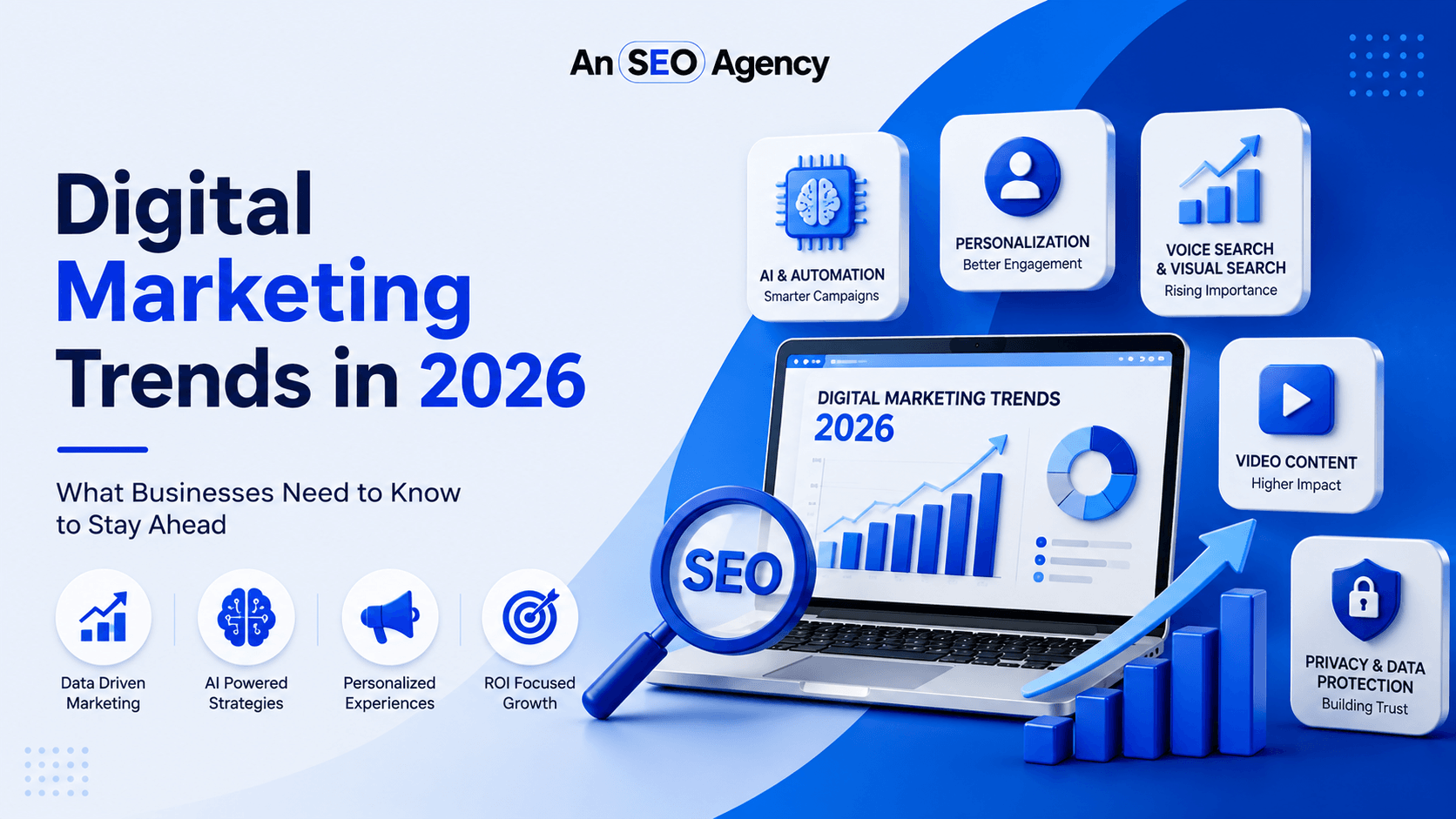
The top digital marketing trends in 2026 include AI search optimization, AEO, GEO, Google AI Overviews, topical authority, first-party data, AI personalization, creator-led content, local SEO, online reputation management, PPC automation, technical SEO and human-focused brand storytelling. Businesses need strategy, trust and useful content to stay visible.
Why Digital Marketing Is Changing in 2026
Digital marketing is changing because user behavior is changing. People do not only search short keywords anymore. They ask full questions, compare brands through AI tools and expect quick answers before visiting a website.
For example, a user may ask:
- Which SEO agency is best for small businesses?
- How can I improve my website visibility in AI search?
- What is the best digital marketing strategy in 2026?
- Which company can help with SEO, AEO and GEO?
- How do I get more leads from Google?
This means businesses must create content that answers questions clearly. They must also build brand authority across multiple platforms.
Google’s official guidance on generative AI features says SEO best practices still apply to AI-powered search experiences. Therefore, businesses should not stop SEO. Instead, they should upgrade SEO with better content, answer-based structure, technical clarity and trust signals.
If you want to understand how AI is changing search, AN SEO Agency’s blog on How AI Is Changing SEO Now explains why businesses must adapt to new search behavior.
AI Search Is Becoming a Major Discovery Channel
AI search is one of the biggest digital marketing trends in 2026. Users now ask Google AI Overviews, ChatGPT, Perplexity, Gemini and Copilot for answers, product ideas, agency recommendations and business comparisons.
This changes how brands are discovered.
Earlier, a business mainly needed to rank on Google. Now, it also needs to be understood by AI tools. That means your website should clearly explain who you are, what you offer, who you help and why customers should trust you.
AI search visibility depends on:
- Helpful content
- Clear service pages
- Strong topical authority
- Trusted external mentions
- Customer reviews
- Structured data
- Internal links
- Brand consistency
- Technical SEO
- Local signals
For example, a business that wants AI search visibility should publish blogs that answer real customer questions. AN SEO Agency’s guide on How to Get Your Brand Mentioned in ChatGPT and Perplexity explains how brand mentions, authority and helpful content support AI discovery.
In 2026, businesses should not ask only, “Are we ranking?” They should also ask, “Can AI tools understand and recommend our brand?”
AEO and GEO Are Becoming Part of SEO
AEO means Answer Engine Optimization. It helps content appear in direct answers, featured snippets, voice search and AI-generated answers.
GEO means Generative Engine Optimization. It helps brands get mentioned, cited or referenced inside generative AI tools such as ChatGPT, Perplexity, Gemini and Copilot.
Traditional SEO still matters, but businesses now need all three approaches.
In simple words:
- SEO helps your website rank.
- AEO helps your content answer.
- GEO helps your brand get mentioned.
AN SEO Agency’s blog on SEO vs AEO vs GEO explains this difference in detail and shows why businesses should combine all three for stronger search visibility.
This trend matters because customers now search differently. A business owner may not search “SEO agency near me.” Instead, they may ask an AI tool, “Which agency can help my business appear in Google AI Overviews?”
Therefore, businesses should write content that answers, educates and proves trust.
Google AI Overviews Are Changing Content Strategy
Google AI Overviews are changing how users interact with search results. In many searches, Google may show an AI-generated summary before traditional organic results.
This means users can get answers faster. However, it also means businesses must create content that is clear, useful and source-worthy.
Google’s guidance on AI features and websites explains that AI search can help people discover web content. Therefore, websites still matter. However, weak content may struggle because AI search needs reliable answers.
To improve content for AI Overviews, businesses should:
- Answer the main question early
- Use clear headings
- Add examples
- Include FAQs
- Use trusted sources
- Build content clusters
- Improve technical SEO
- Update old blogs
- Add internal links
- Use structured data
For example, AN SEO Agency’s Google AI Overviews Optimization Guide for Businesses explains how businesses can prepare pages for AI-powered search results.
In 2026, content should not only target keywords. It should also answer user questions in a way Google can understand and trust.
Topical Authority Is Replacing Random Blogging
Random blogging is becoming less effective. Businesses can no longer publish disconnected posts and expect strong SEO results.
Instead, they need topical authority.
Topical authority means your website deeply covers a subject through connected pages, service content, guides, FAQs and supporting blogs.
For example, if a business wants to become known for AI search optimization, it should write about:
- AI search SEO
- AEO
- GEO
- Google AI Overviews
- Topical authority
- Schema markup
- Internal linking
- ChatGPT visibility
- Perplexity visibility
- Content strategy
- Technical SEO
This makes the website easier for search engines and AI tools to understand.
AN SEO Agency’s blog on How to Build Topical Authority for AI Search explains why topic clusters, internal links and authority signals are now essential.
Therefore, businesses should build content ecosystems instead of publishing one-off blogs.
First-Party Data Is Becoming More Important
First-party data is information collected directly from your audience through your website, forms, CRM, email list, customer interactions, purchases, bookings and analytics.
As privacy rules, cookie changes and platform restrictions continue affecting advertising, businesses need their own customer data.
Useful first-party data includes:
- Email subscribers
- Website behavior
- Customer inquiries
- Purchase history
- Lead source data
- CRM notes
- Form submissions
- Repeat customer data
- Customer feedback
- Review insights
This helps businesses understand what customers want and which marketing channels perform best.
For example, Google Analytics can show customer behavior, but a business still needs strategy to understand what that data means. AN SEO Agency’s article on Can Free Tools Really Replace a Digital Marketing Agency? explains why tools are useful but expert interpretation is still needed.
In 2026, businesses should collect data ethically, use it responsibly and improve customer experiences with it.
AI-Powered Personalization Is Growing
AI-powered personalization is another major digital marketing trend in 2026.
Customers now expect brands to show relevant offers, content and recommendations. AI tools can help businesses analyze behavior, segment audiences and personalize campaigns more efficiently.
Personalization can improve:
- Email marketing
- PPC campaigns
- Website content
- Product recommendations
- Landing page messaging
- Social ads
- Retargeting campaigns
- Customer support
- Lead nurturing
However, personalization must feel helpful, not invasive. If customers feel tracked or manipulated, trust can drop.
Therefore, businesses should use personalization to improve relevance. They should not use it to overload users with aggressive ads.
For example, a service business can personalize follow-up emails based on the user’s inquiry type. An e-commerce brand can recommend products based on browsing behavior. A B2B company can customize landing page content for different industries.
In 2026, personalization should combine AI efficiency with human judgment.
Human Creativity Still Matters
AI can help with research, outlines, content ideas, ad variations and data analysis. However, it cannot fully replace human creativity, brand understanding and emotional connection.
This is important because many brands now use similar AI tools. As a result, content and ads can start looking the same.
Businesses that win in 2026 will use AI for speed but rely on humans for originality, storytelling and strategy.
Strong human creativity helps with:
- Brand voice
- Campaign ideas
- Emotional storytelling
- Visual identity
- Customer psychology
- Community building
- Social content
- Creative ads
- Brand differentiation
For example, a tool can write a basic caption, but it may not understand your local audience, humor, customer pain points or brand personality. A marketing team can turn insights into campaigns that feel real.
This is why businesses need a balance. AI can support execution, but humans must lead strategy.
Video and Creator-Led Content Are Rising
Short-form video, influencer marketing and creator-led content continue growing in 2026.
Customers often trust people more than polished brand messages. Therefore, creator content can help businesses build authenticity, awareness and engagement.
Creator-led content may include:
- Short videos
- Product demos
- Service explainers
- Testimonials
- Behind-the-scenes content
- Local influencer campaigns
- Expert interviews
- Social proof videos
- Educational reels
- Customer stories
For small businesses, this does not always require big influencers. Local creators, industry experts, happy customers and team members can also create effective content.
For example, a digital marketing agency can publish short videos explaining SEO tips, PPC mistakes, AI search changes and website audit insights. This helps build trust before customers contact the business.
Additionally, video content can support SEO when it is embedded into blogs, used on service pages and shared across social platforms.
Local SEO Is Becoming More Trust-Focused
Local SEO is not only about ranking on Google Maps. In 2026, it is also about trust.
Customers check reviews, photos, business hours, location details, responses, website quality and social proof before choosing a local business.
Local SEO now depends on:
- Google Business Profile
- Customer reviews
- Review responses
- Service pages
- Location pages
- Local citations
- Local backlinks
- Business photos
- Local FAQs
- NAP consistency
- Website trust signals
For example, a customer searching for the best digital marketing company in Chandigarh will compare websites, reviews and service quality before making contact. AN SEO Agency’s blog on Top 10 Digital Marketing Companies in Chandigarh is useful because it supports local relevance while helping users compare options.
Businesses should also keep their Google Business Profile updated because Google’s Business Profile tools help companies manage how they appear in Search and Maps.
In 2026, local SEO success depends on both visibility and credibility.
ORM Is Now Part of Digital Growth
Online reputation management, also called ORM, is no longer optional.
Customers often search a brand before buying. They read reviews, check complaints, look at social media and compare competitors.
A poor online reputation can reduce conversions even if your website ranks well.
ORM includes:
- Review management
- Negative review responses
- Brand search monitoring
- Social media monitoring
- Positive content publishing
- Customer feedback analysis
- Google Business Profile management
- Trust-building content
- Complaint resolution
- Brand mention tracking
AN SEO Agency’s guide on How to Protect Your Online Reputation With ORM explains how reviews, search results and online trust affect business growth.
In 2026, ORM should work together with SEO and content marketing. A good ranking will not help much if customers do not trust the brand.
PPC Is Becoming More Automated
Paid advertising is becoming more automated through AI-powered bidding, audience targeting, creative testing and campaign optimization.
Platforms like Google Ads and Meta Ads now use more machine learning to improve campaign performance. However, automation does not mean businesses should run campaigns without strategy.
PPC still needs human planning in areas like:
- Offer selection
- Landing page quality
- Budget control
- Audience strategy
- Conversion tracking
- Ad message testing
- Keyword selection
- Negative keywords
- Creative direction
- Lead quality analysis
AI can help optimize delivery, but marketers must define goals and evaluate results.
For example, a campaign may generate many leads, but those leads may not be qualified. A marketing team must review lead quality, call data and sales outcomes.
For businesses investing in paid ads, AN SEO Agency’s PPC services can help connect automation with strategy, tracking and ROI-focused decision-making.
Technical SEO Still Matters
Search engines and AI systems need to crawl, render and understand your website. If your site is slow, broken, blocked or confusing, visibility can suffer.
Important technical SEO areas include:
- Crawlability
- Indexability
- Mobile usability
- Page speed
- HTTPS security
- Structured data
- Internal links
- XML sitemap
- Core Web Vitals
- Canonical tags
- Broken link fixes
- JavaScript SEO
Google’s technical requirements for Search explain the minimum conditions pages need for Search eligibility. Similarly, Core Web Vitals help measure loading performance, responsiveness and visual stability.
AN SEO Agency’s blog on Why Technical SEO Matters for Website Performance in 2026 explains how technical health supports user experience, rankings and conversions.
In 2026, businesses should not focus only on content. They must also make sure their websites are fast, secure and easy to use.
Comparison Table: Old Marketing vs 2026 Marketing
| Area | Old Digital Marketing | Digital Marketing in 2026 |
| SEO | Keyword ranking focused | SEO, AEO and GEO focused |
| Content | Random blogs | Topic clusters and helpful answers |
| Search | Google results only | Google, AI Overviews and AI tools |
| Ads | Manual campaign control | AI-assisted automation with strategy |
| Data | Platform data only | First-party data and CRM insights |
| Social media | Brand posts | Creator-led and video-first content |
| Local SEO | Map ranking only | Reviews, trust, listings and local content |
| Reputation | Handled after problems | Managed proactively |
| Website | Basic online presence | Fast, structured and conversion-focused |
| Strategy | Channel-by-channel | Integrated full-funnel growth |
Mini Case Study
Imagine a local service business that wants more leads in 2026.
At first, the business runs a few social media posts and uses basic SEO. It has a website, but the service pages are thin. Its Google Business Profile is not updated, reviews are not managed and content is not connected.
As a result, traffic is low and leads are inconsistent.
Then, the business updates its digital marketing strategy.
First, it improves website speed, fixes technical SEO issues and updates service pages. Next, it builds topic clusters around customer questions. It also adds FAQs, publishes helpful blogs, improves Google Business Profile, asks happy customers for honest reviews and starts tracking leads properly.
Meanwhile, the business uses AI tools for research and ad testing, but human marketers control strategy, brand voice and conversion planning.
After a few months, the business gets better search visibility, stronger local trust, improved lead quality and clearer marketing data.
This example shows why digital marketing in 2026 needs connected strategy, not random tactics.
Expert Quote
“Digital marketing in 2026 is not about using every new tool. It is about building trust, answering real customer questions and using AI intelligently to support strategy, not replace it.”
Digital Marketing Checklist for 2026
Use this checklist to prepare your business for new digital marketing trends:
- Improve SEO foundations
- Build AEO and GEO strategy
- Optimize for Google AI Overviews
- Create topic clusters
- Update old blogs
- Add internal links to old content
- Use trusted external links
- Improve technical SEO
- Add structured data
- Optimize Google Business Profile
- Collect honest reviews
- Manage online reputation
- Use first-party data
- Track conversions
- Improve PPC landing pages
- Test AI-powered ads
- Create short videos
- Build creator partnerships
- Improve website speed
- Focus on customer trust
FAQs
What are the top digital marketing trends in 2026?
Top trends include AI search, AEO, GEO, AI Overviews, personalization, creator content, local SEO, ORM and automation.
Is SEO still important in 2026?
Yes. SEO is still important because AI-powered search features still depend on crawlable, helpful and trusted web content.
What is AEO in digital marketing?
AEO means Answer Engine Optimization. It helps content appear in direct answers, AI summaries and voice search results.
What is GEO in marketing?
GEO means Generative Engine Optimization. It helps brands get mentioned or cited in AI-generated responses.
How can small businesses use AI marketing?
Small businesses can use AI for research, content ideas, ads, reporting, personalization and customer support.
Why is ORM important in 2026?
ORM is important because customers check reviews, search results and brand trust before choosing a business.