
How to Build Topical Authority for AI Search
- Introduction
- What Is Topical Authority for AI Search?
- Why Topical Authority Matters in AI Search
- How AI Search Changed Content Strategy
- Topical Authority vs Traditional Keyword SEO
- How to Choose Your Core Topic Cluster
- How to Build Content Clusters for AI Search
- Why Internal Linking Matters
- How E-E-A-T Supports Topical Authority
- How Schema Markup Helps AI Understand Content
- How Brand Mentions Support AI Visibility
- Local Topical Authority for Businesses
- Technical SEO and Topical Authority
- Comparison Table: Random Blogging vs Topical Authority
- Mini Case Study
- Common Mistakes to Avoid
- Topical Authority Checklist
- FAQs
- Introduction
- What Is Topical Authority for AI Search?
- Why Topical Authority Matters in AI Search
- How AI Search Changed Content Strategy
- Topical Authority vs Traditional Keyword SEO
- How to Choose Your Core Topic Cluster
- How to Build Content Clusters for AI Search
- Why Internal Linking Matters
- How E-E-A-T Supports Topical Authority
- How Schema Markup Helps AI Understand Content
- How Brand Mentions Support AI Visibility
- Local Topical Authority for Businesses
- Technical SEO and Topical Authority
- Comparison Table: Random Blogging vs Topical Authority
- Mini Case Study
- Common Mistakes to Avoid
- Topical Authority Checklist
- FAQs
Introduction
Topical authority for AI search is now one of the most important SEO strategies for businesses that want long-term visibility. Search is no longer only about ranking one page for one keyword. Today, Google AI Overviews, ChatGPT, Perplexity, Gemini, Copilot and other AI-powered tools need to understand whether your website is a trusted source on a complete subject.
As a result, businesses must stop publishing random blogs and start building connected content systems. A website that covers a topic deeply, links related pages naturally, answers real customer questions and proves expertise becomes easier for search engines and AI tools to understand.
For example, an SEO agency should not publish only one article about AI search. It should create a full content cluster around SEO, AEO, GEO, Google AI Overviews, brand mentions, content strategy, internal linking, structured data and technical SEO.
If you are still learning how AI search connects with traditional search, AN SEO Agency’s guide on SEO vs AEO vs GEO explains how rankings, answer visibility and generative AI mentions now work together.
Topical authority for AI search means building deep, connected and trustworthy content around a core subject so search engines and AI tools can understand your expertise. Businesses can build it through topic clusters, answer-based blogs, internal links, schema markup, expert insights, brand mentions, technical SEO and consistent content updates.
What Is Topical Authority for AI Search?
Topical authority means your website is seen as a reliable source on a specific subject.
In traditional SEO, businesses often focused on ranking individual pages. However, AI search looks for broader context. AI-powered systems need to understand your entire website, your expertise, your related topics, your brand mentions and how your content connects.
For example, a business that wants authority around AI search should not only write one blog titled “What Is AI Search?” It should also publish supporting content about Google AI Overviews, AEO, GEO, ChatGPT visibility, Perplexity citations, structured data, topical maps, service pages and customer FAQs.
This helps search engines understand the website as a complete resource.
Google’s SEO Starter Guide explains that websites should make content easy for search engines and users to understand. Similarly, Google’s AI optimization guidance confirms that SEO best practices still apply to generative AI features in Google Search.
Therefore, topical authority for AI search is not a shortcut. It is a stronger way to organize, write and connect content for both humans and AI-powered search systems.
Why Topical Authority Matters in AI Search
Topical authority matters because AI tools need confidence before they summarize, cite, or recommend a source.
When users ask AI tools questions, the answer engine tries to provide useful, reliable and complete answers. A website with one thin blog may not look strong enough. However, a website with a full content ecosystem around the topic sends stronger authority signals.
For businesses, topical authority can improve:
- Organic rankings
- AI Overviews visibility
- Featured snippet potential
- Internal linking strength
- Brand trust
- Content depth
- AI answer relevance
- Lead quality
- User engagement
Moreover, topical authority helps users move through the customer journey. A visitor may start with an educational blog, read a comparison article, check a service page and then contact the business.
For example, a reader learning about answer engines may first read AN SEO Agency’s article on Difference Between SEO and AEO before moving to a more advanced topic like Google AI Overviews optimization.
This connected journey helps users and search systems understand that your website has depth.
How AI Search Changed Content Strategy
AI search changed content strategy because users now ask longer and more specific questions.
Earlier, someone might search “SEO tips.” Now, they may ask:
- How can a small business build topical authority for AI search?
- What content helps brands appear in ChatGPT?
- How does Google AI Overviews choose sources?
- What is the difference between AEO and GEO?
- How can service pages rank in AI search?
This means businesses need content that answers real questions clearly.
Google’s helpful content guidance encourages content created for people first. That matters because AI search tools need content that is useful, specific and trustworthy.
Therefore, your content strategy should include:
- Direct answers
- Topic clusters
- Detailed guides
- FAQs
- Case studies
- Comparison tables
- Service pages
- Internal links
- External sources
- Expert insights
AN SEO Agency’s article on How to Get Your Brand Mentioned in ChatGPT and Perplexity is a good example of a topic that supports AI search authority because it targets a real modern business question.
Topical Authority vs Traditional Keyword SEO
Traditional keyword SEO often focuses on individual keywords. Topical authority focuses on the full subject.
For example, a traditional SEO plan may target keywords like:
- SEO services
- Local SEO
- Technical SEO
- Content marketing
- Digital marketing agency
However, a topical authority plan goes deeper. It asks:
- What does the audience need to understand before buying?
- What questions do users ask at each stage?
- What related topics prove expertise?
- Which old blogs should support the new article?
- Which service pages should receive internal links?
- Which external sources support credibility?
This approach creates a stronger content network.
For AI search, this matters because answer engines often need more than keyword matching. They need context, relationships, entities and trust.
For example, a website that writes about SEO, AEO, GEO, Google AI Overviews, technical SEO, schema, internal linking and content strategy becomes easier to understand as a digital marketing authority.
AN SEO Agency’s guide on AEO and SEO Strategies for Modern Search supports this idea because it explains why traditional SEO and answer-based visibility should work together.
How to Choose Your Core Topic Cluster
The first step is choosing a core topic that connects to your business services.
A core topic should be broad enough to support many related articles but specific enough to match your business goals.
For AN SEO Agency, strong core topics may include:
- AI search optimization
- AEO
- GEO
- Local SEO
- Technical SEO
- Content marketing
- Google AI Overviews
- Brand visibility
- Online reputation management
- PPC strategy
For example, if your core topic is AI search optimization, your cluster may include:
- What is AI search optimization?
- How to build topical authority for AI search
- Google AI Overviews optimization guide
- How to write blogs that AI tools trust
- How to get your brand mentioned in ChatGPT
- SEO vs AEO vs GEO
- How schema markup supports AI visibility
- How brand mentions influence AI search
- Technical SEO checklist for AI search
This structure helps build depth.
Moreover, it makes internal linking much easier because every article has a logical relationship with another article.
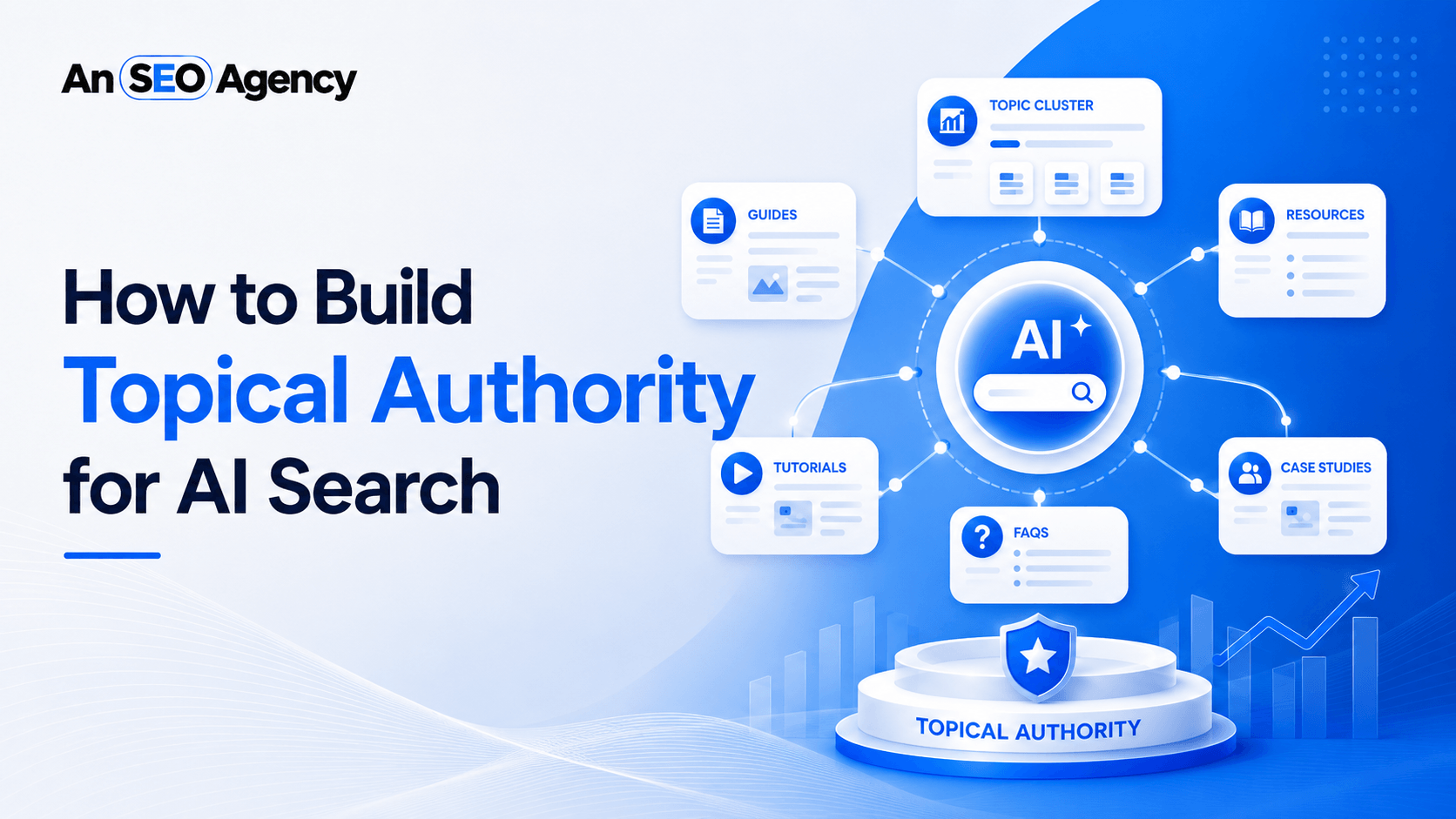
How to Build Content Clusters for AI Search
A content cluster is a group of related pages connected around one main topic.
It usually includes:
- One pillar page
- Several supporting blogs
- Related service pages
- FAQs
- Case studies
- Internal links
- External references
The pillar page gives a broad overview. Supporting blogs answer specific questions. Service pages explain how your business helps. Case studies prove real-world expertise.
For example, a topical authority cluster around AI search could work like this:
Pillar page
AI Search Optimization Guide for Businesses
Supporting blogs
- How to Build Topical Authority for AI Search
- SEO vs AEO vs GEO
- How to Optimize Blogs for Google AI Overviews
- How Brand Mentions Improve AI Search Visibility
- How Internal Linking Helps AI Tools Understand Your Website
- How to Use Schema Markup for AI Search Visibility
Service pages
- SEO Services
- Technical SEO
- Content Marketing Services
- Link Building Services
For example, when a blog explains technical SEO, it can naturally guide readers toward AN SEO Agency’s Technical SEO services or the existing blog on Why Technical SEO Matters for Website Performance in 2026.
This helps users find useful next steps while helping search engines understand topic relationships.
Why Internal Linking Matters
Internal linking is one of the strongest ways to build topical authority.
It helps users discover related content. It also helps search engines understand which pages are connected and which pages are important.
For example, a blog about topical authority can link to older AN SEO Agency articles about How to Use AEO for Brand Visibility when discussing answer-based content. It can also link to How to Protect Your Online Reputation With ORM when discussing brand trust and online credibility.
Good internal links should:
- Use natural anchor text
- Support the current section
- Help the reader learn more
- Connect related topics
- Avoid forced exact-match keywords
- Link to old blogs and service pages
- Support the main content cluster
However, internal links should not feel random. They should help the reader continue learning.
For example, if a section discusses brand mentions in AI search, linking to a blog about ChatGPT and Perplexity mentions makes sense. If a section discusses website performance, linking to a technical SEO article makes sense.
This creates a stronger content ecosystem.
How E-E-A-T Supports Topical Authority
E-E-A-T stands for experience, expertise, authoritativeness and trustworthiness.
Although E-E-A-T is not a single ranking score, it reflects quality signals that matter for trust. For AI search, these signals become even more important because AI tools need reliable sources before summarizing information.
Businesses can improve E-E-A-T by adding:
- Real author information
- Expert quotes
- Case studies
- Client examples
- Customer reviews
- Transparent contact details
- Updated content
- Clear service descriptions
- Reliable external sources
- Helpful internal resources
For example, if a blog claims that AI search is changing SEO, it should explain how and support important points with trusted sources like Google Search Central.
Additionally, businesses should avoid vague claims. Saying “we are experts” is not enough. Instead, prove expertise through helpful content, examples, service details and case studies.
AN SEO Agency’s SEO service page already positions the company around search visibility, traffic generation, technical improvements and digital growth. Linking educational blogs to SEO services helps connect expertise with commercial intent.
How Schema Markup Helps AI Understand Content
Schema markup is structured data that helps search engines understand page content more clearly.
It does not guarantee AI search visibility. However, it can support better understanding of your website, business, services, articles, FAQs, reviews and breadcrumbs.
Google’s structured data documentation explains that structured data gives Google explicit clues about page meaning.
For topical authority, useful schema types include:
- Organization schema
- Article schema
- FAQ schema
- Breadcrumb schema
- Service schema
- LocalBusiness schema
- Review schema
- Product schema where relevant
For example, an article about topical authority can use Article schema. A service page can use Service schema. A local agency page can use LocalBusiness schema. FAQ sections can use FAQ schema when appropriate.
However, schema should match visible content. Do not add fake reviews, fake ratings, or services not shown on the page.
Schema works best when your content is already helpful, clear and well structured.
How Brand Mentions Support AI Visibility
Brand mentions help AI tools understand your business beyond your own website.
A brand mention happens when another website, directory, review platform, publication, partner page, or social profile mentions your brand. Sometimes it includes a backlink. Sometimes it does not. Both can support brand recognition.
For topical authority, brand mentions matter because they reinforce your expertise across the web.
Strong brand mention sources include:
- Industry blogs
- Guest posts
- Local directories
- Digital PR articles
- Review platforms
- Social media profiles
- Podcast pages
- Partner websites
- Case study pages
- Business listings
For example, if multiple trusted websites mention AN SEO Agency in relation to SEO, AEO, GEO and AI search optimization, search systems can better understand the brand’s topic relevance.
This is also why AN SEO Agency’s blog on How to Get Your Brand Mentioned in ChatGPT and Perplexity is a useful supporting article for an AI search content cluster.
Moreover, brand mentions help connect topical authority with real-world credibility.
Local Topical Authority for Businesses
Local businesses can also build topical authority for AI search.
For example, a local SEO agency, dentist, lawyer, contractor, hotel, or restaurant should not only optimize one homepage. It should create location-relevant content that answers local customer questions.
A local topical authority strategy may include:
- Location service pages
- Google Business Profile optimization
- Local FAQs
- Customer reviews
- Local case studies
- Local citations
- Local backlinks
- Service-area content
- Review response strategy
- Location-specific blog topics
Google’s Business Profile Help gives businesses official guidance for managing visibility across Google Search and Maps.
For AN SEO Agency, location pages such as SEO Agency in United States help support geographic relevance. In addition, local SEO articles can support AI search when they answer location-based service questions clearly.
For example, a local customer may ask an AI tool, “Which SEO agency helps small businesses in the United States?” Strong local content and reviews can improve the chances of being understood as relevant.
Technical SEO and Topical Authority
Technical SEO supports topical authority because search engines need to access and understand your content.
Even the best content cluster can fail if the website has crawl problems, broken links, slow pages, poor mobile usability, or confusing navigation.
Important technical SEO elements include:
- Crawlable pages
- Indexable content
- Fast loading speed
- Mobile-friendly design
- Clean URLs
- XML sitemap
- Internal links
- Core Web Vitals
- HTTPS security
- Proper redirects
- Canonical tags
- No broken pages
- Accessible design
Google’s technical requirements for Search explain the minimum technical conditions needed for pages to appear in Google Search.
Moreover, Google’s Core Web Vitals documentation explains important user experience metrics related to loading, responsiveness and visual stability.
Therefore, topical authority is not only about writing more blogs. It also requires a website that performs well and makes content easy to crawl, index and navigate.
Comparison Table: Random Blogging vs Topical Authority
| Area | Random Blogging | Topical Authority Strategy |
| Content planning | Topics are chosen randomly | Topics follow a clear content cluster |
| SEO value | Pages compete separately | Pages support each other |
| AI search value | Weak context | Strong topic understanding |
| Internal links | Few or random links | Strategic links between related pages |
| User journey | Visitors may leave quickly | Visitors find helpful next steps |
| Authority | Hard to prove expertise | Easier to show depth and trust |
| Updates | Old blogs become outdated | Old blogs are refreshed and connected |
| Conversion | Weak path to services | Clear path from content to service pages |
A topical authority strategy creates better structure for users, Google and AI search tools.
Mini Case Study
Imagine a small digital marketing company that wants to rank for AI search topics.
At first, the company publishes random blogs. One article covers SEO tips, another discusses social media and another talks about PPC. However, the blogs do not link to each other and none of them build deep authority around one topic.
As a result, the website has content, but it does not look like a strong source on AI search.
Then, the company builds a topical authority strategy.
First, it chooses AI search optimization as the main topic. Next, it creates supporting blogs about AEO, GEO, Google AI Overviews, topical authority, content clusters, internal linking, schema markup, brand mentions and technical SEO.
After that, the company links related blogs together. It also adds trusted external sources, improves service pages, updates old blogs and adds FAQs to important pages.
Over time, search engines can understand the website more clearly. Users also find more helpful information. As a result, the business improves its chances of ranking in traditional search and appearing in AI-powered answers.
This example shows why topical authority works better than publishing disconnected blogs.
Expert Quote
“Topical authority for AI search is not about publishing more content. It is about creating the clearest, most connected and most trustworthy content ecosystem around the questions your customers already ask.”
Common Mistakes to Avoid
Publishing disconnected blogs
Random blogs do not build strong topic depth. Every blog should support a larger content cluster.
Ignoring internal links
Without internal links, search engines may struggle to understand how your pages connect.
Targeting only keywords
Keywords matter, but topical authority requires full subject coverage, user questions and semantic relationships.
Writing thin content
Short and vague content does not prove expertise. Businesses should provide useful answers, examples and practical steps.
Forgetting old blogs
Old blogs can support new content when they are updated and linked properly.
Ignoring technical SEO
A content cluster cannot perform well if pages are slow, broken, blocked, or hard to crawl.
Skipping external sources
Trusted external links help support credibility, especially when discussing SEO, AI search and Google updates.
Topical Authority Checklist
Use this checklist to build topical authority for AI search:
- Choose one core topic
- Define supporting subtopics
- Create a pillar page
- Write supporting blog posts
- Add internal links to old blogs
- Link to relevant service pages
- Add external sources naturally
- Use direct answers
- Add FAQ sections
- Keep FAQ questions under 150 characters
- Use comparison tables
- Include examples and case studies
- Add expert quotes
- Use schema markup
- Improve page speed
- Fix broken links
- Update old content
- Build brand mentions
- Track rankings and AI visibility
- Review content every few months
This checklist helps businesses move from random content publishing to strategic authority building.
FAQs
What is topical authority in SEO?
Topical authority means your website deeply covers a subject and becomes a trusted resource on that topic.
Why does topical authority matter for AI search?
It helps AI tools understand your expertise, content depth and trustworthiness across a complete topic.
How do I build topical authority?
Build topic clusters, publish helpful blogs, use internal links, add FAQs, update content and prove expertise.
Do internal links help topical authority?
Yes. Internal links help search engines understand relationships between related pages and topic clusters.
Is topical authority better than keyword SEO?
Topical authority is not a replacement. It improves keyword SEO by adding depth, context and better structure.
Can small businesses build topical authority?
Yes. Small businesses can build authority by answering customer questions and creating focused content clusters.