
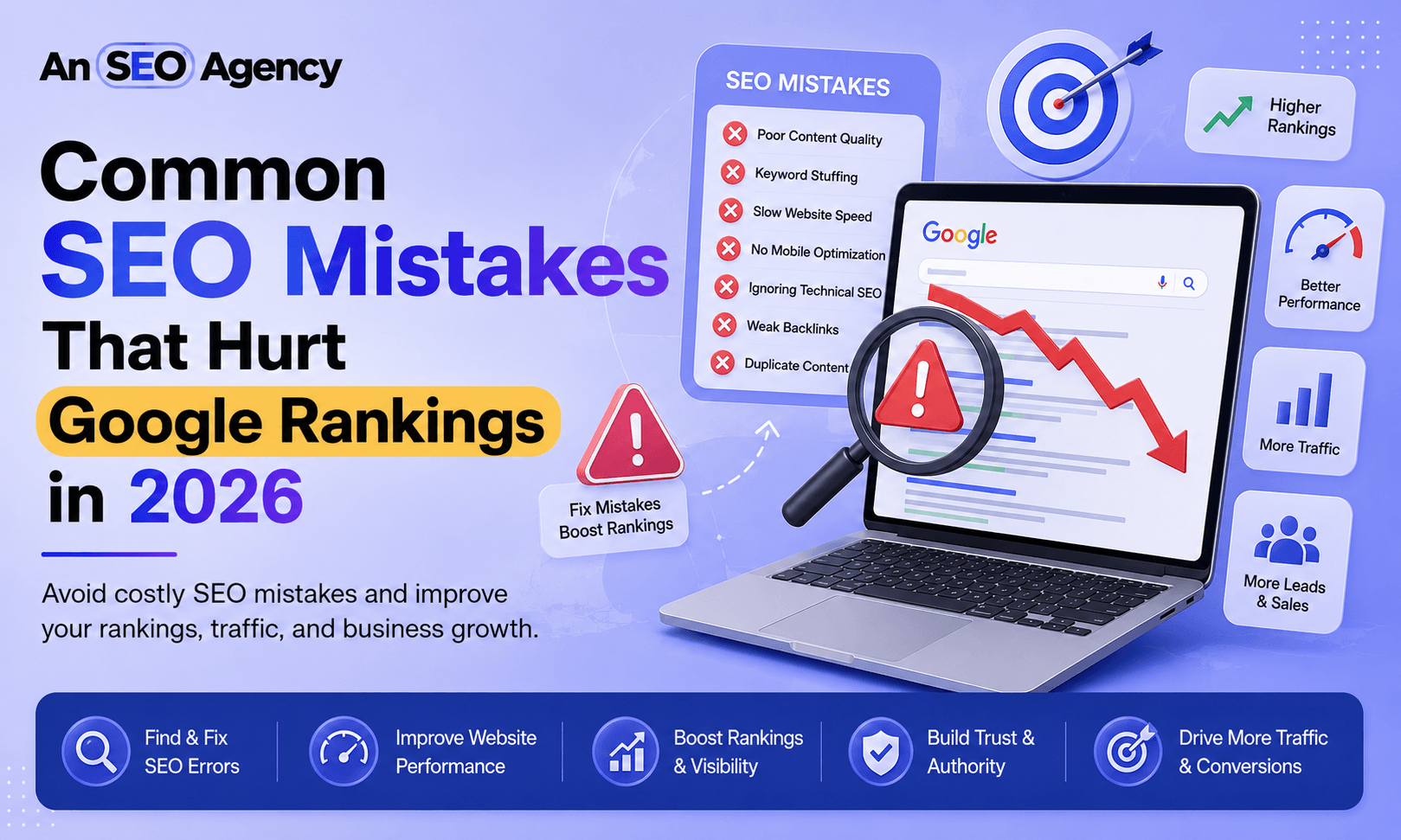
Common SEO Mistakes That Hurt Google Rankings in 2026
- Introduction
- Why SEO Mistakes Affect Google Rankings
- Ignoring Search Intent
- Publishing Low-Quality AI-Generated Content
- Poor Website Speed and Core Web Vitals
- Weak Mobile Optimization
- Keyword Stuffing and Over-Optimization
- Ignoring Technical SEO
- Weak Internal Linking Structure
- Missing Schema Markup and Structured Data
- Duplicate Content and Cannibalisation Issues
- Poor User Experience and Website Design
- Ignoring E-E-A-T and Trust Signals
- Not Optimizing for AI Search and AEO
- Weak Backlink Strategy
- Ignoring Content Updates and Freshness
- Comparison Table: Outdated SEO vs Modern SEO in 2026
- Mini Case Study
- Complete SEO Improvement Checklist
- FAQs
- Introduction
- Why SEO Mistakes Affect Google Rankings
- Ignoring Search Intent
- Publishing Low-Quality AI-Generated Content
- Poor Website Speed and Core Web Vitals
- Weak Mobile Optimization
- Keyword Stuffing and Over-Optimization
- Ignoring Technical SEO
- Weak Internal Linking Structure
- Missing Schema Markup and Structured Data
- Duplicate Content and Cannibalisation Issues
- Poor User Experience and Website Design
- Ignoring E-E-A-T and Trust Signals
- Not Optimizing for AI Search and AEO
- Weak Backlink Strategy
- Ignoring Content Updates and Freshness
- Comparison Table: Outdated SEO vs Modern SEO in 2026
- Mini Case Study
- Complete SEO Improvement Checklist
- FAQs
Introduction
SEO in 2026 is more advanced, competitive, and user-focused than ever before. However, common SEO mistakes still hurt Google rankings. Search engines no longer rank websites based only on keywords and backlinks. Instead, Google now evaluates overall website quality, helpful content, technical performance, user experience, trust signals, and search intent satisfaction.
As a result, many businesses lose rankings because they continue using outdated SEO practices or ignore important optimization factors.
Moreover, AI-powered search experiences are changing how users discover content online. Search engines can now better understand:
- User behavior
- Content quality
- Website expertise
- Search intent
- User experience
- Technical performance
Therefore, businesses that ignore modern SEO strategies may experience:
- Lower rankings
- Reduced traffic
- Higher bounce rates
- Poor engagement
- Fewer leads and conversions
Understanding and fixing common SEO mistakes can help websites improve visibility, authority, and long-term organic growth.
Why SEO Mistakes Affect Google Rankings
Google’s goal is to provide users with the most useful, relevant, trustworthy, and high-quality results.
If a website is:
- Slow
- Difficult to navigate
- Poorly optimized
- Technically weak
- Full of thin content
- Unhelpful for users
then rankings can decline significantly.
Additionally, Google’s algorithms now focus heavily on:
- Helpful content
- Core Web Vitals
- Mobile usability
- E-E-A-T signals
- Content quality
- Technical SEO
- Search intent satisfaction
Even small SEO problems can reduce crawlability, indexing, engagement, and ranking performance over time.
Therefore, businesses should regularly audit and optimize their websites.
Ignoring Search Intent
One of the biggest SEO mistakes businesses make in 2026 is focusing only on keywords instead of understanding user intent.
Search intent refers to the reason behind a user’s search query.
For example:
A user searching:
“Best CRM software for small businesses�
expects:
- Product comparisons
- Features
- Pricing
- Reviews
- Recommendations
- Pros and cons
If the page only repeats keywords without answering these questions clearly, Google may rank competitors higher.
Types of search intent
Businesses should optimize content for:
- Informational intent
- Transactional intent
- Navigational intent
- Commercial investigation intent
How to optimize for search intent
To improve rankings:
- Analyze competitor content
- Answer user questions directly
- Add FAQs
- Use comparison tables
- Include examples and case studies
- Match content format to user expectations
Search intent optimization is now essential for modern SEO success.
Publishing Low-Quality AI-Generated Content
AI content tools are becoming widely used, but publishing generic AI-written articles without human improvement is a major SEO mistake.
Google prioritizes:
- Helpful content
- Experience-based insights
- Expertise
- Originality
- Real value
Problems with low-quality AI content
Thin AI-generated content often:
- Repeats generic information
- Lacks unique insights
- Misses real-world experience
- Provides poor user value
- Sounds robotic
Better approach for AI-assisted SEO content
Businesses should combine:
- Human expertise
- AI assistance
- Real examples
- Statistics
- Case studies
- Original opinions
- Industry insights
AI should support content creation, not fully replace expertise.
Poor Website Speed and Core Web Vitals
Website speed remains one of the most important SEO ranking factors in 2026.
Users expect fast-loading pages. If a website takes too long to load, visitors often leave quickly.
Google also measures page experience using Core Web Vitals such as:
- Largest Contentful Paint (LCP)
- Interaction to Next Paint (INP)
- Cumulative Layout Shift (CLS)
Common speed-related SEO mistakes
Businesses often:
- Upload uncompressed images
- Use heavy scripts
- Ignore caching
- Choose poor hosting
- Overuse plugins
- Load unnecessary fonts and animations
How to improve website speed
Businesses should:
- Compress images
- Use caching
- Optimize code
- Reduce JavaScript
- Improve hosting quality
- Enable lazy loading
- Optimize mobile performance
Fast websites improve:
- Rankings
- User engagement
- Conversion rates
- Crawl efficiency
Weak Mobile Optimization
Google uses mobile-first indexing, meaning it primarily evaluates the mobile version of websites.
Therefore, poor mobile optimization can significantly hurt rankings and conversions.
Common mobile SEO mistakes
- Small unreadable text
- Slow mobile loading speed
- Broken layouts
- Difficult navigation
- Poor button spacing
- Intrusive popups
Mobile SEO best practices
Businesses should:
- Use responsive design
- Optimize images for mobile
- Improve touch usability
- Simplify navigation
- Test across devices
- Improve mobile page speed
Mobile experience directly impacts SEO and user satisfaction.
Keyword Stuffing and Over-Optimization
Repeating keywords unnaturally is an outdated SEO strategy that can negatively affect rankings.
Search engines now understand:
- Context
- Topics
- Semantic relationships
- Natural language
Common over-optimization mistakes
- Excessive keyword repetition
- Spammy anchor text
- Forced headings
- Over-optimized meta tags
Better SEO approach
Instead of stuffing keywords:
- Write naturally
- Use related terms
- Focus on readability
- Optimize for topics
- Answer user questions thoroughly
Helpful content performs better than overly optimized content.
Ignoring Technical SEO
Technical SEO creates the foundation for website performance and search visibility.
Even strong content may struggle to rank if technical SEO is poor.
Common technical SEO mistakes
- Broken links
- Crawl errors
- Duplicate pages
- Missing XML sitemap
- Incorrect redirects
- Slow page speed
- Weak site architecture
- Missing HTTPS
Why technical SEO matters
Technical SEO helps:
- Improve crawlability
- Improve indexing
- Improve performance
- Support rankings
- Improve user experience
Businesses should regularly perform technical SEO audits.
Weak Internal Linking Structure
Internal linking helps search engines understand website structure and page relationships.
Weak internal linking can:
- Reduce crawl efficiency
- Limit authority flow
- Make navigation confusing
Internal linking best practices
Businesses should:
- Link related pages naturally
- Create topic clusters
- Use descriptive anchor text
- Strengthen service page authority
- Improve user navigation
Strong internal linking supports both SEO and user experience.
Missing Schema Markup and Structured Data
Structured data helps search engines understand website content more clearly.
Without schema markup, websites may miss opportunities for:
- Rich snippets
- Enhanced search listings
- Better click-through rates
- AI search visibility
Common schema types
Businesses should use:
- FAQ schema
- Organization schema
- Review schema
- Product schema
- Local business schema
- Article schema
Schema markup improves search appearance and content understanding.
Duplicate Content and Cannibalisation Issues
Duplicate content can confuse search engines and weaken rankings.
Keyword cannibalisation happens when multiple pages compete for the same keyword.
Common duplicate content problems
- Similar service pages
- Repeated blog topics
- Duplicate metadata
- Multiple URL versions
- Thin location pages
How to avoid duplication
Businesses should:
- Create unique pages
- Use canonical tags
- Consolidate overlapping content
- Optimize keyword targeting carefully
Unique content improves authority and rankings.
Poor User Experience and Website Design
User experience now strongly influences SEO performance.
If users struggle to navigate a website, engagement decreases and bounce rates increase.
Common UX mistakes
- Cluttered layouts
- Poor readability
- Intrusive ads
- Confusing navigation
- Weak CTAs
- Poor accessibility
Better UX practices
Businesses should:
- Simplify layouts
- Improve readability
- Use clear headings
- Optimize navigation
- Improve accessibility
- Guide users toward action
Search engines reward websites that create positive user experiences.
Ignoring E-E-A-T and Trust Signals
Google increasingly values:
- Experience
- Expertise
- Authoritativeness
- Trustworthiness
These E-E-A-T signals help Google evaluate content quality.
Missing trust signals can hurt SEO
Businesses often forget:
- Author information
- Reviews
- Testimonials
- Case studies
- Contact details
- Privacy policies
Trust-building elements improve both SEO and conversions.
Not Optimizing for AI Search and AEO
AI-powered search and Answer Engine Optimization (AEO) are growing rapidly.
Businesses that ignore conversational search optimization may lose visibility in AI-generated answers.
How to optimize for AI search
Businesses should:
- Answer questions directly
- Add FAQ sections
- Use conversational headings
- Structure content logically
- Improve semantic SEO
- Add schema markup
AEO is becoming increasingly important in 2026.
Weak Backlink Strategy
Backlinks still matter, but low-quality link-building tactics can damage rankings.
Common backlink mistakes
- Buying spam links
- Irrelevant guest posts
- Link farms
- Excessive exact-match anchors
Better backlink strategy
Businesses should focus on:
- Digital PR
- Authority content
- Industry partnerships
- High-quality mentions
- Natural link acquisition
Quality matters far more than quantity.
Ignoring Content Updates and Freshness
Outdated content can gradually lose rankings over time.
Many businesses publish blogs once and never update them.
Why content freshness matters
Regular updates help:
- Improve relevance
- Add new information
- Match current trends
- Improve rankings
- Increase engagement
Businesses should regularly refresh old content with:
- Updated statistics
- New insights
- Better structure
- Improved SEO optimization
Comparison Table: Outdated SEO vs Modern SEO in 2026
| Area | Outdated SEO | Modern SEO |
| Keywords | Keyword stuffing | Intent-focused optimization |
| Content | Thin AI content | Helpful expert-driven content |
| Mobile SEO | Desktop-first design | Mobile-first optimization |
| Technical SEO | Ignored | Strong technical foundation |
| UX | Cluttered layouts | User-focused experiences |
| Backlinks | Spammy link building | Authority-based links |
| Search Optimization | Traditional SEO only | SEO + AEO optimization |
| Content Strategy | Publish only | Continuous optimization |
Mini Case Study
A business website experienced declining rankings despite publishing regular content.
After a complete SEO audit, several issues were discovered:
- Thin AI-generated blogs
- Poor mobile usability
- Slow loading speed
- Weak internal linking
- Missing schema markup
- Search intent mismatch
First, technical SEO issues were fixed and website speed improved.
Then, old blogs were updated with:
- Better formatting
- FAQs
- Real examples
- Internal links
- Stronger search intent targeting
After several months:
- Organic traffic increased
- Bounce rate decreased
- User engagement improved
- Rankings recovered significantly
This shows how fixing SEO mistakes can dramatically improve website performance.
Complete SEO Improvement Checklist
Content Optimization Checklist
- Focus on user intent
- Create helpful content
- Avoid keyword stuffing
- Add FAQs
- Include real examples
- Update old content regularly
Technical SEO Checklist
- Improve page speed
- Fix crawl errors
- Optimize Core Web Vitals
- Use HTTPS
- Add XML sitemap
- Improve mobile usability
UX Optimization Checklist
- Simplify navigation
- Improve readability
- Optimize CTAs
- Reduce intrusive popups
- Improve accessibility
AI Search & AEO Checklist
- Add conversational content
- Use schema markup
- Answer questions directly
- Improve semantic SEO
- Structure headings clearly
FAQs
What are the most common SEO mistakes in 2026?
Common SEO mistakes include keyword stuffing, poor mobile optimization, weak technical SEO, low-quality AI content, slow website speed, and ignoring search intent.
Does website speed affect Google rankings?
Yes. Website speed and Core Web Vitals directly impact rankings, user experience, engagement, and conversions.
Why is search intent important for SEO?
Search intent helps search engines determine whether content satisfies user needs and expectations effectively.
Can AI-generated content hurt SEO?
Low-quality AI-generated content can hurt SEO if it lacks originality, expertise, helpfulness, and real value.