
Is AI Making Every Brand Look the Same? The Hidden Cost of Automated Marketing
- Introduction
- Is AI Making Every Brand Look the Same?
- Why AI-Generated Marketing Content Looks Similar
- What Research Reveals About AI and Brand Originality
- The Hidden Costs of Automated Marketing
- How AI Affects Brand Identity and Differentiation
- AI-Generated Content and SEO Performance
- Why AI-Generated Visuals Can Damage Brand Recognition
- When AI Helps Marketing Instead of Hurting It
- AI Marketing vs Human-Led Marketing
- How to Maintain a Unique Brand Identity While Using AI
- A Practical AI Marketing Workflow for Businesses
- How to Measure Whether Your Brand Is Becoming Too Generic
- Industry Examples: How Businesses Can Avoid Generic AI Marketing
- Expert Opinion: What Marketing Researchers Say
- Common AI Marketing Mistakes Businesses Should Avoid
- Frequently Asked Questions
- Introduction
- Is AI Making Every Brand Look the Same?
- Why AI-Generated Marketing Content Looks Similar
- What Research Reveals About AI and Brand Originality
- The Hidden Costs of Automated Marketing
- How AI Affects Brand Identity and Differentiation
- AI-Generated Content and SEO Performance
- Why AI-Generated Visuals Can Damage Brand Recognition
- When AI Helps Marketing Instead of Hurting It
- AI Marketing vs Human-Led Marketing
- How to Maintain a Unique Brand Identity While Using AI
- A Practical AI Marketing Workflow for Businesses
- How to Measure Whether Your Brand Is Becoming Too Generic
- Industry Examples: How Businesses Can Avoid Generic AI Marketing
- Expert Opinion: What Marketing Researchers Say
- Common AI Marketing Mistakes Businesses Should Avoid
- Frequently Asked Questions
Introduction
Is AI making brands look the same? It is becoming an important question for businesses investing in AI-generated marketing content, automated advertising, social media management and content creation.
Artificial intelligence has changed digital marketing dramatically. Businesses can now generate blogs, social media captions, advertisements, emails, website copy, images and videos within minutes.
What previously required several hours of writing, designing and planning can often be completed much faster.
However, there is a growing problem.
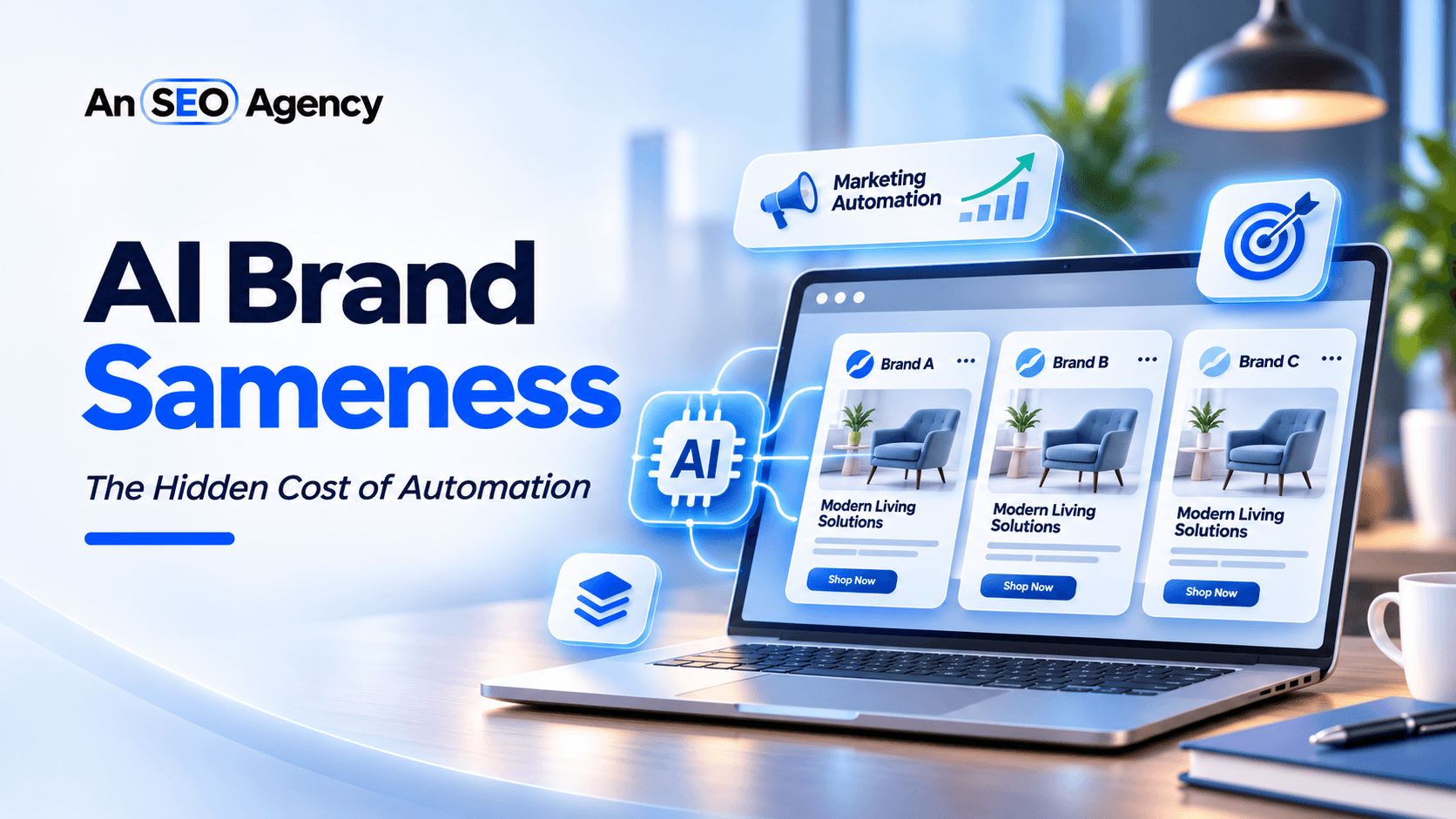
When thousands of businesses use similar AI tools, similar prompts and similar content templates, their marketing can start sounding and looking remarkably alike.
The same phrases appear in advertisements. The same polished images appear across websites. Social media captions use similar structures, while brand messaging becomes increasingly generic.
As a result, businesses may publish more content without becoming more recognizable.
This creates a difficult question: If every brand uses AI to produce professional-looking marketing, what makes one business different from another?
The answer is not to stop using AI. Instead, businesses need to reconsider how they combine automation with original thinking, customer understanding and brand strategy.
At AN SEO Agency, we believe successful digital marketing should combine technological efficiency with meaningful differentiation. AI can help businesses produce content, but a distinctive identity is what helps customers remember and choose a brand.
Is AI Making Every Brand Look the Same?
Featured Snippet Answer
AI can make brands look and sound similar when businesses rely on generic prompts, automated content templates and AI-generated visuals without clear brand guidelines. Although automation improves production efficiency, excessive dependence can weaken originality, customer trust and differentiation. Businesses can avoid this by combining AI with human creativity, original research and consistent branding.
Why Are Brands Starting to Look Similar?
Imagine opening five websites belonging to different digital marketing agencies.
Each website uses similar headlines:
- Transform Your Digital Presence
- Unlock Your Business Potential
- Innovative Solutions for Business Growth
- Take Your Brand to the Next Level
- Empowering Businesses Through Technology
These statements are not necessarily wrong.
However, they communicate almost nothing distinctive about the companies using them.
A potential customer cannot easily understand which company has better experience, which offers specialized services or why one agency deserves attention.
Now imagine all five businesses also use similar AI-generated graphics, website layouts and social media captions.
The result is a market where brands appear professional but increasingly interchangeable.
This is one of the central risks of automated marketing.
AI can improve how quickly businesses produce content. However, speed alone does not create a memorable brand.
Why AI-Generated Marketing Content Looks Similar
Several factors contribute to the growing similarity between AI-assisted marketing campaigns.
1. Businesses Use Similar AI Prompts
Many marketers enter basic instructions such as:
“Write an engaging social media post for a digital marketing agency.”
Or:
“Create professional website content for an SEO company.”
These prompts do not explain the company’s audience, expertise, positioning, personality or competitive advantages.
As a result, AI often produces conventional marketing language.
For example, it may emphasize innovation, quality, customer satisfaction and business growth because these themes appear frequently in marketing content.
However, almost every competitor can make similar claims.
What Should Businesses Do Instead?
A stronger prompt should provide meaningful brand context.
For example:
“Write a LinkedIn post for an SEO agency serving small businesses. Our audience consists of business owners struggling with low-quality leads. Use a direct, educational tone. Explain one common SEO mistake, include a practical example and avoid generic promotional language.”
This gives AI a clearer direction.
However, even detailed prompts should not replace original experience or genuine business insights.
2. AI Learns From Existing Content Patterns
Generative AI models learn patterns from large amounts of training data.
They can produce useful explanations, compelling headlines and creative ideas. However, their outputs may also reflect widely repeated language and familiar content structures.
Consequently, businesses using similar systems for similar tasks may receive overlapping ideas.
For example, an AI tool asked to generate a content marketing strategy may repeatedly suggest:
- Publish educational blogs
- Build topical authority
- Optimize website content
- Post consistently on social media
- Track marketing performance
These suggestions can be helpful.
However, they are not automatically a differentiated strategy.
What matters is how the business applies them to its audience, industry and competitive environment.
3. Automated Design Tools Encourage Visual Similarity
AI-generated marketing visuals can also reduce differentiation.
Businesses often use image generators and design platforms to create banners, product illustrations and social media graphics.
Without detailed brand guidance, the results may rely on familiar visual elements:
- Blue and purple gradients
- Glowing technology backgrounds
- Generic office environments
- Floating analytics dashboards
- Artificial-looking business professionals
- Similar illustrations and icon styles
These designs can appear attractive individually.
However, when many businesses use comparable visuals, the overall branding becomes less memorable.
A strong visual identity requires more than attractive graphics. It needs distinctive colors, typography, photography, composition and recognizable brand elements.
4. Marketing Automation Prioritizes Efficiency
Marketing automation platforms are designed to make repetitive tasks faster.
For example, businesses can automate email sequences, social media scheduling, ad variations and customer segmentation.
However, when teams prioritize quantity over strategy, they may publish content without reviewing whether it reflects the brand.
The result can be more campaigns but less differentiation.
Automation should improve execution. It should not become a replacement for brand thinking.
What Research Reveals About AI and Brand Originality
The concern that AI-generated content can become repetitive is supported by research.
However, it is important to distinguish the evidence from broader marketing assumptions. Studies involving writing and creative ideation demonstrate potential homogenization effects, but they do not prove that every AI-assisted advertising campaign performs poorly.
Study 1: AI Can Improve Individual Creativity While Reducing Diversity
A study published in Science Advances in 2024 examined how generative AI affected creative storytelling.
The researchers found that access to AI-generated ideas could improve how creative and enjoyable individual stories appeared.
However, stories created with AI assistance also became more similar to one another.
The study, Generative AI Enhances Individual Creativity but Reduces Collective Diversity, demonstrates an important trade-off.
AI can help an individual produce stronger work while potentially reducing the overall variety of ideas produced across a group.
For marketing teams, this suggests that AI-assisted creative quality and brand distinctiveness should be evaluated separately.
Study 2: AI-Generated Writing Can Reduce Creative Diversity
A 2025 study published in Computers in Human Behavior: Artificial Humans examined 2,200 college admissions essays across three preregistered studies.
Researchers found that additional human-written essays introduced more new ideas than additional GPT-generated essays.
The difference grew as the number of essays increased.
The researchers also found that changes to prompts and model parameters did not eliminate the overall diversity gap.
The study, Homogenizing Effect of Large Language Models on Creative Diversity, suggests that widespread use of similar AI systems can reduce collective originality.
Although college admissions essays differ from marketing campaigns, the findings offer a useful warning for businesses publishing AI-generated content at scale.
Study 3: Consumer Trust in AI Marketing Is Under Pressure
A March 2026 survey from Gartner found that 50% of surveyed U.S. consumers preferred brands that avoided generative AI in consumer-facing content.
The survey included 1,539 U.S. consumers and was conducted in October 2025.
Additionally, 68% reported frequently questioning whether the content and information they encountered was real.
These findings, published in Gartner’s research on consumer attitudes toward AI-generated marketing, highlight the importance of authenticity and transparency.
The findings represent surveyed U.S. consumers rather than every customer worldwide. Nevertheless, they show why brands should not assume customers automatically welcome AI-generated advertising.
What These Studies Mean for Businesses
Together, the studies highlight three important considerations.
First, AI can improve production efficiency and individual creative output.
Second, repeated use of similar AI systems can contribute to more homogeneous content.
Third, customers may become skeptical when marketing feels synthetic or difficult to verify.
Therefore, businesses should use AI thoughtfully rather than treating automated content volume as a primary measure of marketing success.
The Hidden Costs of Automated Marketing
AI marketing is often promoted as a way to reduce expenses.
Businesses can save time on writing, design and campaign production.
However, the direct cost of producing content is only one part of the equation.
There are additional costs that businesses may overlook.
1. Loss of Brand Differentiation
One of the biggest hidden costs is losing the characteristics that make your brand recognizable.
Brand differentiation explains why customers should choose your company instead of another business offering similar services.
For example, an SEO agency may specialize in technical SEO, while another focuses on local lead generation.
If both agencies publish identical messaging about helping businesses grow, potential customers may never understand the difference.
This can turn a meaningful service decision into a price comparison.
As a result, businesses may struggle to justify premium pricing or communicate specialized expertise.
2. Reduced Customer Trust
Customers increasingly evaluate whether online content appears authentic.
A website filled with unrealistic testimonials, artificial-looking team photographs and generic claims may raise questions.
For example, an AI-generated photograph of a fictional office team could create a misleading impression if visitors believe those people represent actual employees.
Similarly, AI-generated case studies that describe results the company never achieved can seriously damage credibility.
Businesses should distinguish between illustrative content and factual representations.
Authenticity is especially important for industries where trust influences purchasing decisions.
3. Weaker Emotional Connections
Customers do not remember brands only because those brands publish information.
They remember experiences, personalities, stories and meaningful interactions.
For example, a local business sharing the story of how it solved a difficult customer problem may create a stronger connection than a generic post about customer satisfaction.
AI can help present that story.
However, the real experience must come from the business.
Without genuine human input, marketing can become technically polished but emotionally unconvincing.
4. Lower Content Value
Publishing more content does not automatically create more business value.
Consider a company producing 30 AI-generated blogs each month.
If most articles repeat information already available online, they may contribute little to customer education.
Meanwhile, a competitor publishing fewer articles with original research, useful examples and firsthand experience may offer a stronger reason for visitors to return.
This is particularly important for SEO.
Google’s guidance on using generative AI content says AI can help research and structure content, but generating large numbers of pages without adding value can violate its scaled content abuse policies.
Therefore, content volume should not become the main objective.
5. Increased Editing and Correction Costs
AI-generated content may require significant human review.
A business may save time producing a first draft but later need to correct:
- Inaccurate statements
- Unsupported statistics
- Generic examples
- Wrong product descriptions
- Inconsistent brand language
- Incorrect image details
- Unnecessary repetition
- Misleading promotional claims
If these problems are discovered after publication, the correction process can become even more expensive.
Therefore, businesses should calculate total production cost, including review and revision time, rather than only the time spent generating content.
6. Poorer Conversion Performance
When brands fail to communicate meaningful differences, customers may struggle to understand why they should take action.
For example, two landing pages may both promise quality service, experienced professionals and business growth.
However, a third landing page might explain a specific problem, demonstrate a clear process and provide credible evidence.
The third page gives visitors more information to support a decision.
Although conversion performance depends on many factors, clearer differentiation can help improve the relevance and persuasiveness of marketing messages.
How AI Affects Brand Identity and Differentiation
Brand identity consists of more than a logo.
It includes how a company communicates, behaves, presents its services and interacts with customers.
A distinctive brand may be recognized through its:
- Visual identity
- Writing style
- Tone of voice
- Customer experience
- Industry expertise
- Core values
- Original perspective
- Product or service positioning
- Consistent communication
AI can support these elements, but it needs guidance.
Brand Voice Matters More Than Ever
Imagine two companies posting about the same SEO update.
The first says:
“Stay ahead of the competition with our innovative SEO solutions designed to maximize your online potential.”
The second says:
“Your website traffic increased, but your leads didn’t. Before publishing another blog, check whether your service pages target the searches that actually bring customers.”
The first message is broad and promotional.
The second identifies a specific business problem and offers a practical direction.
This is what differentiated marketing looks like.
It does not need complicated language.
It needs relevance, clarity and perspective.
For more context, AN SEO Agency’s article on How AI Is Changing SEO Now explains why original, useful content remains important as search experiences evolve.
AI-Generated Content and SEO Performance
AI-generated content is not automatically harmful to SEO.
Google evaluates content quality and usefulness rather than banning content simply because AI helped produce it.
However, AI-generated content becomes problematic when businesses publish large quantities of repetitive material created primarily to attract search traffic.
Why Generic AI Content Struggles to Differentiate
Consider two businesses publishing articles about digital marketing trends.
Both use AI to produce general explanations about SEO, social media and PPC.
Neither article includes original research, practical experience or new observations.
From the reader’s perspective, there may be little reason to prefer one article over the other.
Google’s guidance for generative AI features in Search emphasizes the importance of valuable, unique content and original perspectives.
Therefore, businesses should focus on creating content that adds information customers cannot easily find everywhere else.
What Makes AI-Assisted Content More Valuable?
Useful content can include:
- Original research
- Firsthand experiences
- Accurate industry examples
- Expert analysis
- Product comparisons
- Customer questions
- Transparent limitations
- Practical recommendations
- Relevant visual demonstrations
- Updated information
For example, a digital marketing agency can explain what it discovered while auditing a website, provided it has permission to share the findings.
That analysis may offer more value than another generic SEO checklist.
Additionally, internal linking helps connect original content with relevant expertise. AN SEO Agency’s guide on SEO vs AEO vs GEO provides useful background on how traditional rankings and AI-powered discovery fit into a broader visibility strategy.
Why AI-Generated Visuals Can Damage Brand Recognition
Visual branding creates immediate impressions.
Customers may recognize a brand through its colors, photography, design language or illustrations before reading any text.
However, businesses that rely heavily on generic AI visuals can lose this visual consistency.
For example, a brand may use:
- One illustration style on its homepage
- A completely different style in its blogs
- Unrelated colors in social media posts
- Generic AI-generated people in advertisements
- Different logo variations across banners
Even if individual designs appear attractive, the overall brand may feel disconnected.
How to Maintain Visual Consistency
Businesses should establish clear design guidelines covering:
- Approved brand colors
- Original logo usage
- Typography
- Image composition
- Photography preferences
- Illustration style
- Graphic templates
- Spacing and layout
- Social media formats
- Website banner styles
AI image tools can then support an existing visual identity rather than inventing a different one for every campaign.
For example, a business could use AI to generate background concepts while retaining its original logo, brand colors and approved visual elements.
This preserves recognition while benefiting from faster design production.
When AI Helps Marketing Instead of Hurting It
AI is not the problem by itself.
The real issue is using AI without strategy or meaningful human oversight.
When used appropriately, AI can improve several marketing activities.
AI for Research
AI can help marketers organize research questions, identify topics to investigate and summarize information for review.
However, important claims should be verified using reliable sources.
AI for Content Planning
Businesses can use AI to generate editorial outlines, topic clusters and content calendars.
Human marketers should then decide which topics match customer needs and business priorities.
AI for Creative Exploration
AI can generate alternative headline concepts, campaign directions and design ideas.
However, a creative team should choose and refine ideas based on brand positioning.
AI for Marketing Automation
Automation can assist with reporting, campaign monitoring, scheduling, segmentation and routine customer communication.
For example, an ecommerce business can automate abandoned-cart reminders while still using personalized and brand-consistent messaging.
AI for SEO Analysis
AI tools can help organize keyword information, identify content gaps and summarize website data.
However, marketers still need to decide which opportunities matter commercially.
AN SEO Agency’s article on New Marketing Trends to Grow Business explains how automation, AI search, content, paid advertising and customer experience can support an integrated marketing strategy.
AI Marketing vs Human-Led Marketing
| Area | AI-Only Marketing | Human-Led, AI-Assisted Marketing |
| Content ideas | Often based on common patterns | Based on business goals and original insights |
| Brand voice | Can become generic | Guided by a distinctive identity |
| Research | Fast summaries that require verification | Verified information and business context |
| Visual design | May use familiar AI-generated styles | Follows established brand guidelines |
| Customer understanding | Depends on supplied data | Includes customer experience and direct feedback |
| Campaign production | Faster initial output | Efficient production with quality review |
| Storytelling | Can generate fictional or generic examples | Uses genuine experiences and approved stories |
| Consistency | Depends on prompts and workflows | Maintained through brand standards |
| Trust | May suffer from misleading content | Supported by authenticity and transparency |
| Best outcome | High output volume | More distinctive, relevant and useful marketing |
The strongest approach is usually a combination of human direction and AI efficiency.
How to Maintain a Unique Brand Identity While Using AI
Businesses do not need to abandon AI to protect originality.
Instead, they should establish clear standards for how AI supports marketing.
- Build a Detailed Brand Voice Guide
Before using AI for content creation, define the brand’s personality.
The guide should explain:
- Who the audience is
- How the brand communicates
- Which problems it solves
- What makes it different
- Which terms it prefers
- Which phrases it avoids
- What level of technical detail is appropriate
- How calls to action should sound
For example, a professional financial consulting firm may require precise and conservative language.
Meanwhile, a creative digital agency may use a more energetic and conversational style.
Both can use AI effectively, but their outputs should not sound identical.
- Give AI Original Business Information
Do not depend only on generic prompts.
Provide approved material such as:
- Real customer questions
- Service documentation
- Product details
- Approved testimonials
- Existing brand guidelines
- Verified statistics
- Original research
- Marketing strategy documents
This gives AI a stronger foundation.
- Use Real Customer Experiences
Customer experiences are valuable sources of distinctive content.
For example, a digital agency could explain a common problem customers face when their website receives traffic but generates few inquiries.
A healthcare provider could answer frequently asked questions based on real appointment discussions without revealing private patient information.
A retailer could explain which product features customers frequently misunderstand.
These details help content feel relevant and grounded.
- Maintain Human Editorial Control
Every important AI-generated asset should have an appropriate review process.
Editors should check:
- Factual accuracy
- Brand voice
- Originality
- Customer relevance
- Compliance
- Visual consistency
- Clarity
- Conversion intent
High-risk content involving health, finance, legal claims or customer guarantees deserves additional specialist review.
- Publish Less Generic Content
A strong marketing strategy should prioritize useful information over content volume.
Rather than publishing numerous repetitive articles, businesses should invest in distinctive resources.
These may include original research, detailed guides, transparent comparisons and practical insights.
For businesses working on AI search visibility, legitimate third-party recognition can also help demonstrate brand presence. AN SEO Agency’s guide on How to Get Your Brand Mentioned in ChatGPT and Perplexity provides additional context on brand discoverability.
- Protect Brand Authenticity
Businesses should avoid presenting fictional AI-generated testimonials, fabricated customer stories or synthetic employee photographs as real.
When AI-generated media could materially influence customer understanding, explain its illustrative nature where appropriate.
Authenticity should remain a core marketing principle.
A Practical AI Marketing Workflow for Businesses
Businesses can follow a structured workflow that combines efficient production with brand differentiation.
Step 1: Define the Business Objective
Start with the desired outcome.
Are you trying to improve brand awareness, generate qualified leads, increase sales or educate customers?
Without a clear objective, AI-generated content may look polished but serve no meaningful purpose.
Step 2: Collect Original Inputs
Gather customer questions, campaign data, relevant service details and verified business insights.
For example, if a business wants to publish an article about website conversion problems, the marketing team should investigate actual causes and practical solutions before generating the draft.
Step 3: Create a Brand-Specific Brief
The brief should explain the audience, topic, tone, desired outcome and differentiating message.
It should also identify unsupported claims and prohibited language.
Step 4: Use AI for the First Draft
Let AI assist with structure, phrasing and alternative ideas.
However, avoid treating the first output as a finished campaign.
Step 5: Add Human Expertise
This is the most important step.
Improve the draft with original analysis, real examples, brand-specific recommendations and accurate sources.
Remove anything generic, repetitive or unsupported.
Step 6: Review Visual and Editorial Consistency
Check whether the content looks and sounds like your brand.
For visual assets, verify original logos, approved colors, typography and consistency with previous campaigns.
Step 7: Publish and Measure
Track the business outcomes that matter.
These may include engagement, qualified inquiries, conversions, brand recall and repeat visits.
Step 8: Improve the Process
Use performance results and customer feedback to refine future campaigns.
The goal is not simply to generate content faster.
It is to produce better marketing with less unnecessary effort.
How to Measure Whether Your Brand Is Becoming Too Generic
Many businesses measure impressions, traffic, likes and conversions.
However, brand differentiation deserves attention too.
Brand Originality Audit
Review five recent blog posts, five advertisements and five social media graphics.
Then evaluate each asset using the following questions.
| Evaluation Area | Question to Ask | Warning Sign |
| Brand Voice | Does this sound like our business? | Could belong to any competitor |
| Original Insight | Does it provide something distinctive? | Repeats common advice |
| Customer Relevance | Does it address a real customer problem? | Uses vague promotional claims |
| Visual Identity | Does it follow our design guidelines? | Colors and styles change frequently |
| Credibility | Are claims backed by evidence? | Uses unsupported statistics |
| Brand Recognition | Would someone recognize the brand without the logo? | Looks like a generic template |
| Conversion Value | Does it explain why customers should choose us? | Offers no meaningful distinction |
Score each category from 0 to 2:
- 0: Weak or missing
- 1: Partially achieved
- 2: Clearly achieved
With seven categories, the maximum is 14 points.
This is a practical internal review framework, not a scientifically validated brand assessment scale.
A low score suggests that the content needs stronger differentiation before publication.
Additional Performance Metrics
Businesses can also monitor:
- Branded search interest
- Direct website visits
- Returning visitors
- Conversion rate
- Customer feedback
- Brand recall surveys
- Repeat purchases
- Qualified lead rates
- Creative fatigue
- Engagement quality
These metrics can provide useful context, although no single metric proves that AI-generated content is responsible for changes in brand recognition.
Industry Examples: How Businesses Can Avoid Generic AI Marketing
Example 1: Digital Marketing Agency
A generic AI-generated message might say:
“We provide innovative digital marketing solutions to help businesses grow.”
A stronger message would explain a specific problem:
“Getting more website traffic but fewer inquiries? Start by reviewing whether your highest-traffic pages match the services customers actually want.”
The second message gives the audience a clear reason to engage.
Example 2: Ecommerce Business
An automated product description might say:
“Discover premium quality and unmatched comfort.”
A stronger product description would explain materials, dimensions, fit, care instructions and the intended use.
This helps customers understand what they are purchasing.
Example 3: Local Service Business
A generic advertisement might say:
“Your trusted partner for professional home services.”
A more useful advertisement might describe the specific service, supported location, response process and what customers should expect.
It should avoid promising arrival times or outcomes that the business cannot consistently deliver.
Example 4: Professional Services
A generic website might focus on expertise and exceptional customer service.
A more differentiated website would explain the team’s qualifications, the types of cases or projects it handles, its working process and any verified examples it is permitted to share.
Across these industries, the principle remains the same.
The more clearly a business explains its genuine value, the less it needs to depend on generic marketing language.
Expert Opinion: What Marketing Researchers Say
Emily Weiss, Senior Principal Analyst in Gartner’s Marketing practice, offered an important observation in March 2026:
“Marketers should treat GenAI as a trust decision as much as a technology decision.”
The observation highlights a central challenge.
Businesses often evaluate AI tools by how much time or money they save.
However, marketers must also consider how AI affects the customer’s perception of authenticity, credibility and brand identity.
A campaign that costs less to produce may not be better if it weakens customer confidence.
Therefore, businesses should evaluate AI through two separate questions.
First, does it improve operational efficiency?
Second, does it preserve or strengthen the value customers associate with the brand?
Both questions matter.
Common AI Marketing Mistakes Businesses Should Avoid
Publishing AI Content Without Reviewing It
Every draft needs an accuracy and brand review before publication.
Using the Same Prompt for Every Campaign
Generic instructions can produce generic outcomes. Adapt prompts to the audience and objective.
Replacing Real Brand Photography Without a Reason
AI imagery can help illustrate concepts, but real team, product and location photographs often provide stronger factual credibility.
Ignoring Brand Guidelines
A new campaign should still follow established colors, logos, typography and visual standards.
Measuring Success Only by Content Volume
Publishing more posts does not automatically improve brand awareness, leads or revenue.
Inventing Testimonials and Case Studies
Never use AI to fabricate customer experiences, results or professional credentials.
Allowing Automation to Replace Customer Understanding
Customer interviews, support conversations and sales feedback remain important sources of insight.
Copying Competitors’ AI Content
Using AI to imitate competitors’ messaging may make your brand less distinctive.
Instead, focus on customer needs that competitors have not addressed effectively.
Frequently Asked Questions
Is AI making every brand look the same?
AI can contribute to similar branding when businesses use generic prompts, templates and automated content without a clear identity. However, distinctive inputs, human creativity and brand guidelines can reduce this risk.
Why does AI-generated marketing content sound similar?
AI models generate content using learned language patterns. Similar prompts and limited brand information can produce familiar phrases, structures and marketing messages.
Is AI-generated content bad for branding?
Not necessarily. AI can help brands produce useful content efficiently. Problems arise when automation replaces authentic messaging, original ideas and human oversight.
Can AI-generated content affect SEO rankings?
AI-generated content can perform in search when it is helpful and original. However, publishing large quantities of low-value content primarily to manipulate rankings can violate Google's spam policies.
How can businesses maintain a unique brand voice with AI?
Businesses should create brand guidelines, provide detailed prompts, use original customer insights and review content before publication.
Should businesses stop using AI for marketing?
No. Businesses should use AI where it improves productivity, research and execution while keeping human control over strategy, authenticity and important decisions.
Can AI-generated images damage brand identity?
They can when images are inconsistent with the brand's visual guidelines or misrepresent real people, products or locations. Consistent styling and human review help reduce these risks.
What is the biggest hidden cost of automated marketing?
One significant hidden cost is lost differentiation. When customers cannot identify meaningful differences between businesses, marketing may become less memorable and competition may shift toward price.
How can small businesses use AI without losing authenticity?
Small businesses can use AI to support content planning, reporting and routine communication while relying on real customer experiences, local knowledge and genuine brand stories.